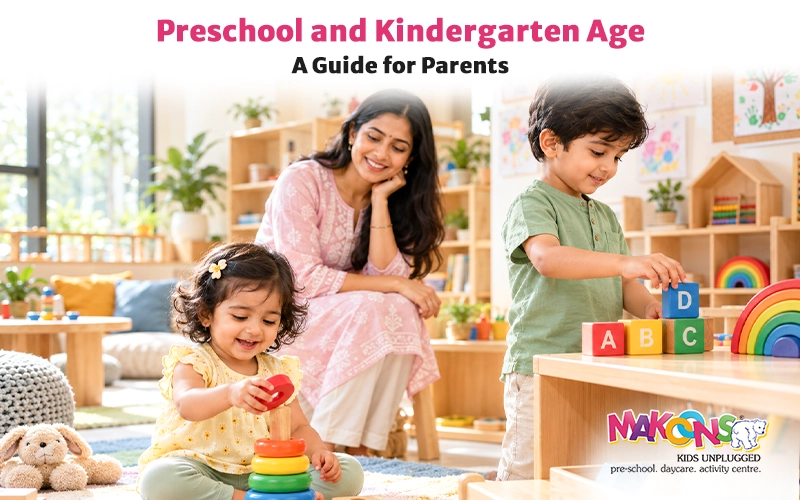
It's an exciting time for every parent when it's time for school. A child's first learning experience is packed with small adventures from the first bag to making new friends! However, one frequent query parents may have is: At what age should children start preschool and kindergarten?
Parents who know what age they are looking at help them to choose the right class for the child to be in, so that they are not set up for failure. In India, one enters preschool at the age of 2-3 years and then heads to kindergarten before Class 1.
Let's look at the various stages, the age criteria and how to determine what is best for your little learner.
1. What is the Right Preschool Age in India?
The standard age of Preschool in India is 2-3 years. Children start to venture outside of home at this stage. They are introduced to simple activities, social interaction, games, stories and creative learning in preschool.
Each child's growth, however, is unique. Some children may feel at ease to join early, and others may require a little more time.
Preschool is not a time for memorising books or producing long answers. It's about helping children to be independent, curious, confident and comfortable in a learning environment.
2. Knowledge of Different Types of Preschool and Kindergarten Classes
Preschool education is structured into various phases based on children's age and development. Here's a basic parent guide:
Class | Typical age |
Playgroup | 2-3 years |
Nursery | 3-4 years |
LKG | 4-5 years |
UKG | 5-6 years |
Class 1 | Around 6 years |
These age ranges are only approximate. Specific requirements for admission may differ from school to school, state to state and under different education rules.
3. The Right Age to Join Preschool?
Preschool entrance age is based on the child's emotional, social and physical readiness.
Most children can begin preschool at the age of 2-3 years. They begin to be interested in playing with other children, listening to stories, singing rhymes and exploring new activities at this age.
A few simple things can be observed prior to admission:
A child actively explores new experiences.
They like to play with other children.
They are able to express basic needs.
They are at ease in being away from parents for a period of time.
Are interested in colours, toys, stories and rhymes.
Don't rush – it is a memory game after all. A happy and comfortable start equates to learning being more enjoyable!
4. When is the Best Age For Your Child to Start Nursery?
The age at which children enter the nursery in India is usually 3-4 years. Nursery is very significant as children are starting to have a routine of the day and are engaging in planned classroom activities.
In this stage learning is more interactive. Children enjoy:
Recognising alphabets and numbers.
Identifying colours and shapes.
Listening to stories of interest.
Singing rhymes and action songs.
Drawing, colouring and painting.
Basic manners and sharing skills.
To foster early learning skills in a fun way without pressuring children.
6. All About Kindergarten Age in India – LKG and UKG
The age range for the kindergarten in India is typically 4-6 years. Kindergarten sets the stage for children to succeed in formal schooling by building their communication, thinking, creativity and early academic skills.
Lower Kindergarten (LKG): 4–5 Years
LKG is an introduction to children to more organised learning. They start to learn letters, numbers, pattern matching and simple directions.
Classroom activities are fun such as puzzles, story telling, music, drawing and group games.
Upper Kindergarten (UKG): 5-6 Years
The skills acquired in LKG will be reinforced by UKG. Children slowly build up their confidence in the reading of simple words, the writing of letters, counting and simple problem solving.
They also acquire other valuable social skills which include teamwork, patience, listening and expressing their ideas.
Both stages aid children in making a smooth transition to primary school.
6. What Should Parents Know? Kindergarten Admission Age
The admission age for kindergarten is based on the kindergarten admission policy of the school, and the education guideline applicable in the state.
The National education policy (NEP) 2020 defines the foundational stage as a period from age 3 to age 8 and consists of three years of preschool education followed by Classes 1 and 2.
The age of entry into Class 1 is recommended as 6 years. So, parents would need to take into account the age criteria of the school they want to enroll their child in before choosing the admission year.
It is always essential to refer to the school's official notification of admission to see the age and cut off date.
7. Age Criteria For School Admission in India
Knowing the age requirements for school entry enables parents to make decisions about their child's schooling.
Children should start Grade 1 around the age of 6 according to the National Education Policy. But admission criteria and deadlines can vary from state to state and school to school.
Prior to applying parents should:
Follow the official school admission guidelines.
Check the child's age for the date set as the cutoff date.
Know the eligibility for nursery, LKG and UKG.
Have a copy of the child's birth certificate available.
If they have any questions regarding eligibility, contact the school.
It is better to review these early in the admissions procedure to make it easier and less stressful.
9. How to Help Your Child with Reading Readiness Skills at Home
Little children starting school is a great adventure! Here are some simple activities that can be done at home to help make the transition easier.
Here are some ideas to help you get your child prepared:
Set up a Daily Routine: Make consistent sleeping, waking, eating and playing time a habit.
Read Picture Books – Colourful books develop vocabulary, imagination and listening skills.
Promote Independent Play: Allow children to play with blocks, puzzles, crayons and toys.
Practice Basic Skills: help develop hand washing skills, eating independently, and organisation of toys.
Planning play dates: play dates are an opportunity for one to learn skills of socializing and sharing.
Make School Exciting: Say things that are positive about teachers, friends, playgrounds and fun classroom activities.
Little steps to build confidence!
10. Ways to Help Parents Avoid the Pitfalls
The excitement of preparing for school can sometimes be too much for parents to handle, but with the desire to help their child get off to a good start, it's an issue everyone wants to deal with.
There are a number of common errors to watch out for:
Making comparisons with other children.
Selecting a school because it is a popular choice.
Not meeting the child's emotional needs.
Pressurising children to learn to read and write too young.
Supervising the teaching process and environment of the school.
Childhood is meant to be full of fun, laughter, discovery and exploration!
10. Start Your Child's Learning On a Happy Note!
Selecting the appropriate preschool and kindergarten age involves seeking a balance between readiness, age and learning opportunities.
Each step of your little one's education is a new experience and discovery in playgroup, nursery, LKG and UKG.
Make an effort to create a safe learning space that is caring and fun so your child feels happy, supported and encouraged to explore.
The best school journey starts with happy little steps, curious minds and big smiles!
Frequently Asked Questions (FAQs)
1 What is the age group of preschool children in India?
Ans: Normally it begins from the age of 2- years.
2. The age at which a child can join the nursery
Ans: The average age of entry into a nursery is at 3-4 years.
3. In India, what is the age of the children in the kindergarten?
Ans: Children generally attend LKG between 4–5 years and UKG between 5–6 years.
4. At what age can children enter Class 1?
Ans: Around 6 years.
Conclusion
Choosing the right preschool and kindergarten age is an important step in your child's learning journey. Each child is unique and will develop at his/her own rate, not at a rate of your choosing, so please don't hurry a child to be admitted. Provide a safe, caring, and fun environment for little learners to grow with confidence, make friends, and explore. After all, happy childhood experiences lay the groundwork for a happier future!