
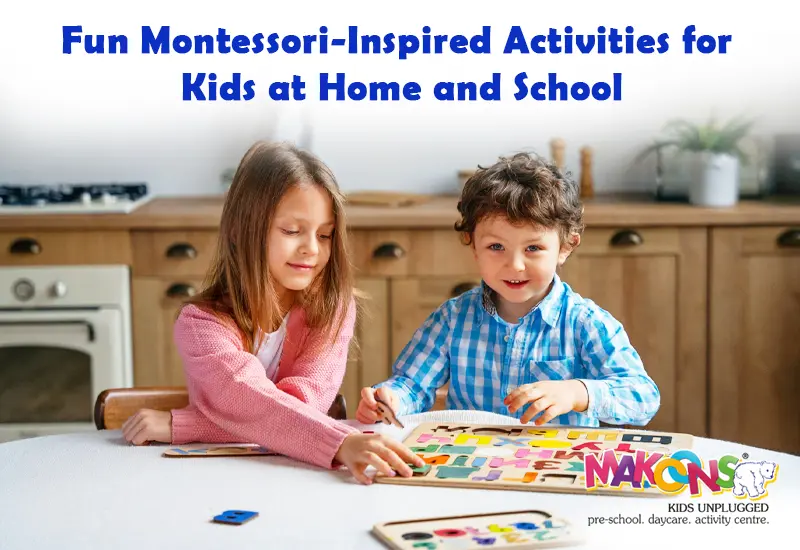
Dr. Maria Montessori's method has been embraced by many individuals for many years for fostering independence, curiosity and development for the young child. The Montessori method's principles of active engagement, freedom with structure and respect for the pace of each child's development makes Montessori attractive to Montessori schools as well as to parents wanting to support their children's development in their home. The following Montessori activities for preschool help to create a positive atmosphere for educators and caregivers to help foster real-life skills and learning through pleasure.
Montessori at Home Preschool
Montessori at home preschool begins with a prepared environment - appropriately sized elements for children, self-directed materials, and an environment that allows children to explore self-directed and be independent. Here are some principles to consider:
Follow the Child - Observe your child's interests and introduce activities that follow their interests and development needs.
Prepared Environment - Ensure the area is clean and organized with shelves of accessible, rotating activities and tools suitable for small hands.
Encourage independence - Help your child learn to choose, complete, and clean-up after activities independently and at their own pace.
Encourage Practical Life Skills - Provide children practice in real, relevant ways (e.g., washing, cooking food, watering plants, and organizing toys).
Montessori Activities for Preschool Classroom (The Essentials)
Practical life skills - Activities such as pouring water from pitcher to pitcher, transferring beans using spoons or tongs or practicing with dressing frames (zipping, buttoning, lacing) enhances gross motor skills, while developing concentration and independence.Kiddos also enjoy helping with basic chores, such as, folding towels, sweeping, watering plants and making simple snacks.
Sensorial Activities - Matching and grading colors using the Montessori color tablets. Simple activities can advance development in Literacy and Numeracy, e.g., Children can construct shapes with sandpaper letters and numbers while verbalizing sounds, so that they are making a connection between tactile action and emergent literacy and numeracy.
Texture explorations- Provide bins of natural materials, shells, pine cones and sandpaper which allow for rich opportunities for descriptions of tactile experiences.
Perfume jars- Provide children to experience and make comparisons between scents using cotton balls with different extracts.
Related Topic: Explore Fun Activities for Toddlers in School: 0-4 Years Old
Mathematics and Sorting
Numbers and Counters- Use large tiles or small objects, to match with numeral cards and develop one-to-one correspondence and basic counting.
Sorting buttons- Not only by size, but also by color or types of buttons. will provide visual discrimination and develop math readiness.
Using measuring cups, using basic recipes or making trail mix, provides natural experiences with math in daily life.
Also reading books with numbers can also provide little ones with a connection to math in their daily lives in a meaningful manner.
Language and literacy
Three-period lessons- "This is...", "Show me...", "What is...?" Using real objects or cards helps introduce vocabulary.
Story baskets- Combine story baskets with objects from their favorite storybooks, develop retelling and sequencing.
Science and nature
Plant seeds and observe growth.This allows us to learn about life, and reflect on development.
Sink and float experiments; invitations to think and explore.
magnetic and non-magnetic; providing different magnets from the fridge, and various items found around the house to promote wonder about the world.
Also Read: Fun Learning Activities to Do at Home with Preschoolers
Montessori Inspired Imaginative Play
Arts Trays: provide clay, and water colours/ or collage materials.-Often we can extend "process" against "product" with a creative arts activity.
Music and Movement: play with classroom instruments, and scarves (light fabric) when using action songs, to discover tempo, sound and rhythm. Create a small farm, or one with animals using figurines, for open-ended storytelling and language development.
Preschool Learning at Home: Adjusting to Expo Learning at Home
Montessori can easily be done at home, try some of the following ideas for home:
Invite your child to help prepare meals; washing veggies, setting the table, pouring juice.Use trays, or baskets to organize your toys and materials; they can usually focus on one at a time.
Rotate books and games every week or so; make note of what is engaging, or exciting.
Make a "nature table". Collect treasures from walks and genuine curiosities; providing display for scientific thoughts and wonder about the living world.
Montessori Inspired Play for Toddlers
Typical Montessori activities for toddlers (2-3 years) include purposeful movement and independence; threading big beads or chunky pasta to develop eye and hand coordination.Finding lids to jars and/or sorting all sorts of everyday items.
Water play; pouring, transferring, squeezing sponges.
"Dressing stations" to practice buttons, zippers or Velcro tabs.
Using sponges or small mops to clean up spills.
Supporting Social Skills and Cooperation
Montessori methods are ideal for supporting social and emotional development:
Group lessons give opportunities to model grace and courtesy: saying "please," "thank you," waiting my turn, willingly helping a friend.
Children often work together to complete a larger project; to put out a snack, care for the class plants and animals, and clean up.
Montessori activities such as "walking on the line" support self awareness of the body, mindfulness and community spirit. Story circles, outdoor walks together, serve to connect and lead together as a group.
Related Topic: 10 Important Skills Kids Learn in Play School
Keys to Success Using Montessori Method Preschool
Reduce distractions which are screens and have only a few activities that are purposeful at one time.
Allow for repetition. Children do the same activity over and over sometimes, and this is how they explore, learn and gain skills and confidence.
Encourage to participate but do not feel pressure. Children have interests, inclinations and timeliness.
Recognize the effort and process and not just praise the end product.
Simple and Easy Do-It-Yourself Montessori Activities
Button frames: Sew large buttons on fabric so children can practice the action of buttoning.
Sensory bins: use a bin filled with rice and beans or natural materials that they can scoop, pour and feel.
Salt tray letters: Have salt in the dish so that children can "write" letters or words in it with their finger.
Homemade Sorting games: use colored pom-poms and matching cups, or different types of pasta in bowls.
Nature hunts: Collect leaves, pebbles or flowers and sort them by color, shape or size.
Why Montessori Learning for Children Works?
Promotes independence and responsibility.
The importance of a child's intrinsic motivation and respect for their choices were fundamental to the Montessori response.
Helps children learn through discovery rather than memorize facts.
Nurtures respect for others, for self and for the environment.
Provides strong opportunities for foundations for success in future academics and further life.
Studies have shown Montessori children often demonstrate superior social skills, academic skills, and emotional intelligence than children from a non-Montessori experience.
Related Topic: 20 Fun & Easy Craft Activities for Preschoolers
Conclusion
Montessori education is not just a method it is providing children the opportunities to investigate, question and discover at their own natural pace, when you can embed preschool Montessori activities as a component of everyday routines in the home and school settings children will have the foundation to be independent, resilient and truly enjoy learning. Montessori can be implemented with easily available resources, simply arranged, while the child is respected as the individual learner that they are each time the approach can be valuable to any family and classroom. Whether you only implement a few in-class Montessori play activities for your child, or give your child the full immersion into preschool Montessori education, the outcomes will be there- curiosity, competence and joy.
