
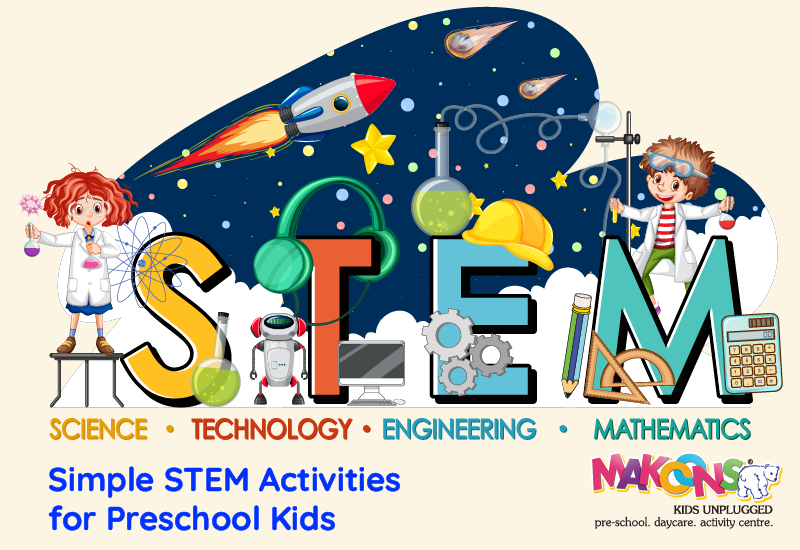
Preschool is a wonderful time for young children to discover their curiosity and imagination while they learn. Young preschoolers are lively and spirited, while exploring and learning about their surroundings in a playful spirit. Because of those characteristics of preschool children, STEM preschool activities contribute greatly to a preschool learner's early experiences of learning in an educational setting, STEM education is a term that is an acronym (or abbreviation) for Science, Technology, Engineering, and Math.
At an early age, STEM education could be a journey of exploration in learning, while also having fun. STEM preschool is not complicated theories, risks, or rewards; STEM preschool is hands-on, real-life preschool STEM experiences, such as building towers, mixing colors, counting blocks, and using simple tools. These real-life preschool experiences all develop logical thinkers, while developing collaborative work and problem solving skills (all vital skills for an independent and lifelong learner).
Why Wait to Introduce STEM Education at the Preschool level?
The critical moment when children's experiences shape their lifelong skills happened long ago. When children participate in early childhood STEM education, they form confidence, and all of this indicates a greater likelihood of their responsibility to embrace challenges in their future. They learn to listen, observe, try new things, and understand that it is ok to not be successful immediately.
STEM proves itself naturally by allowing children to be curious and ask questions around exploration, and an opportunity for discovery. STEM naturally lends itself to the child's “why” questions. Every project leads to an adventure of discovery.What it Develops: Problem Solving
As children stack blocks, or mix sand and water, they are learning about cause and effect, trial and error, and persistence.
What it Develops: The Components of Preschool STEM
Science: When it comes to science and science experiments in preschool, the focus is on observing, questioning, and experimenting with things around them on a daily basis.
Technology: Technology is not just screens and using screen time to learn about technology, but rather it can be many forms, such as, but not limited to; magnifying glass, digital cameras, or coding toys.
Engineering: By getting engaged in hands-on building, constructing, and testing ideas allows children to think critically while doing fun STEM projects they can do with their friends.
Math: Simple counting, sorting, and patterns games are the base of early math preschool experiences.
Simple Preschool Science Activities
1. Sink or Float
Put a plastic tub of water and give few small items (i.e. a spoon, leaf, coin, or toy boat) to children. Let the children make predictions if each item will sink or float. Test each child's predictions.
Skills: Prediction, observation, and problem solving.
Category: Science Activity for preschool age kids.
2. Mixing Colors with Water
Have 3 clear cup of water. One cup will have red food coloring water. One cup will have blue food coloring water. One cup will yellow food coloring water. The children can use droppers to mix combinations of the reds, blues, and yellows.
Skills: Cause and effect; observation.
3. Growing Seeds in Cotton
Take two beans or seeds and place them into a clear jar with damp (not dripping) cotton. Wait for the roots to grow and the shoots to grow so the kids can see them grow.
Skills: observing, being patient, showing care.
Preschool Activities for Early Math
1. Counting with Items in Space
Use fruit, buttons, or blocks to practice counting. For example, "Can you give me three apples."
2. Shape Hunt in the Classroom
Children can walk around the classroom searching for circles, squares, or triangles in the furniture, window panes, or toys.
3. Simple Graphing
Create a chart as a class of favorite fruits in the whole class. They would each place their own sticker under the fruit they picked and then they would count together.
These early math preschool activities support the ability to decontextualize a number by placing it alongside something they experience in their lives.
Fun Engineering Challenges for Preschool
1. Tall Towers
Gather some blocks, cups, or some cardboard pieces and have students build the tallest structure that they can make by not having it fall down.
Skills: Balance, stability, persistence.
2. Paper Bridges
Children will fold paper into many shapes (triangles, arches etc) and then they will test to see how many toy cars the paper bridge will hold.
Skills: Problem solving, cause and effect.
3. Creating with Recyclables
Provide different kinds of boxes, bottles, and other kinds of paper towel/toilet paper rolls, and any other kind of outdoor materials that children can create and invent whatever their imaginative self wants to create. This is a hands-on approach to STEM creativity with preschool children.
Skills: Creativity, Recycle and Reuse
Tech for Early Learning Made Simple
Tech for preschoolers doesn't need to be represented by an array and complex understanding of the different arrays of technology. Rather it can be represented as the introduction of simple tools and gadgets, to enhance and resolve problems.
1. Fun with Magnifying Glasses:
Children can observe the textures of different plants, leaves, or bugs, up close.
2. Digital Cameras:
Kids can take photos of their favorite objects from nature!
3. Coding Toys:
Beginner coding robots that expose children to sequencing concepts, in a fun way!
When preschoolers learn about tech gently, and together with hands-on learning in reality, tech for preschoolers is about exploration vs screen time.
Bringing together STEM subject areas
It is not uncommon for many different skilfully designed learning activities.
Examples:
- STEM Activity
- Subject area Foci
- Building a block city
- Math (counting), Engineering (building), Science
- Planting a garden
- Science (growth), Math (measurement), Technology (watering tool)
- Mixing baking soda & vinegar
- Science (reaction), Math (measurement)
- Creating paper airplanes
- Engineering (build), Math (angles), Science (flight)
This integrated scaffold is the premise of STEM education preschool experiences, to support children's understanding of how subjects engage the real world.
Fun STEM Experiences Kids Can Do at Home/School
1. Shadow Tracing
Children trace shadows of toys, or even their own hands outside.Watching shadows and discussing the experience is fun for them.
2. Ice Melting Race
You put ice cubes in three bowls: one with salt, one with warm water, and one plain – and then talk about what is all about the melting (not a science experiment). A perfect example of authentic fun STEM projects for kids.
3. Counting Jars
You fill a jar or two with buttons, pasta, or beads and have your children count, sort, and compare sizes.
4. Balloon Rockets
You tie a balloon to a straw and let the air out, so the children can see how fast the balloon flies across the room.
Tips for Teachers and Parents
Keep it Fun
STEM learning should feel like play not controlled or structured.
Ask Questions
Rather than just giving children the information or answer, say "What do you think will happen?"
Use Everyday Items
Every piece of STEM you use is typically made with repurposable items spoons, cups or boxes. They are just as useful as fancy systems in learning STEM.
Celebrate Mistakes
You can remind children that not every tower they build will stay up, some of their guesses will be wrong, and that is ok.
Long-Tern Benefits of Early Childhood STEM Education
- Confidence in solving problems.
- Working and communicating as a team.
- Being persistent asking "what if?” or straight up trial/error.
- Preparedness for school subjects that transfer across setting creative play to authentic meaningful learning in their years to come.
This is why early childhood STEM projects are wonderful for their educational opportunity but also not a fad for opportunity to develop life skills.
Conclusion
I can see how STEM might feel overwhelming to educators, but to young children learning STEM is curiosity and play and creativity and exploration. Activities you'll engage in with preschool include simple preschool science and fun STEM projects kids can experience. Each activity fosters life-long learning and skill.
Early math preschool activities, preschool technology learning, and hands-on preschool STEM challenges will lead to joyful experiences that them inspire joy through discovery for educators and parents. The creativity you infuse in your children’s STEM preschool activities, along with the value of patience will help you build the framework of confident, competent, curiosity learners.
