
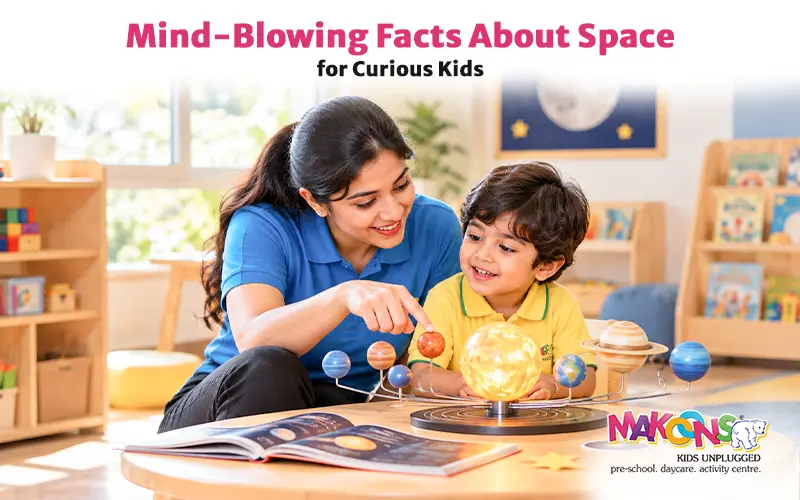
Have you ever looked at the night sky and thought what was there behind the stars? Space is a large area which has planets, stars , moons , galaxies, and a lot of things. In space, there are things that are truly incredible that sound like they're out of a movie!
Children learn about space in a fun manner and get to know how our universe functions. So, let's get ready to experience these space facts for kids as if we were astronauts in our imaginary astronaut helmets!
1. The Sun is a Star
The Sun appears larger because it is closer to the Earth. The sun is a star and it looks different when we see it at night. The Sun provides us with light and heat for our life.
2. Space is Very Quiet
Sounds require air or other medium to propagate. There is little air in space, so sound doesn't travel well. That means space is really quiet as the movies make it seem!
3. The Biggest Planet - Jupiter
Jupiter is the biggest planet in our Solar System. It is so large that it could hold more than a thousand Earths! There are also storms on Jupiter which are extremely large.
4. Saturn has beautiful rings.
Saturn is famous for their shiny rings. Numerous pieces of ice and rock make up these rings. Some pieces are very small and some are a very large size.
5. The Red Planet - Mars
Iron is present in the soil on Mars and this makes the soil red in colour. When iron reacts with oxygen it becomes rusty and gives a red colour to Mars. Hence this is known as the Red Planet.
6. The Sound of Music
The moon is not a source of light, but only reflects it at night. Reflects sunlight. As the Moon is revolving around the Earth it will look different to us from the bright side of the Moon.
9. A Day on Venus Is Longer Than Its Year
Rotation of venus is very slow than other planet in the solar system. Venus has a day that's the same length as 243 Earth days and a year that's the same length as 225 Earth days.
8. Earth That Has a Life
Earth is our home planet and the only planet on which scientists have found life on.
9. Astronauts Can Float
In a spacecraft, it seems that the astronauts float. Because they are continually falling towards the earth with no support to stop them. That is why eating, sleeping and even brushing their teeth can be different in space!
10. The Sun Is Larger Than the Earth
The sun is a very large object as compared to the Earth. There are 109 Earths wide across the sun. The Sun is one of the billions of stars in our galaxy as well.
11. A Very Long Year - Neptune
Neptune is the furthest planet from the sun in our Solar System. Neptune revolves around the Sun in about 165 years.
12. Milky Way Galaxy is Our Galaxy
Our Solar System, the Sun and the Earth are located in a galaxy known as the Milky Way. It is made up of billions of stars. Galaxies are just one of the types of galaxies in the universe.
13. Stars Have Different Colours.
Not all the stars are equal. Some of the stars appear red, some yellow, and some blue or white. Scientists can be told by their colour about their temperature. We can see our Sun yellow from the Earth.
14.The Moon Has No Atmosphere
Earth has a dense atmosphere, while the Moon doesn't. Consequently, it does not experience typical weather conditions like rain, cloudiness or strong winds. The moon has a very long time to stay on the surface of.
15. Black Holes Also Have Very Strong Gravitational Field
A black hole is a point in a space where the gravitational force is very strong. It can be so powerful that light can't even escape once it has passed a certain point. To observe black holes, scientists look at what happens when they encounter an object.
16. Many Planets have Moons
Earth has only one moon where as other planets have so many. Jupiter and Saturn have lots of moons travelling around them. Some moons are bigger and some are smaller.
17. There are lots of rocks in space!
Asteroids are rocks in space. Scientists are able to learn more about how our Solar System formed by studying the most asteroids in our Solar System.
18. A Person's Weight Would Be 18 Times Less on the Moon
But you would weigh 1/6 of that on the Moon as compared to the Earth. That's what made the astronauts able to jump up on the Moon!
19.The Universe is Old Enough to Have Billion-year-old Galaxies
Our Solar System and galaxy are just a small part the universe. The scientists have been able to calculate the number of galaxies in the observable universe to be approximately 2 billion, 200 million. There can be millions and billions of stars in galaxies!
The stars will be our guides in our search for the answers to the mysteries of the universe.
Scientists continue to be the explorers of the universe. They use telescopes, satellites, spacecraft and robots to do their investigations on planets, stars and distant galaxies.
Today's young whizzes and geeks may find themselves on the path to becoming astronauts, scientists or engineers, and who knows, maybe it will be something new in space!
Know More: Common Fruits Names, Uses & Health Benefits For Kids
Why Is It That Kids Should Be Told About Space?
You can use space to stimulate children's questions. The first steps of astronomy for children can be made very easy, for example, staring at the moon, locating the stars or knowing the names of the planets.
The following space facts are also interesting to kids and can help them understand about Earth and its role in the universe. Science for kids is fun with learning planet facts, as every planet has something special to discover.
Educational space facts can be used to cultivate your interest in learning, most importantly.
Conclusion
There are amazing things in the universe! There's always something new to learn, from Jupiter's immense size to Saturn's stunning rings, to the bizarre world of black holes.
These are just some of the space facts that kids should be familiar with. The universe is a huge place; many mysteries remain to be solved.
So, the next time you gaze out into the night sky, don't forget that you're staring at only a small piece of a vast universe. Continue to ask questions, continue to learn and continue to dream big!
Know More: 7 Days of a Week Names | Learn Days in English Easily
