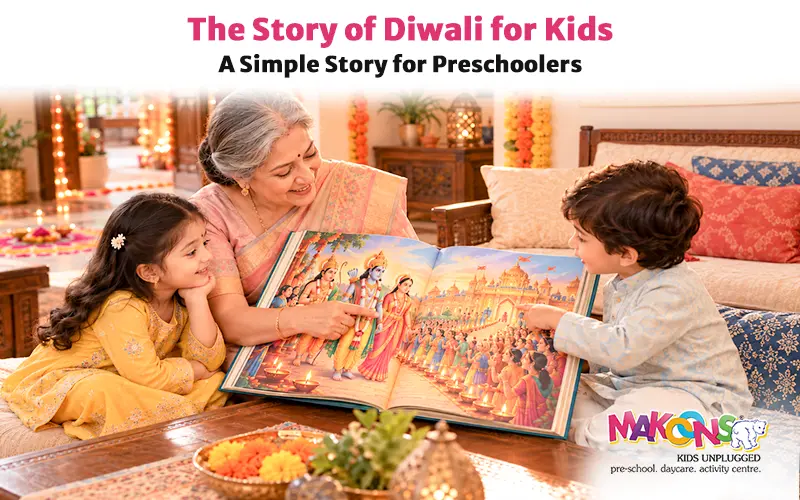
Diwali is a popular festival in India. Children play with their families and share their sweets, rangoli at doorways and homes are lit up with lights. But, have you ever thought of narrating this beautiful festival to the young one?
A simple story can help the preschooler to understand the reasons we celebrate Diwali and what it means to us. Story can be a way for children to learn to be kind, brave, to make good promises, to help others, and for good to finally overcome evil.
In this page you will find a simple story for children about Diwali, an explanation and a simple version for preschoolers, some fun activities to do with the story and some tips for parents and teachers.
Why Do We Celebrate Diwali?
The Diwali Festival is also referred to as Deepavali which is the Festival of Lights. Deepavali is known to mean a line of lamps.
Many Hindu families celebrate Diwali to mark the return to Ayodhya of Lord Rama, Goddess Sita and Lakshmana (a companion of Lord Rama) after a fourteen year period and Rama's victory over Ravana, the King of Lanka. According to this popular story, people of Ayodhya welcomed them by lighting rows of diyas.
Diwali has many different significance and traditions in India, however. Some communities believe that the festival is a festival of Lord Krishna's victory over Narakasura, others believe that the festival is a celebration of Goddess Lakshmi, prosperity, spiritual freedom or others.
A good idea would be to begin a story about Lord Rama returning to Ayodhya as it would be an explanation to the preschoolers as to why many families light diyas and celebrate with joy.
A Preschool Storybook about the festival of Diwali – The Return of Lord Rama.
Related Topic: 10 Fun Diwali Activities For Kids At Home
The Diwali Story For Preschoolers: The Return Of Lord Rama
1. Once Upon A Time In Ayodhya
In a beautiful city, called Ayodhya, was once a prince, wise and courageous, named Rama. He was the son of King Dasharatha and popular with the citizens of his kingdom.
Rama was described by others as being honest, brave and respectful. He was a member of a family and he wanted to do what's right.
He was married to Sita and had a younger brother, Lakshmana. They cared for each other, loved each other deeply.
2. Rama Goes To The Forest
But one day the time came for Rama to leave his home and stay in the forest for 14 years. He was not ready to leave Ayodhya, but did as his father instructed.
Sita and Lakshmana were agreeable to go with him. Together they journeyed and they lived in the forest, they helped each other along the way.
In Ayodhya, Rama was missed and people hoped that he would come back to Ayodhya someday.
3. Ravana Takes Sita Away
In the forest, Ravana, the king of Lanka took Sita as his wife to his kingdom.
Rama wanted to take Sita back home safely. With him was his brother Lakshmana; they began to search for her.
On this trip, they saw Hanuman and he was regarded as their friend and helper. Hanuman and his friends showed Rama the way to Sita and Lanka.
In this segment of the story, children learn that sometimes taking courageous action and determination are needed to help others and be there for people they love.
4. Rama Rescues Sita
They went to Lanka and Rama fought Ravana in a great battle.
With great effort, Rama overcame Ravana and freed Sita. They suffered a tough time and their meeting was jolly and optimistic.
It was a story that is usually recalled as one of the triumphs of good over evil. It is also an opportunity to teach young children concepts of courage, doing what is right and helping someone in need.
5. The Happy Return To Ayodhya
Rama, Sita and Lakshmana went back to Ayodhya after their journey. The people were happy awaiting Rama's return home.
They are welcomed by the people by lighting little oil lamps called diyas. They celebrated their coming home with pretty lights, and the citizens rejoiced.
This tradition involves lighting up diyas during Diwali festival, in remembrance of that joyous homecoming.
Today, many families decorate their houses, make rangolis, share sweets and light lamps during the celebrations.
And that's the tale of Diwali! It does remind us that the dark times can be lit by light, the hard times can be followed by hope, and the right things can be done to get the right things.
Related Topic: Diwali Essay for Kids: Simple and Easy Essay for Children
What Can Children Learn From The Story Of Diwali?
A kids' Ramayana story is more than a rehash of familiar characters. It provides parents and teachers the chance to relate the story to children's personal experience.
Following are 5 simple lessons for discussion after a story:
Kindness: Encourage a friend to be kind to an individual who is sad or in need.
Honesty: Be honest, even when it is not easy to be honest.
Courage: Do something new, ask for help or say “I don't like this, I need help!” if something is wrong.
Teamwork: Do things together rather than individually.
Hope: Keep in mind that tough times can get better by being patient, supported and thoughtful.
Use examples that children are familiar with to describe these values.
Related Topic: How to Make Diwali Greeting Cards with Kids
Fun Ways To Share Diwali Stories With Children
To enhance the Diwali stories for children, the use of play, art, movement and conversation can be incorporated.
1. Make A Diwali Story Picture Book
Provide your child 5 pieces of paper and help them to draw on each one of them a scene:
Rama and Sita at Ayodhya.
Rama, Sita and Lakshmana in the forest.
Hanuman helps Rama.
Rama with Sita on his return.
The people of Ayodhya lighting diyas.
2. Create Paper Diyas
Have colored paper, crayons and glue available. Create paper diyas with your child and then make patterns on them.
While working collaboratively, discuss that many families burn diyas during Diwali as a reminder of Rama's return.
This activity should be done with paper or flameless decorations; children should not be near open flames.
3. Try A Simple Story Role-Play
Using paper crowns, fabric scarves and homemade props, children can be the characters in a few gentle scenes from the story.
Ask them to select their characters like Rama, Sita, Lakshmana, Hanuman or someone who greets the family home. If they are not interested in performing they can help with decorations and/or narration.
Make it brief and don't make too scary battles.
4. Ask Questions After The Story
Children will understand what they have heard when they have a short conversation.
Try asking:
In which place was Rama staying?
With whom did Rama go to the forest?
Who aided Rama on his journey?
How were the people waiting for Rama when he returned?
5. Draw A Picture Of Light
Have your child create a picture that makes them feel happy, safe or loved. It might be a lamp, their family, a sunny day or someone helping them.
Use the light in the story of Diwali to remind us of hope, kindness and good deeds that people do for each other.
This activity is meaningful without having to recall all the details.
Related Topic: Easy Diwali Rangoli Designs and Ideas for Kids
How To Tell The Diwali Story According To Your Child's Age?
Children have varying learning capabilities at different ages.
Ages 1-2: Display images of diyas, flowers and festive decorations. Use some basic sentences and words.
Ages 2-3: Speak the story in short sections, concentrating on Rama's trip and his joyful homecoming.
Ages 3–4: Introduce the main characters and the reason why the people of Ayodhya welcomed Rama with the help of lamps.
Ages 4-6: Add more descriptions of how Hanuman helped, how they went to Lanka and the values of courage, team work and kindness.
Final Thoughts
Diwali story is an apt opportunity to discuss Indian traditions and values with the pre school children. This journey of Rama, Sita, Lakshmana and Hanuman begins the learning of children about the values of courage, helping others, hope and good over evil.
Retell the story using simple words, take time and ask questions, as well as pretend play. This isn't to get the kid to repeat a long story, it's about getting the kid to be in tune with the story.
Frequently Asked Questions
1. What is the Diwali story for kids?
Ans: A popular tale of the Diwali festival is that of Lord Rama who travels 14 years with Lakshma and Sita after which he comes back to Ayodhya. They were welcomed by the villagers with rows and rows of diyas. The story is about the struggle between Light and Darkness and is the reason for firecrackers in the homes on Diwali.
2. Why do we light diyas on Diwali?
Ans: In the traditional story when Rama returned the people of Ayodhya lit rows of lamps to welcome Rama back. Nowadays many families use Diyas to celebrate their homecoming, it's good over evil, light over darkness, hope over hopelessness.
3. Who helped Lord Rama to find Sita?
Ans: Hanuman and his friends helped Rama on his search for Sita. Hanuman then came down to Lanka and joined Rama's team of trusted associates, Sita. By sharing his occupation with children, they can learn about the value of loyalty and courage as well as to help others.
4. Is the same Diwali story celebrated everywhere in India?
Ans: No, this isn't the same story, or tradition for Diwali, this is different in each region of the world, each community. Few families keep a memory of Rama entering Ayodhya, few others remember Krishna killing the demon Narakasura, and any other religious memory.
5. What do I do to make the story of Diwali more interesting for young children?
Ans: Using simple role play, puppets and drawing activities, create and use picture books and paper diyas. Ask children some questions and have them recite their favourite part. Don't make the story too complicated or it will be impossible for the children to remember it; and, make the story fun and appropriate for the children to be engaged.