
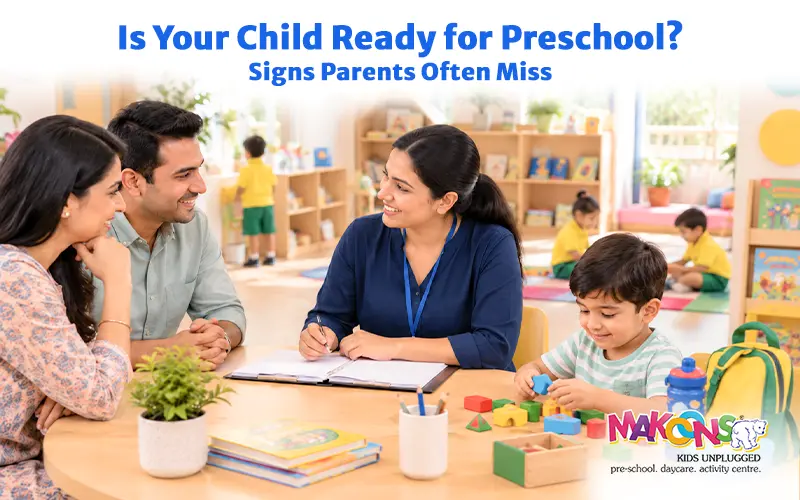
Going to preschool is a major transition for kids and parents. It may bring excitement, curiosity and possibly some tears. Every parent thinks or asks themself if it's the right time to send our child to preschool or wait a little bit longer. It's having a mixture of social, emotional, communication and some day-to-day skills that make a child feel comfortable in the new setting.
All children grow at varying rates. Do not compare your child to other children, rather consider how it shows signs of independence and confidence. With regard to preschool, here are some key indicators that parents may not consider.
What is Preschool Readiness?
Preschool readiness refers to some of the skills a child has to assist in participating in the classroom activities and daily routine. Children don't have to be independent or knowledgeable enough to go to preschool. Teachers are present to assist children in learning.
A child is ready when he/she can express simple needs, respond to basic directions, engage in interaction with others, and perform simple everyday tasks with some assistance. These skills are school readiness skills and they can be acquired as part of play and in everyday activities.
1.Your child can express basic needs
If your child is communicating that means he/she is ready for preschool. A child should be able to inform an adult if they're thirsty, hungry , tired or need any help.
A preschooler doesn't mean that he/she should say words correctly. It is about knowing words, accepting gestures or simple sentences to communicate. Teach your child to express their emotions and ask for help.
2. They are able to follow simple instructions
There are lots of simple directions given in preschool classrooms, for example: put toys away, sit in a circle, wash hands. A child doesn't have to execute all the instructions flawlessly, but it is helpful to be able to comprehend and follow simple directions.
This skill can be developed at home, with some basic games and everyday activities. Give one(s) or two clear directives and commend your child for their achievement.
3. They are interested in other children
A child may be demonstrating social readiness by watching, talking to and playing near other children. There are lots of opportunities for children to share space, play games and make friends at preschool.
There is no need for your child to be a highly social or interpersonally oriented child and to make friends right away. Others are shy and require more time to get used to. Interest in interacting with others is more important than being outgoing.
4. They can be separated from parents for a brief period of time
It can be a challenge to separate, particularly for the first few days in preschool. It can be a positive sign if your child can remain calm with another adult for a brief time, without becoming very upset.
Begin with small separations prior to preschool. Let your child know that you are going away for a short time and leave him or her with someone he or she knows. Slowly add more time to it and always come back on time.
5. They are becoming more independent
Many of the items on a preschool readiness checklist involve little skills of self help. Your child is ready if your child is starting to use a spoon to eat or drink from a bottle or cup, put their things away, wash hands or try to wear shoes.
They don't need to do everything right. Preschool teachers expect young children to need assistance. It is important that your child is willing to try.
6.They Can Express Basic Emotions
Preschool has lots of new experiences for children, and they have big emotions. It can help a child to receive support if they can express their emotions, which include happy, sad, angry, scared, and tired.
Introduce basic vocabulary of emotions and demonstrate healthy ways to react. “I am angry” or “I need help” is a helpful phrase to use that can help make classroom life easier.
7. They Can Participate in Short Activities
Children in preschool don't have to sit still for extended periods of time. It can be helpful however, to be able to focus on a story, puzzle, song, drawing activity or simple game for a few minutes.
Capture your child's attention through activities that they like. Read short stories together, solve puzzles, sing songs or play matching games. Help your child to complete one task before taking up another.
8. They are comfortable with basic routines
A sense of control is important for children, and they feel safer when they understand what is coming next. Routine and familiar activities like getting up, eating, playing, cleaning up, and preparing to leave may help your child adjust to preschool.
As a parent, establish a basic routine at home prior to admission. By establishing consistent meal, play, sleep and getting ready routines, preschool preparation for children might be a bit easier.
9. They Show Curiosity
An important, but frequently dismissed sign is curiosity. Does your child ask questions, play with objects, observe new things or find out how something works?
A curious child is eager to experience something new. Preschool isn't just about worksheets and lessons. It's also about questioning, exploring, singing, playing, creating and learning from the everyday.
10. They Can Handle Small Changes
In the preschool setting, children are introduced to new people, places, activities and routines. You may be able to help a child adjust if they can manage smaller changes with a certain amount of reassurance.
You can help prepare your child by making a few changes at home. Visit a new playground, activity, story or route. Talk about changes before they happen so your child will understand what is happening.
The Best Age for Preschool?
There's no right or wrong age for preschool, but parents will always look for the ideal age. Readiness is related to development, family situations, the preschool program, and being comfortable with new experiences.
Don't just look for readiness skills, check for a number of readiness skills. Discuss the age requirements, expectations for the classroom, daily schedule, and what support is available for new children to the preschool.
Preschool Readiness Checklist
Prior to the start of preschool, see if your child is slowly acquiring these skills:
Communicates basic needs.
Understand simple instructions.
Begins interacting with other children.
Can be separated from parents for brief periods.
Take simple steps to help him or herself.
Expresses basic emotions.
Participates in short activities.
Follows familiar routines.
Explores, is interested in learning.
Carries out small changes with assistance
This checklist represents a guide, and not a test. Children can be prepared even if they don't have mastered some skills.
How Parents Can Prepare Their Child?
Preparing for children in Kindergarten should be a positive experience instead of stressful.
Discuss school in an enthusiastic, but realistic manner.
Read books about preschool.
Visit the school if possible and have your child practice carrying a small bag or opening their lunch box.
When speaking to a child, avoid telling them that they are a big kid now and should not cry.
Instead, deny the assumption that they are missing their parents and say that teachers will help them.
Teaching children is easy if the parent is calm and confident.
Final Thoughts
There's more to it than just academic readiness that you need to know about whether your child is ready for preschool. Signs that are most useful are: Communication, Independence, Curiosity, Emotional expression, Social interest, and Participation in simple routines.
Keep in mind that every child is not perfect and is ready for preschool. Some kids will require additional support with separation, sharing, communication and/or self-care – and this is perfectly normal.
Children can build up these skills with patience, practice, encouragement and a supportive preschool. Make comparisons irrelevant and concentrate on your child's progress. At Homework Club, they are supported to feel secure, understood, and encouraged, and when they feel like this, they approach their first experience in preschool with confidence and excitement.
