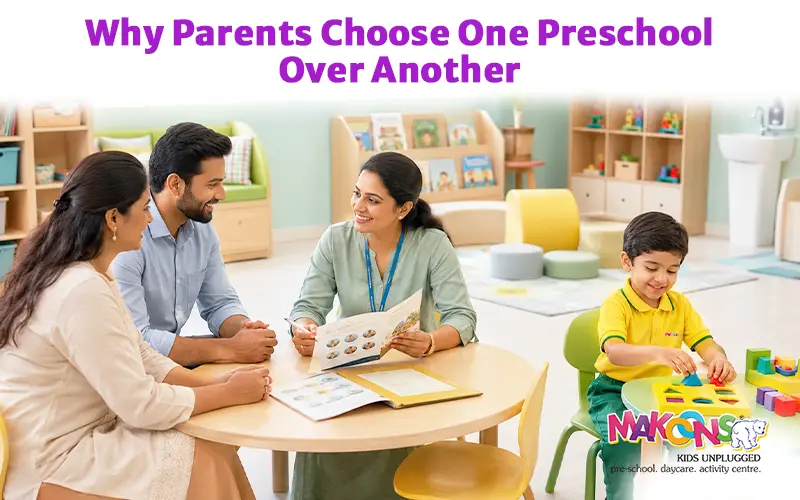
Selecting the right preschool is a crucial decision as a child's early learning environment shapes their self-esteem, socialization, routines and outlook on learning. There are numerous schools that provide similar programs, and parents typically don't just compare prices and locations. They consider safety, teachers, learning approaches and if the setting is a suitable place for their child.
When parents are deciding on a preschool, it is important to understand what factors they take into account and help to make an informed choice.
10 Factors Parents Consider When Choosing a Preschool
1.Safety and child-friendly environment is maintained.
Parents' first priority is usually safety. Parent's concern about their child is important as preschools must have secure entry/ exit gates, clean classrooms and washrooms, safe play equipment, child friendly furniture, emergency rooms and supervision.
Parents can also ask about what school does in any emergency, accident and the event of illness. A school must maintain the environment and awareness of child's well being
2. Effective and Caring Teachers
Teachers have a direct impact on a young child’s experience. Parents expect teachers to know and care for the developmental stages of young children and to be flexible with temperament, learning style and emotional needs.
However as well as qualifications there are skills required in practice, such as communication, classroom management, observation, and empathy. At the school visit parents can observe whether teachers take children seriously, encourage them to participate and do not just give instructions.
3. The Quality of the Preschool Curriculum
A good early years curriculum should facilitate learning through activities that are suitable for the age and not too academic. Parents are searching for a combination of language, early numeracy skills, motor skills, creativity, problem solving, music, movement, and social – emotional learning.
Not all preschools are created equal in terms of providing worksheets. It's one that provides children with real-life opportunities for them to explore, investigate, ask questions, communicate and learn through play.
4. Children Learn Through Play and Activities.
Hands-on learning is the natural way of teaching young children. Parents can then make comparisons between schools regarding the use of stories, art, puzzles, role play, sensory play, outdoor play, experiments and group games.
A good pre-school will have a good routine but will also allow children to explore through play, so that children are curious and independent, but still having fun with learning.
5. Hygiene, Nutrition and Health Practices
A school must maintain the hygiene and cleanliness. A safe and clean environment makes a good place. The parents could talk to the classroom about hygiene, bathroom, water, air exchange, tidying up etc. and what to do if a child is sick.
If they do receive food/snacks, the family can ask about the quality of the food, allergens, menus and hygiene measures. All these details can make a very big difference in a child's comfort level.
6. Parent-Teacher Communication
Hearing what parents and children are learning and how they are coping can be of benefit for both parent and child. Parents may wish to have regular updates, parent-teacher meetings, activity reports or equitable digital communications from schools.
They also want to know who to contact and they have a concern. A responsive preschool engages parents in the preschool; responds to their needs and communicates with them in a respectful manner.
7. Your Location
Factors other than the educational value of a preschool can affect selection. Children and families may be unduly stressed by being too far away or too difficult to reach their school.
Parents compare the travel time, the number of school hours, pick-up time, holidays, and daily routine. A routine which helps young children to feel secure and familiar and makes family life easier.
8. Work Experience Opportunities
Children grow at different rates and parents can take into account the ratio of teacher to child and class size. Smaller or well-managed groups can be easier for the teacher to observe children, to find out what they need and to encourage their involvement and support.
On a visit, parents can enquire about how teachers deal with quiet children, active children, disagreements and young children needing more support.
9. School Reputation and Reviews
The opinions of other parents can be helpful, but should be one of many considerations. Families might want to look at reviews, word of mouth, the school's background, stability of its staff, and clear information about its programs.
It is the parent's responsibility to check for key information. The best evidence that is available comes from a visit to the preschool, a conversation with staff, classroom inspection and asking specific questions, rather than just the rating from the internet.
10. Fees and Overall Value
Financial considerations, of course, are one of the factors to consider when selecting a preschool. The parents can compare tuition fees, entrance fees, transportation costs, food costs, activity costs, uniform costs, and other costs.
But the lowest price is not necessarily the best price and the highest school is not necessarily the best school. Families should ask about what is covered in the fee and ask if the school offers a safe, enriching and developmentally appropriate experience.
How Parents Make the Final Decision
After parents have considered a variety of schools, the choice needs to be made according to the needs of their child and family. Selecting a preschool is easy when you keep these in mind:
Visit classroom: Go and visit preschool, check classroom, play areas , washrooms , safety arrangements and all surrounding
Meet with Teachers: Go and Talk to teachers about your child , observe them how they're treating your child and their interactions with young ones.
Know the curriculum: Review and see if learning and play, creativity, physical activities, and social development are balanced.
Take your child into account: Take your child's personality, interests, learning speed and comfort into consideration.
Consider fees and facilities: Take into account the full cost, such as tuition, transportation, meals, activities and other costs.
Talk to Parents: Communicate with parents, let them know what their child is doing , how they're doing.
Take Reviews: It's good to take reviews of a preschool before you decide to go.
Be attentive: You should be more attentive because your child should feel safe and comfortable.
Conclusion
Selecting a preschool is not easy, you have to check the quality of education, safety, convenience, affordability and comfort. Child development is the top priority for parents. You've to check their environment also, not just academics.
Families choose a preschool after a full research process, asking questions and observing the environment. A child needs a comfortable environment, appreciation not just academic pressure. When a child feels safe or joyful, they already start loving learning.
Related Topics
How To Judge A Quality Preschool Beyond The Pretty Building
How Preschools Plan Their Daily Curriculum