
For entrepreneurs seeking to enter into the education arena, starting a play school can be an interesting business opportunity. However, before one takes the leap into investing, he or she needs to get a detailed answer to this question: what is the actual cost of operating a play school in India?
It depends on no fixed number. The play school startup cost is based on the city, property, size of the centre, interior, curriculum, staffing, equipment and marketing as well as independent or franchise model.
This variation can be seen in current available franchise information. For instance, Makoons has an indicative all-in franchise investment level of ₹12 lakh–₹25 lakh, and other preschool brands openly advertise significantly varying entry-level and package levels. In a recent study done by NIEPA, it is reported that opening a franchise preschool typically costs around 10 lakh-20 lakh and that franchise models can have recurring royalties. These are only indicative market prices and should not be used as a market price.
This guide provides a breakdown of the cost of starting a play school, looks at the costs involved and identifies the unexpected costs that many play school entrepreneurs often miss.
What Is The Typical Play School Startup Cost In India?
The costs for a small to medium play school may range from ₹5 lakh to ₹25 lakh or higher, depending on the model and location, for planning purposes.
A small independent setting in a low income area can have a much smaller start-up budget, a large major city setting with professionally designed interiors and more space can have very high start-up costs.
The investment can be considered as:
₹5–10 lakh: Reasonably possible for a small, independent venture or certain low investment franchise options, especially those where property and infrastructure expenses are low.
₹10 lakh to ₹15 lakh: A larger allocation of funds for a well-equipped smaller centre.
₹15–25 lakh: Realistic planning range for many of the branded schools or larger models based on various reasons such as location, inclusions etc.
₹25 lakh+: Possible for premium locations, bigger centres, larger interior spaces, daycare or higher cost cities.
These are ranges, not averages for the industry. The investment level you should consider is dependent upon a property quotation, equipment needs, staff plan, and your specific franchise or independent business model.
What Makes Up The Play School Business Cost?
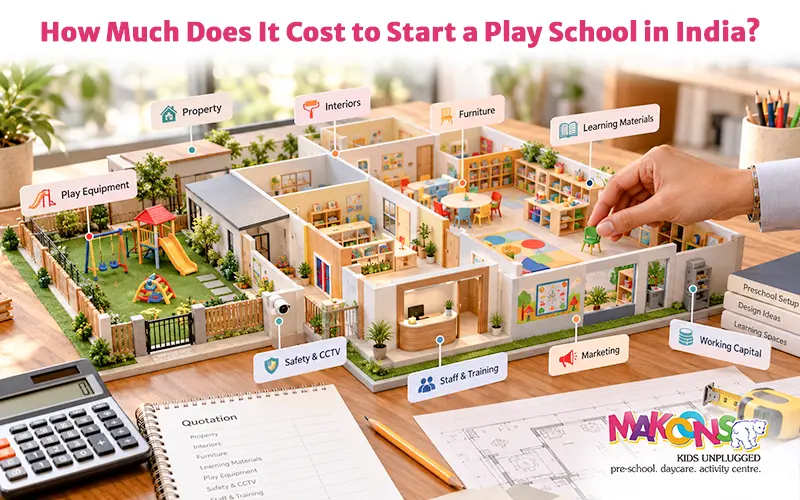
A total investment in a play school is typically composed of several individual investments rather than a single investment.
You can expect to budget for:
Property and security deposit
Interiors and renovation
Furniture
Learning materials and toys
Children's play equipment (indoor and outdoor)
Franchise fee (if applicable)
Branding and signage
CCTV and security
The recruitment and training of staff.
Marketing
Registrations and professional services
Technology and administrative equipment
Utilities and initial supplies
Working capital
The worst error is figuring out just how much cash it takes to open the doors. There will also be a need for sufficient funds to run the centre during the period of building admissions.
1. Property And Rent
One of the major expenses for your play school setup can be the property.
Some of your other first time homeowner costs could be:
Security deposit
Advance rent
Brokerage, if applicable
Renovation
Electrical work
Plumbing
Painting
Signage
Property modifications
The site must be chosen according to need and also cost.
A good commercial site could be in front of you, but it might also be expensive. A more balanced mix may be found in a residential area where there are several families and children.
When renting, take into account:
The number of families with young children in the immediate vicinity.
Accessibility for parents
Easy drop and pick up of the products.
Arrangements for parking or stopping
Preschools that are already in operation.
Safety of the surrounding area
Rent compared with realistic expected enrolment
There are also some franchise brands with minimum space requirements. For instance, makoons currently require a minimum investment of approximately 1,500 sq. ft. built up area, with the total investment depending on the city tier, size of property and whether owned or rented.
Don't select the bigger house for the sake of "impression. If a new business is providing a centre that is too large and will cost too much, then it is putting undue strain on the business.
2. Interiors And Renovation
It is important that a play school be designed for young children and not merely upgraded from an existing office or shop.
The cost of your play school set up might include:
Classroom interiors
Child-sized furniture
Flooring
Storage
Reception area
Activity zones
Child-friendly washrooms
Lighting
Ventilation
Safety features
Wall branding
Outdoor play area
The price can range greatly as per the property condition and finishing.
There can be a particular design standard for a franchise. Makoons, for instance, provides infrastructure and interiors in its investment package, the actual cost of which will depend on the site.
When considering decorative features, first consider:
Safety
Functionality
Child-friendly design
Hygiene
Learning environment
Durability
A colourful wall is useful, but safe flooring, proper ventilation and suitable furniture are more important.
3. Furniture, Toys And Learning Materials
Children should have opportunities to explore, move, create and interact.
Your investment could consist of the following:
Tables and chairs
Bookshelves
Storage units
Activity tables
Floor mats
Books
Puzzles
Blocks
Art materials
Pretend-play resources
Manipulatives
Musical instruments
Indoor play equipment
Outdoor play equipment
When purchasing these resources, refrain from purchasing them just because they look appealing.
See if they are:
Age-appropriate
Safe
Durable
Easy to clean
Easy to use and re-use
Appropriate for the needs of children
In the Ministry of Women and Child Development's Aadharshila curriculum for children between 3-6 years, special focus is laid on providing meaningful, play-based and age-appropriate activities. It can be used as a handy guide to determine if the learning materials and program of a school or franchise are developmentally appropriate.
4. Franchise Fee, If You Choose A Franchise
If you are choosing to start a play school that's branded, you can use the franchise fee to be your initial investment.
A franchise package may include:
Brand usage
Curriculum
Teaching resources
Training
Setup guidance
Marketing material
Operational systems
Admission support
There are differing franchise models, however.
For instance, the total investment in Makoons is currently around ₹12 lakh – ₹25 lakh, and the case of Little Berries is similar with an indicative investment of ₹15 lakh – ₹20 lakh. Bright Kid Montessori provides packages from lower entry points, however it is important to note that published package costs are not always the full package of operating a centre as there are additional costs of property, interiors and staffing.
This illustrates why the actual price of a franchise isn't always as straightforward as it seems.
Ask the franchisor:
What is the franchise fee composed of?
Are interiors included?
Do the learning materials contain?
Does teacher training come as part of it?
Is marketing included?
Are there royalties?
Are there any renewal fees?
What are the costs that are still the responsibility of the franchisee?
5. Staff Recruitment And Salaries
The quality of teachers and support team is the key factor in a play school.
Depending on the size of the centre you may need:
Centre head
Preschool teachers
Assistant teachers
Helpers
Administrative staff
Housekeeping personnel
Help and support regarding security (if needed),
Recruitment and training costs may be part of your initial play school business expense, but these are ongoing costs of running your business.
Before opening, calculate the monthly cost of your complete team.
Don't assume that the number of students needed to support the staffing cost of every classroom will be there immediately when you create your financial plan.
Quality based staffing should also be assessed. A teacher of young children should be patient, communicate, know how to manage the classroom AND understand the development of children, not just be able to finish a syllabus.
6. Safety And Security Expenses
Safety should be considered an integral part of the investment and not an added option.
Potential expenses include:
CCTV cameras
Child-safe furniture
Safety gates
Ensure that entry and exit are secured.
First-aid supplies
Fire-safety equipment
Safe electrical fittings
Non-slip flooring
Emergency signage
Child identification and handover systems for the children.
Also develop procedures for:
Authorised pick-up and dropping off for children
Emergencies
Injuries
Staff responsibilities
Visitor access
Parent communication
Review the requirements in your local, municipal and property. While a franchise may offer guidance, it's important to understand what approvals and safety requirements are still your responsibility.
7. Marketing And Admissions
It takes a concerted effort to breed admission into a play school.
To ensure that local parents become aware of the centre and have reasons to consider it, they need a plan.
Some of the items you could be spending on your launch marketing budget include:
Website development
Google Business Profile
Local digital advertising
Social media marketing
Brochures
Outdoor signage
Open-house events
Parent orientation
Community activities
Admission campaigns
A franchise can offer marketing literature and startup assistance at the brand level. As outlined by Makoons, for instance, their franchise investment comes with pre-launch marketing and first year admission support. Be sure to include a specific definition of these services in your agreement, though.
If you are running an independent play school, you will have to devise your own marketing plan.
8. Registration, Professional And Compliance Costs
Another investment that has to be made at the play school is to establish the business properly.
You might need professional help when it comes to:
Business registration
Accounting
Tax-related compliance
Local permissions
Property documentation
Fire and building standards
Employment documentation
Other applicable registrations
Requirements vary from state to state and from authority to authority and hence there is no national checklist that is applicable to all play schools.
Your accountant, company professional or local legal advisor will be able to assist you in defining your requirements.
Be aware that the treatment of certain services and structures may result in different GST treatment. CBIC has clarified that services offered by the educational institutions in the field of pre-school education will be exempt in certain conditions, but it is advisable for the entrepreneurs to seek expert tax advice on their own tax position as regards treatment of the services offered by the play school and not to assume that all services provided by educational institutions in the context of pre-school education are exempt.
9. Working Capital: Don't Spend Your Entire Budget On Setup
This is one of the essentials for a New Entrepreneur.
Now assume the total cost of everything you need is ₹15 lakh.
This doesn't always translate to ₹15 lakh to be spent on interiors, furniture and equipment.
There is still money needed for:
Monthly salaries
Rent
Electricity
Internet
Cleaning
Marketing
Maintenance
Learning-material replacement
Software
Unexpected repairs
Admissions can be increased over time.
So you need to have a separate working capital provision in your financial plan.
One easy exercise is to work out what you would expect your fixed expenditure to be per month and then simulate a slower admission than your usual.
For instance, if your expenditure is ₹1.5 lakh per month and the number of admissions can take a few months to arrive, the cash reserve can make a difference between handling the situation with ease and being put under financial strain as soon as you open your centre.
Also Read:How To Start a Play School In India: Investment and Requirements
An Illustrative ₹15 Lakh Play School Budget
Suppose that there is a hypothetical Independent Play School, which has an initial budget of ₹15 lakh.
This is a plan example, and not a market typical quotation.
The allocation of the investment could be made across:
Initial Property expenses and property deposit.
Interiors and renovation
Furniture
Learning materials
Play equipment
CCTV and safety
Branding and signage
Initial marketing
Recruitment and training of staff.
Registration fees and professional fees.
Working capital
This will be decided by your location and property.
The key here is to reserve part of the capital for the business – don't burn it all down before opening day.
What Can Increase The Cost To Start A Play School?
There are a number of ways it can push you up in the investment.
Location
Typically, property and operating expenses are higher in major cities and higher premium neighbourhoods.
Property Size
The bigger the centre, the more furniture, equipment, interiors and staff will be required.
Property Condition
If it's an unfinished property, you might need to put in a lot of work.
Franchise Requirements
The franchisor might have interior, furnishings, branding or equipment requirements.
Daycare
Adding daycare can increase staffing, operating hours, equipment and other costs.
Premium Positioning
The initial investment can be quite high due to high-end interiors, technology and specialized facilities.
Marketing
There is a general need for a substantial marketing budget for aggressive launch advertising.
Read More: Top 10 Preschool Franchise in India: Complete Guide
Independent Play School Vs Franchise: Which Can Cost Less?
There is no one right and one wrong answer.
An independent play school is not subject to franchise fees, and it may be more difficult to overlook expenses. However, you have to create your own curriculum, branding, marketing, operational systems and training processes.
There can be a higher investment that can be made up for by providing access to established systems, curriculum, training and brand support, etc.
For instance, according to the recent study by NIEPA on preschool franchising, there are a few operational advantages, consistent curriculum and brand recognition of the preschool franchise as well as potential recurring royalty costs.
The correct comparison is thus:
Total setup cost + recurring operating cost + value of support, rather than simply:
Franchise fee vs no franchise fee.
How To Reduce Your Play School Startup Cost?
Children's safety and quality of learning can be maintained while controlling costs.
Consider these approaches:
Choose where you live for need, not for prestige.
Before signing a lease, check out a few properties.
Wherever possible, negotiate rent and deposit terms.
Focus on key safety and learning facilities.
Don't spend on frivolous items.
Buy quality, long-lasting learning resources.
Know all of the details of your franchise package.
Leverage local community marketing and paid advertising.
Consider an achievable staffing team.
Keep a working-capital reserve.
Shop around when buying equipment.
The aim should not be to establish the minimum cost play school. It should be to ensure a centre that is sustainable financially with funds being put to the purpose of real improvement in safety, learning and parent experience.
Checklist Before You Invest
If you are considering using this product, answer the following questions:
Am I familiar with the number of young families in the target area?
Have I looked at other preschools and their fees?
Do I have the correct rent and deposit fees?
Have I been given a setup quote with an itemised breakdown?
Have I worked out the monthly salaries?
Do I have a marketing budget?
Have I kept working capital aside?
Have I reviewed local permissions and safety?
Have I contrasted independent and franchise models?
When deciding to franchise, have I read the entire agreement?
Have I met with current franchisees?
Have I worked out the number of pupils required to meet monthly costs?
If you don't know the answers to these questions, you might need to do more research prior to investing your money.
Final Thoughts
The initial investment to set up a play school in India varies from a relatively low capital investment for an independent play school to ₹20 lakh or above for a larger or branded play school. No single number can represent an investment for every business owner.
The actual startup costs for your play school will vary depending on your location, property, play school size, interiors, staffing, curriculum, equipment and business model.
The greatest financial principle is to think beyond start-up investment. A business investment in a play school will require sufficient capital to establish the play school and to sustain it until enrollment is stabilized.
Meanwhile, quality should never be viewed as a separate issue from cost. The present framework of Early Childhood in India is more focused on meaningful and developmental learning in the child which is age-appropriate and play-based. A play school, therefore, should invest in the teachers, learning materials and the safety measures and experience it offers to children in addition to investing in buildings and furniture.
Before investing, do local market research, get written quotes and know all the ongoing costs and make conservative estimates.
Frequently Asked Questions
1. What would be the cost of running a play school in India?
No, there is not a set amount. In some areas, it may be possible to set up a small independent play school with a capital investment of about ₹5-10 lakh; professionally equipped or branded centres, however, may need a capital investment of ₹10-25 lakh or more. The cost is highly dependent on the property, city, size and business model.
2. What are the key costs involved in launching a play school?
The top costs are typically property deposit and rent, interiors and furniture, learning materials and play equipment, recruitment and salaries, safety systems, marketing, registrations and working capital. Franchise fee and any recurring fees should also be taken into consideration if you opt for a franchise.
3. Would it be more cost effective to start an independent play school than take a franchise?
This can be, especially since there is no fee for a franchise or royalty for an independent centre. It is important to note, however, that the curriculum, brand, marketing, training and operating systems have to be developed by the individual. Don't just see the franchise fee, but the entire cost of both models.
4. How much working capital is required for Play School?
No universal figure as monthly costs are dependent on location and centre size. Estimate your rent, salaries, utilities, marketing costs and other fixed expenses, and have a solid reserve during the time when your admissions are still in the works.
5. Does the play school setup fee cover the rent of the property?
Not always. When looking at advertised packages, infrastructure and set up may be included in some packages, but not in others; and those may include a rent charge, a security deposit or other charges for property expenses. Don't just take a price on the chin, always request an itemised quotation specifying exactly what is included and what isn't.
6. Is a play school profitable in India?
A play school can be a sustainable business however, it is not a business that will be profitable. Relies on enrollment, fees, rent, staffing, marketing, and retention and operating efficiency. Prior to investing, determine the number of students needed to break even based on conservative estimates, not on returns on investment promises.
