Initiating a preschool under a franchise model will enable the franchisee to gain access to the brand, the curriculum, training of teachers, operational support etc. Before entering into an agreement, one of the financial facts that every prospective franchise owner should know is that the franchise fee isn't the only amount paid to the franchisor.
Some brands of preschools will require a franchise fee. Others receive royalties based on revenue or profits, some receive fees based on an annual payment for the brand, marketing contributions, technology charges or payments for learning materials. Be wary of brands that offer zero-royalty deals, as this doesn't necessarily mean they have no ongoing fees.
It is important to recognise the different types of fees that can occur with a franchise, as these can help you to estimate what your investment looks like, compare all franchise options fairly and prevent unpleasant surprises after opening your centre.
This guide will outline what options are available for preschool payment structures, what you should review in the agreement and how to determine a financial commitment before investing.
1. What Is a Franchise Fee?
The first payment made to a franchisor for the purposes of operating a business under a brand name and under the implementation of particular business systems is typically known as a franchise fee.
This payment in a preschool franchise can cover:
Brand name, logo and brand guidelines.
Curriculum and teaching plan.
First training of teachers and franchisees.
Use of operating manuals and standard procedures.
Advice on setting up and providing facilities at centres.
Marketing resources and launch support.
Admission and operating instructions.
Specific contents will vary according to the franchise and the agreement.
Currently, Little Berries has an indicative franchise fee of ₹3 lakh and a total investment of around ₹15-20 lakh. Hello Kids promises an investment size between ₹3.1–7.1 lakh and calls its model a fixed brand fee per year, instead of the regular royalty. These examples help to see why it's important to look at the entire payment structure of a franchise offer, and not just the upfront cost.
Will franchise fees be refundable?
Not necessarily. The agreement must define if the fee is refundable, partially refundable or non-refundable and outline what will happen if:
You leave before the centre is open.
The proposed property is rejected.
The franchisor is unable to offer the support as promised.
The agreement has ended.
The franchise is sold to another person.
Ask: “What exactly am I paying for, and under what circumstances, if any, can this fee be refunded?”
Also verify if the franchise fee is included out of the way the property, interiors, furnishing, equipment and other set up costs.
Related Topics: Low Investment Play School Franchise: What's Realistic And What To Question
2. What Is a Preschool Franchise Royalty?
Preschool Franchise Royalty is a continuous payment to the franchisor as per the franchise agreement. It is generally associated with the revenues of the franchisee, but some contracts base it on profit or on some other agreed formula.
Royalty payments can be used for continuing services like:
Curriculum updates.
Brand management.
Operational guidance.
Training and Pro Development.
Marketing resources.
Quality monitoring.
Access to franchise systems.
But these advantages don't necessarily come with a royalty. See what continuous support the franchisor has pledged.
Common Royalty Structures
- Revenue based royalty: Centre receives a percentage of the centre's defined revenue.
- Profit based royalty: A share of the profits is paid based on the definition of profit in the agreement.
- Fixed royalty: Payments are made at fixed intervals irrespective of income, as per the contract.
The method used to calculate the number of cups is important. A revenue royalty can be continued even if the centre is not profitable or costs are high. Special care must be taken with the treatment of expenses, depreciation, owner compensation and other deductions for a profit-based royalty.
In the case of a revenue-based royalty, the effect on your costs will be dependent on how much revenue you make.
If the pre-school is collecting ₹3 lakh per month for tuition etc as an ancillary fee and the agreement demands a hypothetical Royalty of 5% on the revenue, then the monthly revenue to the pre-school is:
Monthly revenue: ₹3,00,000
Royalty at 5%: ₹15,000
Annual royalty , assuming unchanged revenue : ₹1,80,000
This is just an illustration and not a standard rate nor a recommendation. The amount you actually have to pay will depend on the rate in the agreement, what is included in the definition of revenue and which items are excluded, and the payment schedule.
Important: Determine if the royalty is based on fees billed, fees collected or some specific amount. Inquire about refunds, discounts, unpaid fees and admission fees and day care income.
Related Topic: How Does a No-Royalty Preschool Franchise Work?
3. What Are Recurring Franchise Fees?
Recurring Franchise Fees are fees that occur on a regular or repeat basis in the course of the Franchise Relationship. One of them might be the payment of royalties, but it's not the only possible recurring charge.
You'll see the following depending on the agreement:
Annual brand or renewal fee
A fee charged on an annual basis for the continued use of the brand, renewal of the contract, and/or access to specific services.
Marketing contribution
The fee which is used for central brand campaigns, advertising resources or promotion. There can be a separate local marketing budget.
A fee charged for a technology or software application
Fees for admissions, communication with the parents, attendance, learning platforms, etc.Admission, communication with parents, attendance, fees on learning platforms, etc.
Cost of curriculum and learning materials
Payment for books, workbook, teaching kit, uniforms or other resources as specified. They can be cost per child, per order or on a set schedule.
Training fees
Initial training may be provided free, but travel and/or accommodation, refresher training and additional staff training may be at extra cost.
Inspection/support fees
You might have to pay extra fees for extra visits, audits, special support and services that are not included in the standard support package, as specified in some arrangements.
Mandatory purchases
The franchisor may necessitate that some supplies, uniforms, equipment or materials be obtained from approved vendors. Check the pricing, minimum order requirements and replacement schedule.
Not all preschool franchises require all the above fees. The idea is to determine which ones relate to a particular offer you are interested in.
4. What Does A Zero-Royalty Preschool Franchise Really Mean?
A zero-royalty model typically refers to a model that requires the franchisor to waive a particular royalty. Does not necessarily imply no monthly payments.
For instance, on Makoon's franchise website, they offer a zero-royalty business model. Hello Kids says that their model is one without royalties but with a one-time annual brand fee. Currently THE KiDS offers a model with a profit royalty of 30%. These are all commercial structures and the outlined terms should be checked with them before committing to a choice.
If you're considering a zero-royalty deal, you should ask:
Do you need to pay an annual brand or renewal fee?
Do there exist technology or marketing charges?
Do learning materials have to be bought from the franchisor?
Do you have any minimum purchasing requirements?
Are there additional training periods after the first?
Do you charge for further centres?
Are there any changes to the charges throughout the agreement?
Are there any minimum payments regardless of enrollment?
The zero-royalty franchise might be appropriate for a business owner who does not wish to receive revenue based royalty payments. But there must be the comparison of initial investment, fixed charges, compulsory purchases and actual support provided.
Related Topic: 10 Common Mistakes New Preschool Franchise Owners Should Avoid
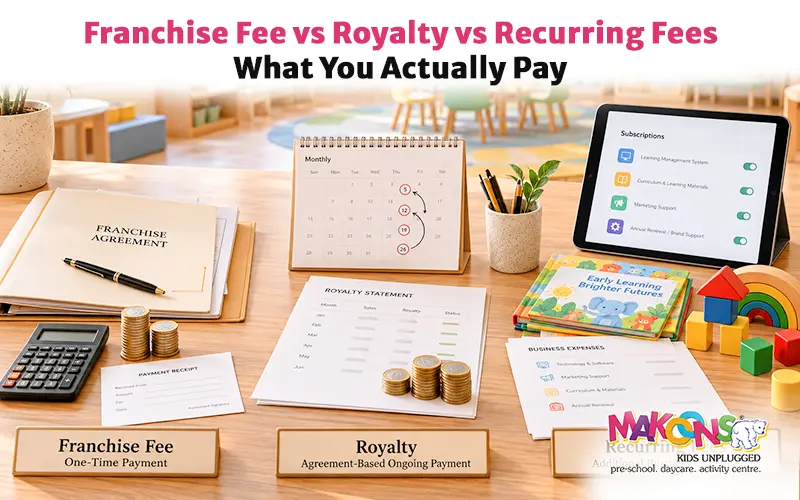
5. Franchise Fee Vs Royalty Vs Recurring Fees: The Difference
Let's take the three terms in the simplest way:
Franchise fee: The amount of money that you pay at the beginning to get the franchise rights and some benefits at the beginning.
Royalty: The amount of money paid on a regular basis by the lessee, according to a specified royalty formula.
Recurring franchise fees: Any fees that are paid year after year, such as annual brand, technology, and/or marketing fees.
These charges are in addition to your centre's day to day business costs such as rent, employee salaries, utilities and insurance, advertising in your area, and maintenance.
So there are three parts to your financial commitment:
Up-front investment costs for a franchise or franchise start-up.
Ongoing franchisor payments.
Day-to-day operating expenses.
If the payments are recurring and the franchise is appearing to be cheap at the start, it could cost more after the initial investment.
6. How To Calculate The Actual Cost Of A Preschool Franchise
Before deciding, create a cost sheet for both opening and operating costs.
Initial Investment
Include:
Franchise fee
Property deposit and advance rent
Interiors and renovation
Furniture, play equipment
Learning materials
Signage and branding
Technology setup
Recruitment and training of staff
Initial marketing
Registration Fees, Applicable Fees
Working capital
Monthly And Annual Expenses
Include:
Rent
Wages and compulsory employment expenses, if applicable
Utilities and maintenance
Local marketing
Software subscriptions
Royalty
Marketing contributions
Learning materials
Any insurance or other reimbursable costs
Brand, renewal or support fees are due and payable annually
A simple illustration
Suppose that there are two potential franchise deals:
Franchise A
Reduce the start-up cost of a franchise
Revenue-based royalty
Separate technology charge
Franchise B
Higher initial fee
No royalty
Established an annual brand fee
Both are not necessarily more or less expensive. Compare total cost over a period of two or more years based on reasonable enrollment, revenue and expense assumptions. Consider a slower admissions scenario, rather than assuming that your centre will be full from the start.
This method will provide you with a more useful view of the possible preschool franchise fees you will be paying during the agreement.
Related Topic: How To Verify A Genuine Preschool Franchise Before Investing
7. Questions To Ask Before Signing A Franchise Agreement
Ask written responses to the questions below:
What is the complete initial franchise fee, and what does it include?
Can the fee be refunded at any time?
How is actual Royalty paid and when is it paid?
Based on what is royalty paid -- revenue, collections or profit?
Do there exist minimum royalty payments?
How much does it cost to renew the brand or for annual brand renewal or for marketing?
Are technology, curriculum and training included?
Do they have a minimum purchase/reorder requirement or specific suppliers?
Is there any option for a raise in fees during the contract term?
What if the agreement comes to an end, what happens to outstanding payments?
Do you have late reporting or payment penalties?
Does the agreement allow the franchisor to audit financial records?
What support must the franchisor provide in return for ongoing payments?
Prior to signing, read the agreement with a lawyer and, if it applies, an accountant. Ensure the tax treatment is agreed upon and ensure proper invoices are requested for payments.
8. How To Compare Franchise Payment Structures Fairly
Don't choose a preschool franchise that has a low franchise fee or say it will not require any royalties.
Instead, compare:
Total initial investment
Total recurring fees
The amount of marketing expenditures needed in that area
Curriculum and training elements that include
Support quality and availability
Mandatory purchases
Renewal and exit terms
Territory protection
The monthly operating costs that are to be expected
financial performance under conservative enrollment assumptions
Talk to current franchisees about their own experience of fees that they weren't expecting, how much help is provided and how much notice is given to them of changes.
The best deal on payment is the one you know about, can essentially afford and can get some value out of (not necessarily the cheapest option that's being touted with the headline price).
Final Thoughts
It is crucial to know the difference between a franchise fee, a preschool franchise royalty and recurring franchise fees before you invest in early childhood education.
Up-front payment may give you access to the brand and its systems, and any ongoing payments (royalties) for the duration of the contract could affect cash flow. A zero-royalty model may cut down on one type of payment but there are other considerations such as annual fees, required items, marketing returns and other contractual obligations.
Ask for an itemized fee schedule, figure out the total cost over multiple years, check the terms and conditions of the franchisor and get the agreement professionally reviewed before signing it. Be transparent in making money and make reasonable predictions to make a better franchise determination.
Frequently Asked Questions
1. What is the difference between a franchise fee and a royalty?
The franchise fee is usually a lump-sum price that is paid for the use of the franchise, and is compensation that has been agreed upon. A royalty is a recurring item of payment, usually based on a percentage of revenue or profit, based on a contract. Each franchisee will have a different organization of the structure.
2. Are preschool franchise fees a one-time payment?
Not always. It is possible to pay one fee for the initial franchise and then several renewal fees, for marketing, technology, training and learning materials. Read all fee information and agreement.
3. Does a zero-royalty preschool franchise have no recurring fees?
Usually, No. Zero symbolically represents no specific royalty. You may be required to pay annual brand fees, renewals, technology fees, and/or marketing contribution or obligation to purchase fees. Check written conditions.
4. How is preschool franchise royalty calculated?
This will vary according to the agreement. The royalty can be either on revenue, collected fees, profit or a fixed amount. Check the applicable rate, base, frequency, reporting, refund and unpaid fees.
5. Which is better: a royalty-based franchise or a zero-royalty franchise?
There is no one right or wrong choice. Take a look at the initial fee, recurring cost, services offered, required purchases, and projected total cost over the course of several years. Thinking about the model, what do you think will make it sustainable if it doesn't achieve the number of admissions?
6. What should I check before paying preschool franchise fees?
Check coverage of fees, refunds, royalty, annual fees, renewal policy, required purchases, tax treatment, support policy and termination policy. Obtain in writing and independent legal and financial advice before signing.