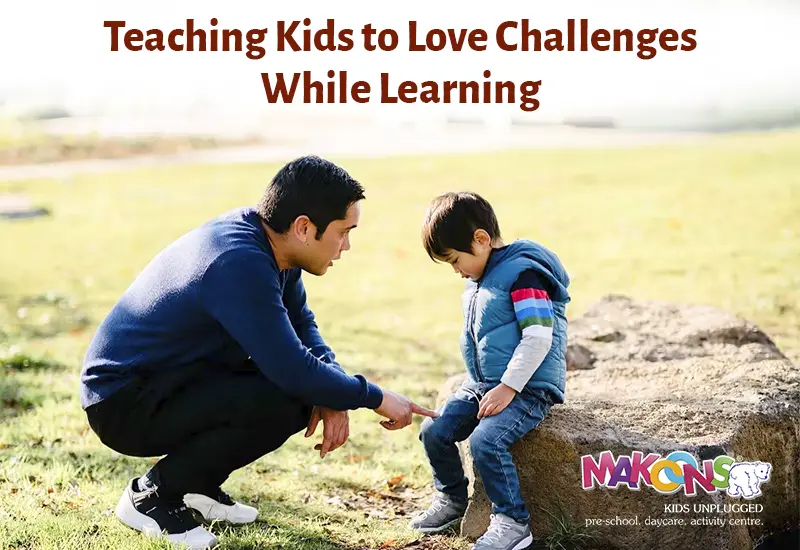
Children love to play. They love to explore. But when something feels hard or while facing any kind of challenge, many children stop trying. They may say, “I can’t do it.” They may cry or walk away.
As parents and teachers, we want kids to keep going. We want them to see challenges as fun, not scary. We want them to believe, “I can learn this.”
This idea is called a growth mindset for kids. A growth mindset means children believe they can improve with practice. It teaches them that effort matters more than talent.
When kids have this mindset, they welcome hard work. They don’t run away from mistakes. They see learning as an adventure.
Why Challenges Are Good?
Challenges are not bad. They are important. They help children grow. When kids face something tough, they learn new skills.
Challenges teach kids:
- To think in different ways
- To solve problems
- To stay calm and patient
- To keep trying after failure
- To feel proud after success
If life is always easy, children do not grow strong. Struggles shape them. Effort makes them brave.
What Is a Growth Mindset?
- A growth mindset is simple. It means, “I can get better if I try.”
- A fixed mindset is different. It says, “I am good or bad, and that’s it.”
For example, a child says, “I cannot draw well.” A fixed mindset will make them stop. A growth mindset will say, “I can get better with practice.”
This small change in thinking is powerful. It helps kids see challenges as steps forward.
Early Learning Mindset
Preschool is the best time to build this habit. At this age, children are brimming with curiosity. They ask questions all the time. They want to try new things.
They will love challenges if we help them. For instance, a child may struggle prepping a puzzle. Initially, an upset feeling may come. But with gentle support, they will try again; when they finally make it, they are proud.
Here are some preschool learning tips:
- Praise effort more than results
- Use words like, “You are trying hard”
- Break big tasks into small parts
- Give children time to solve problems before helping
These steps teach children that learning is a process.
Teaching Resilience
Resilience means not giving up. It means bouncing back after mistakes. Kids with resilience are strong. They can handle hard work.
You can teach resilience with daily play:
- Blocks: If a tower falls, rebuild it.
- Shoes: Keep practicing until laces are tied.
- Writing: Show that letters look better with practice.
Adults must also show resilience. When parents and teachers stay calm during struggles, kids learn by watching.
Encouraging Curiosity
Curiosity makes learning fun. Curious kids ask, “Why? How? What if?” They want to explore.
You can encourage curiosity in simple ways:
- Answer their questions with interest
- Read storybooks with new ideas
- Take walks in nature
- Allow safe experiments at home
For example, if a child asks, “Why do birds fly?” give a simple answer. Then watch birds together. Curiosity grows when kids feel their questions matter.
Positive Learning Habits
Habits shape behavior. Good habits make learning easier.
Some positive learning habits are:
- Read daily. Even one page builds focus.
- Practice often. Small steps each day bring progress.
- Ask for help. Show that needing support is okay.
- Celebrate small wins. Every step matters.
- Try again. One failure is not the end.
When children practice these habits, they become stronger learners.
Child Motivation Strategies
Sometimes children lose interest. They may say, “I don’t want to.” Motivation helps bring them back.
Here are simple child motivation strategies:
- Set small goals. One puzzle. One page. One word.
- Give rewards. Stickers, stars, or hugs.
- Offer choices. Let them pick between two tasks.
- Share stories. Talk about people who tried hard and succeeded.
- Motivation is like fuel. Over time, kids learn to enjoy challenges on their own.
Role of Parents
Parents are the first teachers. Kids watch parents closely. What you do matters more than what you say.
Ways parents can help:
- Share your own struggles. Say, “This was hard, but I tried again.”
- Praise effort, not just results.
- Make a safe space where mistakes are okay.
- Play games that involve problem-solving.
When kids see parents value effort, they copy the same behavior.
Role of Teachers
Teachers guide kids in classrooms. They have a big role in shaping mindset.
Some preschool learning tips for teachers:
- Say, “Let’s try again” instead of “You are wrong.”
- Give group projects to build teamwork.
- Praise effort in front of the class.
- Provide tasks that are not too easy and not too hard.
- A positive classroom builds strong, confident learners.
Mistakes Are Lessons
Mistakes are not failures. They are lessons. Each mistake shows us what to try next.
Help kids reflect with simple questions:
- “What did you learn?”
- “What will you try next time?”
- “How can you do it differently?”
When mistakes feel safe, kids take more risks in learning. They explore more. They grow faster.
Fun Learning Activities
Learning can be fun. Activities make challenges exciting.
Here are some ideas:
Word games: Build vocabulary while playing.
Math riddles: Teach numbers in a playful way.
Treasure hunts: Encourage teamwork.
Storytelling: Let kids invent their own endings.
Building challenges: Create tall towers or shapes.
These games mix fun with learning. Kids don’t feel pressure. They enjoy the challenge.
Building Confidence
When kids face challenges, they build confidence. They learn:
- Problems can be solved
- Practice brings progress
- Curiosity leads to answers
- Mistakes are normal
Confidence helps them in every part of life. It helps in school, sports, friendships, and later jobs.
Final Thoughts
Teaching kids to love challenges is one of the best gifts we can give them. It makes them strong and curious. It helps them see learning as fun, not stressful.
With a growth mindset for kids, simple child motivation strategies, and positive learning habits, parents and teachers can guide children well.
Remember these simple truths:
- Praise effort
- Encourage curiosity
- Teach resilience
- Accept mistakes
When kids build an aversion toward challenges, they not only fare poorly at school but also develop inadequacies concerning courage, patience, and joy in learning. These lessons, however, stand as pillars for life.
Read Also : 7 wonders of the world - A guide for curious kids