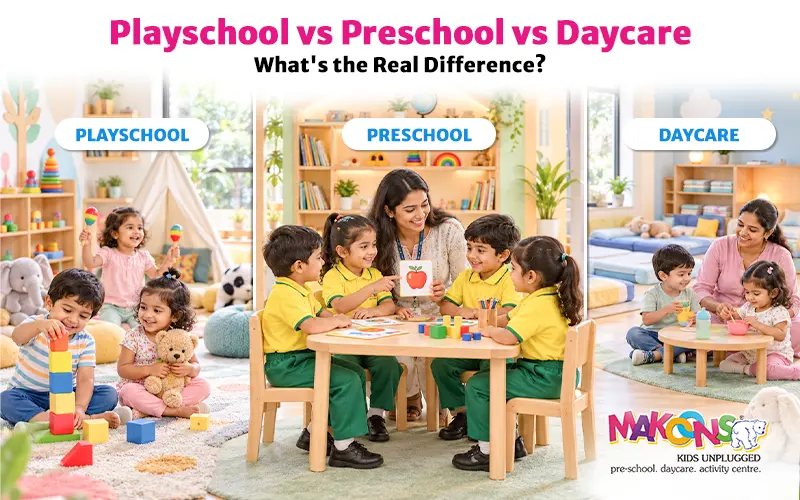
Parents often confuse the word playschool with preschool, nursery, kindergarten and daycare. But they don't all have the same meaning.
When you are considering a playschool vs preschool option for your child, knowing the difference can help you make an easier decision. Preschool vs daycare is the same as well, as one is mainly concerned with early learning while the other is mainly concerned with care and supervision.
In addition, words can differ from city to city and institution to institution. The government education resources even mention that preschool programmes are referred to as nursery school, pre-school, kindergarten, LKG, UKG, play centres, crèches and Balvatikas in India.
What Is A Playschool?
A playschool is a place for young children to play, interact and engage in age-appropriate activities for a portion of the day.
The term "playschool" does not have a consistent definition across the country that sets it apart from "preschool. The common usage of the words can overlap significantly.
Simple playschool meaning:
Playschool is an early learning setting where young children are mainly engaged in learning through play, activities and interaction and exploration.
At a typical playschool, children may be introduced to:
Colours and shapes
Rhymes and songs
Storytelling
Art and craft
Simple puzzles
Using blocks and building activities.
Music and movement
Social interaction
Basic language activities
Outdoor play
It is usually oriented towards getting children comfortable in a group setting and promoting early growth.
What is the main focus?
Play, interaction and early development.
It is especially helpful for young children as the act of playing offers a constructive and fun means of learning about the world around them, as well as skills.
What Is A Preschool?
The meaning of the preschool is not limited to "a place where children play.
Preschool is typically an early childhood education program that is organised and gradually introduces children to the next phases of learning, as well as all aspects of their development.
Simple preschool meaning:
An early childhood education program that provides services for children before they start formal primary education, to help them develop physically, cognitively, linguistically, socially-emotionally and creatively.
A good pre-school can have:
Story-based learning
Early language and literacy
Early numeracy
Art and creative expression
Music
Movement
Pretend play
Nature exploration
Problem-solving activities
Group activities
What Is Daycare?
Daycare is not a play school and is not the same as preschool.
A day care is a place that offers care, supervision and a safe environment for children while their parents are on the job or unable to be present.
A day care could permit children to attend for longer hours than a regular pre-school program.
Simple daycare meaning:
Daycare is child-care that is available to supervise and care for children, provide meals or rest schedules and age appropriate activities when parents are absent.
Whether or not daycare has: Depends on centre and child's age
Supervised play
Meals or snacks
Nap/rest time
Help with diapering/urination.
Outdoor activities
Storytelling
Creative activities
Basic learning activities
Pick-up/drop-off services
The main goal is caring, and in many modern day care centres activities for children's learning and development are included.
Playschool Vs Preschool Vs Daycare: The Core Difference
The simplest method to grasp the three is to check their key use.
Playschool
The primary purpose: Early socialisation and early learning through play.
Preschool
Main purpose: Integrated early childhood development and education.
Daycare
Main purpose: caring for children, supervision and support for working families.
However, there is overlap among these categories.
For instance, a centre could provide:
Preschool + Daycare
or
Playschool + Preschool + Daycare
That is why it is important for parents to enquire into the programme and not just the terminology.
Playschool Vs Preschool: What's The Difference?
One of the most frequent queries of parents is this.
In reality, the distinction is not that significant as many institutions may refer to "playschool" and "preschool" as the same type of programme.
There may be variations, however, in the emphasis.
Playschool may place greater emphasis on:
Free play
Social interaction
Songs and rhymes
Simple activities
Separation readiness
Familiarisation with group settings
Preschool may emphasize more:
Developmental learning goals
Early language
Early numeracy
Structured activities
Creative development
Social-emotional development
School readiness
Important:
This is not an excuse to replace play with worksheets in the preschool.
Indeed, play, activity, exploration and interaction have been a key focus of the Foundational Stage in India.
What this means is that a good preschool should still feel like a game.
Preschool Vs Daycare: What's The Difference?
The difference is made more apparent here.
The focus of preschool is on:
- Learning and development
- The main focus of daycare is on:
- Care and supervision
A child may go to preschool for three or four hours and stay at the same centre for the daycare until parents return from work.
For example:
9:00 AM – 12:30 PM: Preschool programme
12:30 PM – 6:00 PM: Daycare
The times are subject to change depending on the centre.
Preschool typically includes:
Learning activities
Circle time
Stories
Music
Art
Early literacy
Early numeracy
Outdoor play
Daycare may include:
Lunch
Nap
Free play
Supervised activities
Snacks
Outdoor time
Rest
Childcare
There are some day care centers that offer structured learning, as well, but the main function is childcare.
Playschool Vs Daycare
These are also very different as far as their purpose.
Playschool
It is designed to be used by children to:
Play
Explore
Socialise
Join in with early learning activities
Daycare
The majority of the activities are designed for children to:
Stay safely supervised
Eat
Rest
Play
Follow routines
Be cared for when parents are not present
One important difference: Duration
Typically, playschool programmes are of shorter duration.
Daycare may have longer hours, as it is built to revolve around parents' work and childcare needs.
A Child Can Attend Both Preschool And Daycare
Not all of these are mutually exclusive choices for parents.
A common model is:
The school operates a half-day Preschool (8:30 am to 12:30 pm) and daycare (12:30 pm to 3:30 pm) programme.
This is especially beneficial for working parents.
For example:
Morning
The child is involved in:
Storytelling
Art
Music
Group activities
Early literacy
Outdoor play
Afternoon
The child:
Eats lunch
Rests
Plays
Is able to join in with quiet activities
Puts patiently up with parent
This integrated model is able to offer early childhood education and child care within a single setting.
Why Play Matters In Early Childhood Education?
One of the concerns parents have is whether their children are "just playing" in preschool.
That's a misconception.
Many developmental skills can be combined in a well-designed play activity.
For instance, with blocks the following can be supported:
Fine-motor skills
Spatial understanding
Problem-solving
Creativity
Language
Cooperation
A pretend play activity is a good support for:
Vocabulary
Social interaction
Imagination
Emotional expression
Communication
The Ministry of Education's approach to foundational education emphasizes play-based, discovery-based and experiential learning.
So the question isn't:
“How many worksheets were there in my child's preschool?”
A better question would be:
“What knowledge and understanding is my child developing in the activities?”
How To Choose Between Playschool, Preschool And Daycare?
It depends on your child's age, developmental needs and family's schedule.
Select a Playschool If:
You primarily want:
A gradual introduction to group situations.
Social interaction
Play-based activities
Shorter sessions
Routine, early exposure to structured routine.
Select a Preschool If:
You want:
A more comprehensive early learning programme
Developmental activities
School-readiness support
Language and communication development.
Early numeracy experiences
Choose Daycare If:
The major requirement is:
Extended childcare
Supervision while parents work
Meals and rest
Longer operating hours
An out-of-school safe environment
Choose Preschool + Daycare If:
You need both:
Early education + extended childcare
This can be particularly useful for families who have longer work hours.
What Parents Should Check Before Selecting A Centre?
If it is playschool, preschool or daycare, check out the centre in advance before deciding.
1. Safety
Check:
Access to and from the building.
Child supervision
CCTV policies were followed, if applicable.
Fire-safety arrangements
Safe furniture
Electrical safety
Staircase protection
Emergency procedures
2. Teachers And Caregivers
Notice adults' interactions with children.
Do they:
Speak respectfully?
Listen patiently?
Encourage children?
Respond appropriately to emotions?
Supervise actively?
3. Cleanliness
Check:
Classrooms
Toilets
Eating areas
Sleeping areas
Toys
Outdoor spaces
4. Learning Environment
Look for:
Books
Art materials
Manipulatives
Blocks
Puzzles
5. Child-To-Adult Ratio
Inquire about the number of children who are supervised by each teacher/caregiver, especially for younger children and daycare groups as the number of children will affect the amount of supervision provided.
6. Daily Routine
Ask for a typical day's schedule.
A good routine should provide a sensible balance between:
Active play
Quiet activities
Learning
Meals
Rest
Outdoor time
Common Misconceptions About Playschool, Preschool And Daycare
"Playschool means there is no learning."
Not true.
Child play and child learning go hand in hand.
"Preschool means children should study like primary-school students."
Not necessarily.
Play, movement, exploration and interaction should be a part of developmentally appropriate preschool education.
"A bigger building means a better preschool."
Not necessarily.
The quality of teachers, relationships, safety systems and learning experiences outweigh the size of the building.
What Does NEP 2020 Say About Early Childhood Education?
Early Childhood Care and Education (ECCE) is an important aspect of the National Education Policy (2020).
The National Curriculum Framework for the Foundational Stage defines ECCE as covering the age group from birth to 8 years and highlights that the first 8 years of children's lives is a critical period in their overall development. It also identifies the ages 3-8 as the Foundational Stage.
The policy direction promotes:
Play-based learning
Activity-based learning
Discovery
Experiential learning
Holistic development
Foundational literacy
Foundational numeracy
Social and emotional development
Playschool, Preschool Or Daycare: Which One Is Best?
There is no right or wrong answer.
If your child needs socialisation:
May be suitable for playschool.
If you feel your child needs a broader early-learning program:
It might be better to go to preschool.
If you are in need of a longer childcare session:
There may be a need for day care.
If you're in need of both education and childcare:
Preschool/day care may be an alternative.
In the end it is the quality of the centre rather than the label that is important.
A good playschool can provide great developmental opportunities. Learning can also be lots of fun at a high quality preschool.
Final Thoughts
If you're looking for the difference between playschool and preschool and daycare, it's easier to see the difference when you're talking about what they are for.
The play, interaction and learning of young children is introduced by playschool generally.
Preschool offers a wider early childhood education programme that addresses all aspects of learning, and prepares children for the next phase.
Daycare tends to be a place where you are mostly caring for and watching kids, for longer hours and possibly involved in educational and recreational activities.
These categories are not set in stone, however. There are a plethora of terms for children's programmes in India and even children's resources recognise that such common terms as pre-school, nursery, kindergarten, play centre, crèche and Balvatikas are used.
Frequently Asked Questions
1. What is the difference between playschool and preschool?
In India, these terms are used interchangeably. Play and socialisation and introductory activities will be the focus of playschool generally and developmental learning goals and a wider early childhood education programme may be offered in preschool. The content of the programme may vary from institution to institution.
2. How does pre-school differ from day care?
Care and supervision, and sometimes longer hours, is the main focus of day care, whereas early learning and development is the main focus of preschool. A number of centres provide both pre-school and day-care in a single building.
3. What is the meaning of playschool?
A playschool is typically a place for young children to play, interact with others, sing, tell stories, create and engage in age-appropriate activities. Provides a general description of out-of-school learning.
4. What is the meaning of preschool?
Preschool is an early childhood educational programme that is organised for children before they enter primary school. Uses developmentally appropriate activities to generally support physical, cognitive, language, social-emotional and creative development.
5. What is day care?
Day care is a child care program where children are cared for by someone other than their parent(s)/guardian(s) when their parent(s)/guardian(s) are not there. In some centres daycare may include meals, rest, play, outdoor activities and learning experiences.
6. Is preschool education important for children?
Yes. Quality early childhood education builds children's communication skills, social-emotional, physical, cognitive and early literacy and numeracy skills. The Foundational Stage in India is a significant period of life with emphasis on all-round development of the child and play-based learning as per the National Curriculum Framework (NCF).