
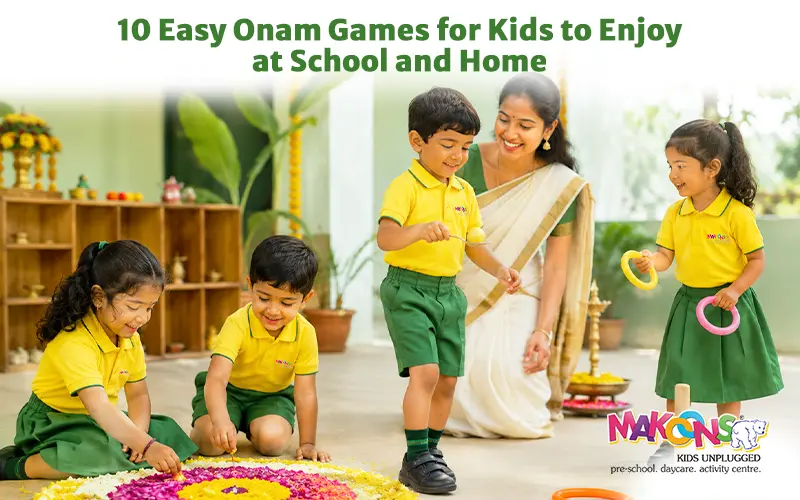
Onam is not limited to flowers, delicious food, dress and family get together. The games, music, moving and dancing, stories and creative activities are also an enjoyable way for children to learn about the culture of Kerala.
The traditional way of celebrating Onam has a number of local games and cultural shows. Onam is traditionally associated with games and activities like Thalapanthukali, Uriyadi, Kilithattu Kali, Kuttiyum Kolum, Tug of War, Thiruvathirakali etc., which are listed by Kerala Tourism.
But there are some traditional games that are physically active or need to be supervised by adults. If you are playing with young children and preschoolers, it is best to adapt an idea to make it simple, safe and appropriate for them.
Whether Onam celebration is at school or at home, these 10 ideas will surely make Onam a fun celebration for both parents and teachers while teaching children about Onam and Kerala tradition.
Why Play Onam Games With Kids?
Games provide children with opportunities to learn whilst enjoying themselves. Well planned Onam activity can motivate:
Large motor skills (running, jumping and balancing)
Fine-motor coordination
Hearing and obeying directions
Teamwork and cooperation
Turn-taking and patience
Creativity and imagination
Cultural awareness
Social interaction
Confidence and communication
Onam is also very closely associated with the tradition of agriculture, community celebration, stories and culture of King Mahabali.
It is not a formal history lesson but can be easily communicated to young children via games.
10 Easy Onam Games For Kids
1. Onam Treasure Hunt
A treasure hunt is the easiest of all Onam games for children to play at home or school!
How to play:
Arrange small Onam related objects around the room/ classroom, such as:
Paper flowers
Images of a pookalam.
Banana-leaf cutouts
Miniature boat pictures
Picture of the king, Mahabali.
Traditional Kerala clothing pictures
Give a simple clue and have the children search for the objects that you have hidden.
Younger children can be helped by showing them a picture of what to find.
Learning benefits:
Observation
Memory
Vocabulary
Problem-solving
Teamwork
In school: Make small groups of children.
At home: Parents can hide the objects in one room and make 5 clues to help the children find them.
2. Pookalam Colour Hunt
Pookalam is one of the most recognizable forms of Onam, this is a traditional flower carpet. Pookalam is a unique feature of Onam festival, which is made using fresh flowers in artistic designs, says Kerala Tourism.
Make this tradition into a simple children's game.
How to play:
Place different coloured paper flowers around the classroom.
Call out a colour.
The children will have to discover that colour.
They bring it back and then put it on a simple pookalam design.
For example:
“Find a yellow flower!”
Children race to get to a yellow coloured paper flower.
Make it more educational.
Have children do the identification of:
Red
Yellow
Pink
White
Orange
Purple
Hence, it becomes an activity for Onam festivity with the children and a colour recognition activity.
3. Onam Musical Statues
Make a game of the musical statues and add an Onam theme to it.
How to play:
Use music designed for holidays or children.
Children are dancing to the music.
Suddenly switch off the music.
Everyone must freeze.
If a child is caught moving, they can demonstrate an engaging task, like a rhythmic clap or a basic dance move.
Don't keep children out of the game due to preschool. Instead, hold all people in place.
Examples of fun actions are:
Use a rowing machine to row a boat.
Using the palms of your hands make a shape like a flower.
Be a tiger as ‘Pulikali'
Clap three times
Do two gentle jumps
Thus, one of the simplest Onam activities can be done in the classroom for Onam celebration.
4. Mini Vallamkali Race
The famous feature of Onam celebration is the traditional snake boat race called "vallamkali. The boat of vallamkali is one of the most significant events during Onam and it is propelled by teams beating in harmony, according to Kerala Tourism.
Just the concept of a boat will do for children.
How to play:
Make paper/cardboard boats.
Then:
Divide the children into groups.
A paper boat should be given to each team.
Use blue paper or blue cloth to make a "river".
Children pull their boats along to the finish line.
Another activity is to have children sit in a line and pretend to row as a team, saying a simple rowing rhyme.
Learning benefits:
Teamwork
Rhythm
Coordination
Imaginative play
Safety tip: Do not put children in handmade boats, or use water indoors.
5. Traditional Tug-of-War
The game of tug of war is one of the traditional Onam games in Kerala and is considered to be a part of the celebration of the community. It has been included in the list of Onam games and cultural activities by Kerala Tourism.
However, the traditional one needs to be modified for young children.
Preschool-friendly version:
A soft, kid friendly rope!
Keep teams small.
Follow a short route.
Have adults supervise.
Make the goal participation rather than winning.
A game of "pull the ribbon" or a soft rope can be played instead of pulling a team, in which case children pull a ribbon or soft rope together towards a mark.
What children learn:
Cooperation
Balance
Coordination
Team spirit
6. Thalapanthukali-Inspired Ball Game
Children play an Onam ball game called Thalapanthukali (also Onapanthu). According to Kerala Tourism it is a team game played by throwing and hitting the ball, the rules of which differ from place to place in Kerala.
The traditional game can be played with sticks and quick-moving balls, which can be unsuitable for little ones.
Rather, develop a safer classroom version.
How to play:
Have a soft foam ball.
Set up a large bucket or cardboard target at a distance a few feet back.
Children throw the ball alternately into the target.
Allow multiple times to every child.
Make it educational:
Call out numbers before each throw:
“Get players to throw the ball into bucket 3.”
Children practice:
Counting
Hand-eye coordination
Turn-taking
Direction-following
7. Onam Picture Matching Game
A wonderful game for younger kids and among the easiest Onam games you can play at home.
Make pairs of picture cards to match:
Pookalam
Banana leaf
Snake boat
Flowers
Traditional clothes
King Mahabali
Onam Sadya
Pulikali
Turn the cards over so they are face down.
Children take 2 cards each and attempt to match them.
For toddlers:
Hold a small number of cards (4-6).
For older preschoolers:
Use 10–16 cards.
Extra learning opportunity
When a child locates a pair, ask him/her:
"What is this?"
Then provide a brief description.
This makes this a mini-culture-learning game.
8. Pulikali Freeze Dance
Pulikali is a colorful folk drama which is closely linked to the Onam festival in Kerala. The performers wear tiger costumes and paint themselves in tiger colours, and dance to traditional music; the Thrissur form dates back to about 200 years, Kerala Tourism says.
The concept can be introduced using a child friendly movement game.
How to play:
Play suitable music.
Children play the role of tigers.
They stroll, stretch and dance as frolicsome tigers.
Once the music ends, they all stand still.
Call out actions:
"Tiger walks!"
"Tiger jumps!"
"Tiger freezes!"
Important:
Body painting is not a complicated activity for children. Costumes are optional, but paper masks or tiger-ear headbands will work.
9. Onam Colour And Beanbag Toss
Make a Target with paper flowers or coloured circles for Onam.
How to play:
Set up 3-4 targets on the ground.
Provide soft bean bags or "balls of fabric" for children.
Have them throw the object on:
The yellow flower
The red circle
The Pookalam
The boat picture
Simple scoring can be implemented for older children.
For preschool children, however, the emphasis is on participation rather than competition.
This game develops:
Hand-eye coordination
Colour recognition
Concentration
Gross-motor skills
Counting
It is very helpful when organising Onam games in the school as it allows several kids to take turns.
10. Kuttiyum Kolum-Inspired Target Game
Kuttiyum Kolum is a traditional folk game of Kerala, which is similar to elements of Cricket or Baseball. According to Kerala Tourism, it is traditionally played using a small stick and a longer stick, and has several regional names.
The traditional game uses sticks, but can be hazardous for young children. According to Kerala Tourism, there has been an increase in eye injury which has been a reason for the ban of the game in some schools.
So do not copy the 'stick hitting' version for younger children.
Safer adaptation:
Use:
A soft foam bat
A soft ball made of foam.
A large cardboard bulls-eye.
Children are permitted to gently tap or roll the ball towards the target.
Why it's useful:
It keeps the concept of aiming and striking but adapts the activity to be more suitable for younger children.
Bonus: Onam Action Game For Toddlers
For very young children keep it very simple.
Call out an Onam related action:
“Flower!” → Hand a flower shape.
“Boat!” → 'Row' as if you were on a boat.
“Tiger!” → walk like a tiger.
“Sadya!” → Fake eating.
“Mahabali!” → Put hands together to greet.
This needs hardly any preparation and can be played in a classroom, home living room or outdoor area.
Traditional Onam Games Vs Child-Friendly Versions
Remember that traditional games do not always require to be reproduced exactly for young children.
There are lots of regional Onam games in Kerala, and the rules of the game may vary from one area to another. For instance, Kerala Tourism mentions local variations in Thalapanthukali, and mentions the dances such as Kilithattu kali, kuttiyum kolum, uriyadi, onathallu, and more.
Teachers and parents can maintain the idea and cultural connection while making an appropriate change in the physical activity for preschool activities.
For example:
Traditional stick game → Foam-ball target game
Traditional boat race → Paper-boat race
Traditional Thalapanthukali → Soft-ball throwing
Authentic Pulikali (Traditional Pulikali) → Freeze dance
Traditional Pookalam – Activity of Paper Flower.
Thus, children can be exposed to the culture, while avoiding activities that are physically challenging for their age.
What Children Can Learn Through Onam Games?
There are various areas of early development that can be supported in a well planned out Onam celebration.
Physical Development
Games are used to provide support to throw, jump, dance and balance skills.
Cognitive Development
Matching games, treasure hunts and colour activities promote memory and problem solving.
Language Development
Teachers can add to the vocabulary words in the following ways:
Onam
Pookalam
Mahabali
Sadya
Vallamkali
Pulikali
Flowers
Boat
Social Development
Team games encourage:
Sharing
Cooperation
Waiting for a turn
Following rules
Encouraging friends
Cultural Awareness
Children are made aware of the connection between festivals and stories, traditions, food, art, music and community.
Tips To Make Onam Games More Inclusive
Not all kids will want to run or take part in games that are competitive.
Provide other opportunities for children to engage.
For example:
A child who doesn't want to run can be the game helper.
A child is free to hold a picture card if he/she does not wish to dance.
Children may participate in teams, not in individual games.
Offer "seated" options of games as available.
Do not make a child do an activity he or she does not wish to do.
Most fun Onam activities include those where kids don't feel the pressure to win.
Final Thoughts
Onam is a great time to infuse culture in the learning process of kids. The traditional games are a source of colours and excitement to Kerala's festive tradition such as Thalapanthukali, Kilithattu Kali, Kuttiyum Kolum and Uriyadi etc. and the activities such as Vallamkali and Pulikali are also a part of the festive celebration.
For preschoolers it should not be all the games that are played by adults. Rather, parents and teachers can make easy and safe adaptations that honor the tradition.
Whether it is a Pookalam colour hunt, mini boat race, Pulikali freeze dance or soft ball, these games are fun and educational at a school or family get-together for kids.
Most significantly provide ample opportunities for kids to play together, understand Kerala traditions, engage in physical activity, get creative and experience Onam in style.
Frequently Asked Questions
1. What are some easy Onam games for kids?
Pookalam colour hunt, Onam treasure hunt, picture matching, musical statues, soft-ball target tossing, mini vallamkali and pulikali freeze dance are some of the easy Onam games for kids. These can be adapted to the ages of the children and space available.
2. What type of games can be played in Onam festival for children of pre-school age?
Simplified versions of traditional activities can be enjoyed by preschoolers. It is easier to organise Pookalam activities, picture matching, softball games and dancing, and treasure hunt. Either completely eliminate or adapt traditional activities that involve sticks or body contact for young children.
3. How to play Onam game at home?
Does not need any special equipment. Use manipulatives, soft balls, cardboard, bowls and household objects to create simple games, while making use of writing and picture creation. One creative activity, one movement game and one matching game or treasure hunt can make a fun celebration of 30–45 min.One creative activity, one movement game and one matching or treasure-hunt activity can be a fun celebration of 30-45 min.
4. Which are some of the traditional Onam games?
Kerala is also known for its traditional games that are played during Onam, such as Thalapanthukali, Kilithattu Kali, Kuttiyum Kolum, Uriyadi, Onathallu, Tug of War and more. Kerala Tourism also covers the various local games and cultural activities which are associated with Onam festival.
5. How can schools make Onam games safe for young children?
Schools should modify the normal games as per the age of the children. Play soft balls (no stick), with adequate space, with supervision, and do not play contact games. The emphasis for teachers should be on participation and cooperation instead of elimination or excessive competition.
6. Why are games useful for Onam celebrations?
Learning by playing games. Children can acquire knowledge on Kerala culture, coordination, communication skills, team work, listening skill, memory and creativity. It is also they that bring Onam activities to kids more interesting than a lecture.
