
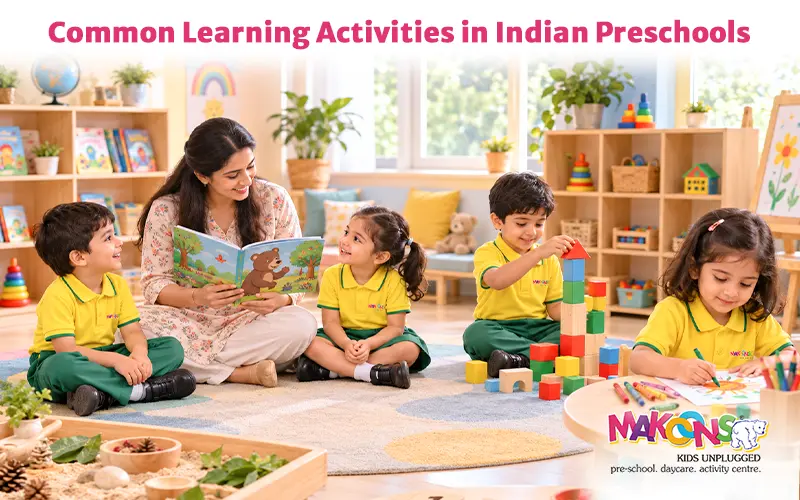
Step into a high quality preschool class, and you might find kids painting, towering with blocks, listening to a story, singing a rhyme or just playing in a tray of sand and water.
These activities might appear as normal play at first sight. However, for young children play is one of the most significant learning experiences.
In the foundational years, play is at the heart of learning as per the National Curriculum Framework for Foundational Stage (NCF-FS) 2022. It has inbuilt in it physical play, conversations, telling stories, shared reading, rhymes, games, toys, visual art and music, all of which are mediums for engaging learning experiences.
The Aadharshila – National Curriculum for Early Childhood Care and Education, 2024, also advocates for children (aged 3-6) learning through play and in an age-appropriate manner. It offers lesson plans based on competency and approximately 150 activities for each developmental domain.
This does not imply that preschool learning activities are merely to "entertain children. They can be used to enhance language, early mathematics, physical development, creativity, social skills, emotional development and independence, if properly planned.
Why Are Learning Activities Important In Preschool?
Children have different learning styles to older pupils. They require opportunities to touch, move, talk, experiment and interact with people and objects in their environment.
Multi-skill learning is possible in a single activity.
During, for instance, children can be building a tower with blocks, they may be:
Counting blocks
Comparing sizes
Developing hand-eye coordination
Understanding balance
Solving problems
Talking to classmates
Taking turns
Using their imagination
The NCF-FS also flags the importance of children's developmental rates. Learning outcomes ought to be seen instead as developmental "milestones" or a continuum, not as "ages 4-5" and "ages 6-7" etc. and "should have achieved" benchmarks.
That's why fostering good learning activities for preschoolers is flexible and developmentally appropriate.
1. Storytelling And Picture-Book Activities
One of the most frequent and useful classroom activities for preschool is storytelling.
The teacher can read a picture book, retell a short story with puppets or simple props to make the story more interesting.
Following the story, the children may be asked:
Who or what were the people or things in the story?
What happened first?
What happened next?
What was the character's reaction?
How would you have reacted?
Can you come up with another ending?
What children learn
Storytelling can encourage:
Vocabulary development
Listening
Comprehension
Memory
Imagination
Communication
Emotional understanding
Children may also be requested to retell a story or put picture cards in order.
Transforms a story into a language, memory and reasoning game.
2. Rhymes, Songs And Action Songs
Many Indian preschool classes have songs and rhymes as an integral part of their daily activities.
Children may sing canonic songs about:
Numbers
Alphabets
Animals
Fruits
Body parts
Seasons
Family
Colours
Action songs give movement to the experience. Children can clap, jump, turn, march or mimic various movements.
What children develop
These early learning activities can be used to assist:
Listening skills
Vocabulary
Memory
Rhythm
Coordination
Body awareness
Confidence
Group participation
In early learning, repetition is especially beneficial because the children can see the same words and concepts in a fun way multiple times.
3. Counting And Number Games
There is no need to start early mathematics with pages and pages of sums.
Counting can be introduced to young children in the preschool setting with the help of objects children can see and touch.
For example:
Counting blocks
Counting steps
Counting numbers in a set
Correlating numbers with items
Counting fruits
Identifying ‘more’ and ‘less’
Creating sets of objects
A teacher could place 5 toy animals on the floor and have the children count them.
One animal can then be taken away:
"How many are left now?"
A child is starting to learn about quantity by experience, not by memorising a number.
4. Sorting And Matching Activities
Another easy yet useful preschool activity is sorting.
Children are able to sort objects by:
Colour
Shape
Size
Texture
Type
Quantity
For example:
"Put all the red blocks here and all the blue blocks there."
In the event that kids comprehend the basic notion, the teacher can make the work more challenging:
"Can you find all the small red blocks?"
Skills developed
Sorting and matching can promote:
Observation
Classification
Comparison
Logical thinking
Early mathematical reasoning
Vocabulary
The activities may also be done with inexpensive materials like bottle caps, leaves, paper shapes or household materials.
5. Shape And Pattern Activities
With the help of games and common items, children in preschool can learn about the basic shapes.
Common shapes include:
Circle
Square
Triangle
Rectangle
Children can be encouraged to look around the classroom for shapes that they can find.
For example:
A clock can look like a circle.
A book can have a rectangular shape.
The faces of some blocks might be square.
Simple sequences can be used as a starting point for pattern activities:
Red – Blue – Red – Blue – ?
Children attempt to guess what they think will happen next.
This helps develop:
Observation
Memory
Sequencing
Prediction
Early mathematical thinking
6. Drawing And Colouring
Drawing is not just a craft activity!
It is a means of visually communicating ideas to children.
A teacher may ask:
"Draw your family."
Or:
"Draw something you saw in the garden."
This may not have a single correct answer.
Children are able to choose what they draw, where to put objects and which colours to use.
Drawing and colouring may contribute to:
Fine motor control
Hand-eye coordination
Creativity
Colour recognition
Concentration
Self-expression
For young kids, the act can be more rewarding than drawing a fine, completed painting.
7. Painting And Finger Painting
Painting is among the most enjoyable fun activities for preschool children.
Children are able to try out:
Paintbrushes
Fingers
Sponges
Leaves
Simple stamps
Paper comes in many varieties.
Colour mixing could also be introduced to the teachers.
For example:
"What do you think will happen when we mix these two colours?"
Children get an opportunity to make a prediction and then observe the result.
Learning benefits
Painting can encourage:
Creativity
Sensory exploration
Fine motor development
Colour awareness
Observation
Self-expression
8. Clay And Dough Activities
Children use their hands and fingers a great deal so clay modelling is very effective.
They can:
Roll clay
Press it
Pinch it
Flatten it
Make balls
Create animals
Make fruits
Build simple objects
NCF-FS explicitly mentions Clay activities in this regard to develop motor skills and imagination.
Clay can be used in conjunction with language instruction in the classroom.
For example:
"Make your favourite fruit."
Then ask:
What type of fruit did you create?
What colour is it?
Is it big or small?
Have you ever had it before?
One activity can then incorporate art, motor skills, vocabulary and conversation.
9. Building Blocks And Construction Play
Blocks are a simple, yet powerful learning tool.
Children can build:
Towers
Houses
Bridges
Roads
Garages
Castles
They are learning about balance, size, shape and position and space when they are constructing.
What children learn
Block play can develop into:
Spatial awareness
Problem-solving
Fine motor skills
Planning
Creativity
Early mathematical thinking
Cooperation
Children also need to communicate and negotiate with each other when working collaboratively.
For example:
"You build the house and I will make the road."
This is social learning by itself without the external intervention of the teacher.
10. Pretend Play And Role-Play
Pretend play enables children to recreate situations that they are familiar with from everyday life.
A classroom can be:
A grocery shop
A doctor's clinic
A restaurant
A bus station
A kitchen
A post office
The child plays the role of shopkeeper and speaks with another child who is playing the role of customer.
They may use make believe money, count and choose what to purchase.
What does pretend play develop?
Communication
Vocabulary
Imagination
Social interaction
Turn-taking
Problem-solving
An understanding of everyday life
Pretend play is also an opportunity for teachers to gain insight into children's social and communication skills.
11. Music And Movement Activities
Children are given opportunities to learn through whole body movement and music.
Common activities include:
Freeze dance
Marching
Rhythm clapping
Action songs
Moving like animals
Following a leader
Simple musical instruments
A teacher could say:
"Can you walk like an elephant?"
Then children repeat the movement.
This can develop:
Coordination
Listening
Body awareness
Rhythm
Balance
Imagination
Music, dance, story telling, drama and play are recognised as valuable means of foundational-stage learning in the NCF-FS.
12. Outdoor Games And Physical Activities
Preschool children require frequent opportunities to be physically active.
Activities in the outdoor preschool classroom may consist of:
Running
Jumping
Hopping
Balancing
Throwing
Catching
Ball games
Simple obstacle courses
Follow-the-leader games
Children practise gross motor skills in these activities.
Teachers can also add the following concepts:
Fast and slow
Near and far
Up and down
Inside and outside
Before and after
Exercise then can help to nurture both physical and intellectual development.
NCF-FS emphasizes the importance of physical activity, coordination, healthy habits, hygiene and safety awareness in the foundational stage of development.
13. Nature Walks And Observation Activities
Children do not have to be within the school's walls for them to learn.
Walking around the school can be a great learning opportunity.
Children can observe:
Leaves
Flowers
Trees
Birds
Insects
Clouds
Stones
Different textures
Teachers can ask:
“What observations do you make?”
“Which Leaf is Larger?”
"Can you find something that is yellow?"
This will help children to make observations, comparisons and descriptions of what they see.
Early concepts about the environment can also be stimulated through nature activities without children having to learn and recall extensive facts.
14. Sand And Water Play
Sand and water play opportunities are rich sensory experiences.
Children can:
Fill containers
Empty containers
Pour water
Compare quantities
Make sand shapes
Dig
Build
Explore textures
NCF-FS particularly suggests the sand, clay and water areas as helpful components of the learning space. It points out activities like pouring water can promote coordination and attention and water play can also help bring in early measurement ideas.
These activities should be supervised and carried out safely and hygienically of course.
15. Puppet Shows And Puppet-Making
Puppets can be used to make stories more interactive.
Teachers can use:
Finger puppets
Hand puppets
Paper puppets
Simple homemade puppets
Children can create their own puppets using paper, as well as safe craft materials.
In the framework of the foundational stage of NCERT, puppetry has been included as a hands-on activity which is a blend of art, storytelling, music, performance and group work.
Children can develop:
Creativity
Communication
Storytelling
Fine motor skills
Confidence
Imagination
Cooperation
A puppet can also help a shy child to join in a conversation more easily.
16. Simple Science And Exploration Activities
The starting point for preschool science should not be anything complicated, it should be curiosity.
Here are some examples of simple experiments that teachers can do:
Sink or float
Children make predictions about whether objects will sink or float.
Colour mixing
Children observe what happens when colours are combined.
Growing a seed
Children watch seeds change over a number of days.
Melting ice
Children observe what happens to ice as it becomes warmer.
The teacher may ask:
What will happen in your opinion?
Why do you think so?
What changed?
What did you notice?
This is an introduction to early scientific practices of observing, predicting and discussing.
17. Puzzles And Matching Games
Puzzles stimulate children's careful observation, problem solving and experimentation.
Puzzles that involve: may be used in preschools.
Animals
Fruits
Vehicles
Shapes
Numbers
Alphabets
Body parts
Everyday objects
Matching games can also include matching pictures, objects, letters or numbers.
For example:
Number 4 → Four objects
This assists children to link abstract symbols to quantities.
18. Festival And Cultural Activities
Festivals and national events are often used in Indian preschools for age-inappropriate activities.
Children will attend:
Rangoli activities
Diwali crafts
Janmashtami-themed art
Onam flower activities
Independence Day crafts
Republic Day activities
Christmas decorations
Story and craft ideas about Eid.
The aim should not be to get children to memorize a lot of information, but to involve them in the culture and make them participants.
Learning can be meaningful when local stories, songs, games, traditions are used to enhance what children are learning in the classroom and can be related to their surroundings.
19. Body Awareness And Action Games
The simple moving games may assist children to learn about their bodies while learning to listen to others.
A teacher may say, for instance:
Touch your nose.
Raise both hands.
Touch your knees.
Jump three times.
Turn around.
Stand on one foot.
These simple instructions take a combination of:
Listening
Vocabulary
Body awareness
Coordination
Balance
Following directions
The activity can become increasingly difficult as children get more comfortable.
20. Daily Routine Activities
Some of the best things that can happen to children in the early years may not be "lessons" at all.
Children learn while:
Washing their hands
Keeping toys away
Arranging their belongings
When the lunch boxes were opened,
Taking turns
Mopping up up after an activity
Greeting classmates
Getting ready to leave the hospital
These routines encourage:
Independence
Responsibility
Self-care
Social skills
Following instructions
Understanding sequences
Everyday developmental learning such as health and wellbeing, hygiene, safety and self-help skills, is recognised as part of the foundational stage in the NCF-FS.
Read More: 10 Fun Art Activities at Makoons Preschool for Kids
Low-Cost Preschool Activities Using Everyday Materials
A good preschool doesn't have to have costly learning toys for each activity.
Useful learning experiences can be created by teachers with the help of:
Cardboard boxes
Paper
Leaves
Sticks
Bottle caps
Empty containers
Old newspapers
Cloth pieces
Reusable packaging
Clay
Children can also be encouraged to develop and utilize their own learning materials in this way.
The Ministry of Women and Child Development has available ECCE resources which include activity calendars and activity compendiums and guidance on play-based learning and the wider programme has encouraged play with DIY toys and community involvement.
The value of the activity in turn rests less on the cost of the materials and more on the planning and facilitation of the activity.
What Makes A Good Preschool Activity?
Not all games and crafts are meaningful learning activities.
A well planned activity should, ideally be:
Age-appropriate
Safe
Interactive
Engaging
Similar to hearing it in the first person.
Suitable for various abilities
Linking to a developmental aim
Open to exploration
Fun but not so distracting
It is also important for teachers to not expect all children to do an activity in the same manner.
A child can construct a tower using 3 blocks, another can construct a tower using 10 blocks. Both could be learning.
The NCF-FS also highlights that children's developmental progress does not take place at a uniform pace and learning outcomes should be viewed as a continuum.
The Role Of The Teacher In Activity-Based Learning
The role of a teacher is not to show an activity and give them directions.
One or more of the following may be part of good facilitation:
Creating an adequate setting
Observing children's play
Asking open-ended questions
To allow for hints rather than answers:
Asking children to share ideas and thoughts
Helping children cooperate
Modifying activities as needed
Relating activities to children's experiences
For instance, say:
"This is a triangle."
The teacher may ask:
"Can you find something in the room that has a similar shape?"
That slight alteration stimulates observation and thinking.
The NCF-FS differentiates between free play and guided play, and emphasizes that guided play enables teachers to scaffold children's learning in a way that is gentle and still child-directed.
Final Thoughts
The best preschool learning activities don't have to be the most expensive and fancy.
With thoughtful use, a story book, some blocks, some clay, a few leaves or a simple song can make a valuable learning experience.
The current Indian children's approaches to early childhood education are definitely in the direction of activity-based, play-based and holistic learning. Aadharshila, for instance, offers a systematic compilation of activities for children in the age group 3-6, organized by various developmental domains; the NCF-FS, on the other hand, emphasizes the role of play for children in the foundational domain.
A preschool activity is, then, not really just an activity to keep children entertained or to fill their time, or to make a 'finished worksheet'.
It should provide opportunities for children to:
Explore
Ask questions
Communicate
Move
Create
Solve problems
Work with others
Make choices
Discover something new
Such experiences repeated in a safe, supportive environment is a strong building block for lifelong learning.
Frequently Asked Questions
1. What are the most common learning activities in Indian preschools?
These activities range from storytelling, rhymes and songs, drawing and painting, clay modelling, counting games, sorting, puzzles, block play, play with make believe, outdoor games, nature walks, music and movement, simple experiments and festival-related crafts.
2. Why are play-based activities important for preschool children?
Young children learn best when they can do these things: actively participate, explore and interact. India's NCF-FS centers around play for foundational learning, engaging stories, play and games, music, art, conversations, and physical play.
3. What skills do preschool activities develop?
Children may acquire language, early literacy, numeracy, fine and gross motor skills, creativity, problem-solving, social interaction, emotional awareness, observation and independence skills, depending on the activity.
4. Do preschool activities require expensive toys?
No. Paper, cardboard, leaves, bottle caps, clay, blocks and other common materials can be used for many effective activities. In India, there are also ECCE resources that are based on activities and DIY for early learning.
5. How can parents support preschool learning at home?
Parents may read books, count objects in daily life, sort toys, let children draw, sing songs with them, go outdoors and let children participate in simple household chores. These can be reinforcing without turning home into another classroom.
6. How should preschool activities be adapted for different children?
Teachers need to take into account children's age, interests, capacity and developmental rate. Activities may be adapted, modified or simplified depending on the child. The NCF-FS highlights that children do not develop at the same pace.
Read More: 20 Fun & Easy Craft Activities for Preschoolers
