
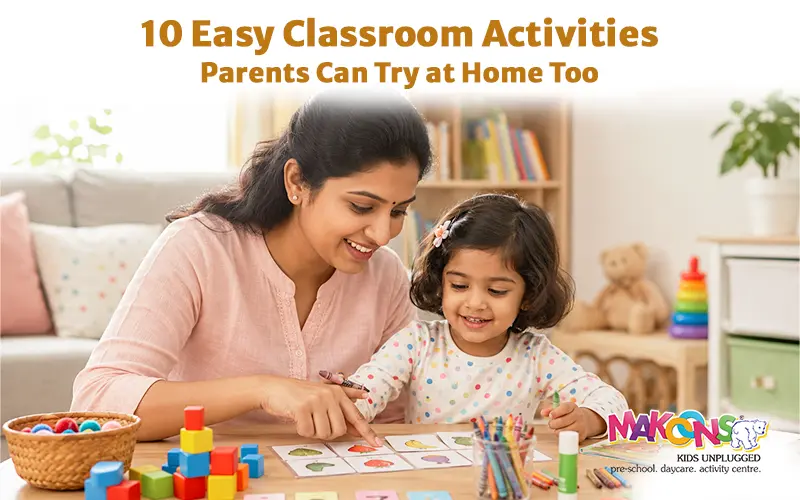
Learning is best when learning is play. But, classrooms help foster creativity and curiosity, and parents can do the same at home. Fun with family and helpful thinking, communication, creativity and problem solving skills can be developed through simple activities in the classroom.
Great thing is that you don't have to get a big play area and learning materials. Common household products can be outstanding learning tools. With this guide, you'll find 10 fun and simple classroom learning activities that you can do at home to support your children to make learning fun and meaningful.
The Value of Classroom Activities
Hands-on learning is essential for many important skills for children. These youngster learning exercises boost:
Language and communication skills;
Memory and concentration
Creativity and imagination
Fine and gross motor skills
Children's social and emotional development.
Develop problem-solving and critical thinking skills.
From preschool to early elementary school, these learning activities can help your child learn the best way to “have fun” learning each day.
1. Alphabet Treasure Hunt
Make letter learning FUN!
What You'll Need
- Paper and marker
- Household objects
How to Play:
On a piece of paper write 1 letter and ask your child to find things around the house that start with this letter. If it is B, then they may find a bottle, book or ball.
Skills Developed:
- Letter recognition
- Vocabulary building
- Observation skills
2. Color Sorting Game
One of the simplest pre-school activities for little ones.
What You'll Need
- Building blocks
- Toys
- Buttons
- Colored paper
How to Play:
Have your child arrange objects by color. When they have finished, tally the numbers in each group together.
Skills Developed:
- Color recognition
- Counting
- Sorting and classification
3. Story Circle
Storytelling fosters imagination and confidence.
How to Play:
Use a first sentence such as:
There was a little rabbit who enjoyed adventures.
Have your child say the next sentence. Continue alternating turns until you have a story.
Skills Developed:
- Creativity
- Speaking skills
- Listening skills
4. Identifying Shapes – Around the House
Children explore their environment while learning shapes and it is so lot more enjoyable.
How to Play:
Have your child look for things that are shaped like:
- Circle
- Square
- Rectangle
- Triangle
For instance, a clock is a circle and a window could be a rectangle.
Skills Developed:
- Shape recognition
- Observation
- Vocabulary
5. DIY Number Hop
The activity incorporates learning and movement.
What You'll Need:
- Masking tape
- Paper with numbers
How to Play:
Place numbers on the floor. Summon a number and your child runs to that number. Simple math questions can also be asked such as:
"What is 2 + 3?"
You child hops to number 5.Your child jumps to the number 5.
Skills Developed:
- Number recognition
- Basic math
- Physical coordination
6. Sink or Float Science Activity
Simple science experiments are favourite among the youngsters.
What You'll Need:
- Bowl of water
- Spoon
- Leaf
- Toy
- Coin
- Plastic lid
How to Play:
Have your child predict if each object will float or sink before dropping it in the water.
Discuss how some objects sink and some float.
Skills Developed:
- Scientific thinking
- Observation
- Prediction skills
7. Memory Matching Game
A popular fun classroom game.
What You'll Need:
- Homemade picture cards
- Alphabet cards
- Number cards
How to Play:
All cards should be face down. Players alternate in flipping two cards at a time. If they are alike, keep them. Otherwise, flip them over.
Skills Developed:
- Memory
- Concentration
- Visual recognition
8. Follow the Leader
This is an active game that helps to build listening skills while keeping kids active.
How to Play:
One person assumes the role of leader and carries out basic movements like:
- Clap hands
- Jump
- Spin
- Hop
- Stretch
All others mimic the actions.
Skills Developed:
- Listening
- Coordination
- Motor skills
9. Building Challenge - Make a paper cup structure.
Make paper cups into an interesting learning experience
What You'll Need:
Paper cups
How to Play
See if you can get your child to create a stack as high as they can using only paper cups. Challenge them to try out various designs.
Skills Developed:
- Creativity
- Problem-solving
- Hand-eye coordination
10. Nature Art Activity
Take learning back to nature.
What You'll Need:
- Leaves
- Flowers
- Twigs
- Glue
- Paper
How to Play:
Gather artifacts on a nature walk and use them to make animals, trees or other colorful artwork.
Discuss the colors and feel of the various plants and textures as they make.
Skills Developed:
- Creativity
- Observation
- Appreciation for nature
Tips for Parents
Here are a few easy suggestions to make learning even more enjoyable at home:
Limit activities to short and fun.
Encourage your child to work hard rather than to achieve the correct outcome.
Allow your child to ask questions.
Let kids play and be creative.
Select age- and interest-appropriate activities.
Keep in mind, learning doesn't have to be book and worksheet related. Learning opportunities can be seen all around us.
The Benefits of Classroom Activities at Home
There are numerous advantages of trying classroom activities at home with children. Children are more confident, curious and independent learners. Parents are also able to spend quality time with their children and to know how their children learn best.
Kids also get encouraged to participate in the many activities that take place inside the house on a regular basis, which promotes reduced screen time. From storytelling to science experiments to building challenges, all activities provide valuable life skills in a playful manner.
Conclusion
Learning is not confined to the classroom. Simple, affordable, and fun activities for parents to do at home that can be done in the classroom. Each activity is a fun way to help kids learn, whether it's a creative art project or exciting science experiments or fun classroom games.
These learning activities for children can be integrated into the everyday life of your family to develop your child's confidence, creativity, and enthusiasm for learning. Any 15-20 minutes spent on learning activities a day can be significant to your child's growth and development.
Frequently Asked Questions
1. What do you mean by classroom activities?
Classroom activities are fun games/tasks to help children develop skills such as reading, counting, speaking and problem solving.
2. Are there opportunities to do classroom activities at home?
Yes. There are lots of activities to be conducted in the classroom that can also be done at home with everyday household items, paper, crayons, toys, and books.
3. Why are learning activities important for kids?
Learning activities enable the children to develop confidence, creativity, thinking skills and make learning more fun.
4. What should preschoolers do in school?
The alphabet games, colour sorting games, storytelling, shape hunts, and memory games are ideal for preschoolers.
5. What is the recommended amount of learning time for children every day?
Fun learning activities, approximately 15-20 minutes daily, will keep young children engaged and learning new skills.
Other Blog Topics To Explore:
How Mobile Phones Affect Children & What Parents Can Do
