
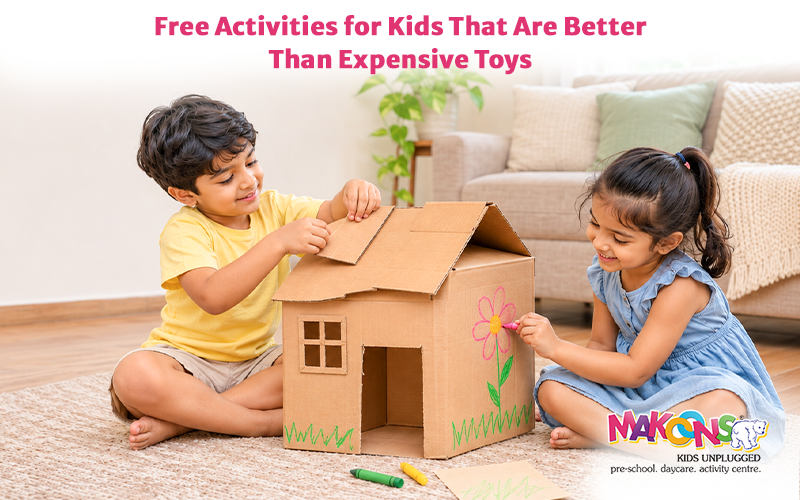
Parents think that their children need expensive toys for educational purposes and entertainment. This belief does not hold true in every situation. Children can develop their creativity and thinking skills and confidence through inexpensive toys. Home-based activities which require minimal resources prove to be effective learning tools for children.
The home offers multiple free educational activities to engage children in enjoyable learning experiences. Parents can save money through these activities. The activities enable children to learn by using their imagination and through their daily life experiences.
This article explains several low cost learning activities that children enjoy. These activities are simple, effective, and easy to do at home.
Why Free Activities Are Better for Kids?
Expensive toys usually have fixed ways to play. Many toys come with buttons, sounds, and instructions. Children often use them the same way every time. This limits creativity.
On the other hand, budget friendly kids activities allow children to explore and imagine. They can create their own games. They can use simple objects in many ways.
Free activities also help children develop:
Problem solving skills
Creativity
Communication
Social skills
Confidence
Another benefit is that these activities without spending money often involve parents or siblings. This improves family bonding.
1. Story Creation Game
Start a story with one sentence, like this: Once there was a small rabbit in a big forest.
The child can continue the story by adding one sentence of their own.
Robots, animals and superheroes can make the story funnier.
Benefits of this activity:
Improves vocabulary
Builds imagination
Encourages communication
This is one of the easiest home activities for preschoolers.
2. Treasure Hunt at Home
Children love searching for hidden objects. A treasure hunt is a great activity that costs nothing.
Hide small household items around the house. For example:
Spoon
Toy car
Pencil
Ball
Give simple clues to help children find them.
Example clues:
“Look near something cold.” (fridge)
“Look where we wash hands.” (sink)
This activity improves observation and thinking skills. It is also one of the most exciting free kids activities at home.
3. Drawing and Coloring
Children naturally enjoy drawing. All you need is paper and a pencil.
Ask children to draw:
Their family
Their favorite animal
A park
Their dream house
You can also create drawing challenges like “draw something that flies”.
This activity supports learning without expensive toys because it develops creativity and focus.
Parents can also discuss the drawing with the child. Ask questions like:
Who is in the picture?
What is happening here?
This builds communication skills.
4. Sorting Household Objects
Sorting is one of the best low cost learning activities for young children.
Collect simple objects from around the house such as:
Buttons
Coins
Leaves
Bottle caps
Ask children to sort them by:
Color
Size
Shape
For example, separate big buttons and small buttons.
This activity teaches early math concepts. It also improves observation skills.
These home activities for preschoolers are simple but very effective for learning.
5. Nature Walk and Observation
Take children outside for a short walk. It could be in a park, garden, or even around the neighborhood.
Ask them to observe things like:
Birds
Trees
Flowers
Ants
Clouds
You can also ask questions such as:
What color is that flower?
How many birds do you see?
What shape is that cloud?
Nature walks are wonderful budget friendly kids activities. They encourage curiosity and awareness of the environment.
Children learn many things through real experiences.
Also Read: 10 Open-Ended Activities That Encourage Creativity And Problem-Solving In Kids
6. Building with Household Items
Instead of buying building toys, children can use simple household items.
Examples include:
Empty boxes
Plastic cups
Cardboard
Paper rolls
Ask children to build towers, houses, or bridges.
They can also create small cities or imaginary buildings.
This activity supports learning without expensive toys because children must think and plan while building.
It improves problem solving and creativity.
7. Music and Dance Time
Music is another great way to keep children active.
Play any song and let children dance freely. You can also create fun games like:
Freeze dance (stop dancing when music stops)
Copy the dance move
Children can also make simple musical instruments using household objects like:
Steel bowls as drums
Spoons as rhythm sticks
These are fun activities without spending money that improve coordination and energy.
8. Simple Science Experiments
Children enjoy small experiments. Many can be done using basic kitchen items.
Example experiments:
Sink or Float Game
Fill a bowl with water. Ask children to guess which objects will sink or float.
Test objects like:
Stone
Leaf
Coin
Plastic spoon
Another idea is mixing colors using water and food coloring.
These free educational games for kids teach basic science in a fun way.
9. Role Play Games
Role playing helps children understand real life situations.
Ask children to pretend to be:
A teacher
A doctor
A shopkeeper
A chef
You can also join the game.
For example, create a small pretend shop using household items. Children can “sell” fruits or toys.
Role play improves confidence, communication, and imagination. It is one of the best free kids activities at home.
Also Read: Simple Home Activities That Help Kids Learn
10. Memory Games
Memory games help children improve focus and attention.
Place 5–6 small objects on a table. Let the child look at them for 30 seconds.
Then cover the objects with a cloth and ask the child to name what they remember.
You can slowly increase the number of objects.
This is one of the easiest low cost learning activities and requires no special materials.
Tips for Parents
Here are a few simple tips to make these activities more effective:
Allow children to explore freely.
Do not focus too much on perfection.
Encourage creativity and ideas.
Spend time playing together.
Keep activities short and fun.
The goal is learning through play. Children learn best when they enjoy the activity.
Conclusion
Children do not need expensive toys to learn and grow. Many simple and meaningful activities can be done at home without spending money.
Free home activities enable children to develop their creative and cognitive abilities while building their self-confidence. Family members use these activities to create precious time together.
Parents can easily include these budget friendly kids activities in daily routines. People can transform their houses into effective educational environments through creative methods.
Children remember their experiences more than their toys. People will find learning more enjoyable when they spend time together while studying basic concepts.
FAQs
1. What are some easy free kids activities at home?
Simple activities for example involves; storytelling, drawing, treasure hunting, object sorting, and memory games, that are both entertaining and enlightening for the child.
2. How do free activities help children learn?
Children develop their creative abilities and imaginative skills while solving problems through free activities. The activities enable children to learn through authentic experiences which extend beyond the limitations of standard toy instructions.
3. Are home activities for preschoolers effective for learning?
Yes. Various household activities that parents do with their preschoolers help their children develop essential skills which include counting and language skills and observational abilities.
4. What are some activities without spending money for kids?
Some examples could be nature-walking, role-play games, dancing, drawing, constructing structures with household items.
5. Why is learning without expensive toys beneficial?
Learning without expensive toys encourages children to think creatively and use imagination. It also helps parents save money.
6. How often should parents do learning activities with kids?
Parents can include short low cost learning activities every day. Even 15–30 minutes of play based learning can support child development.
