
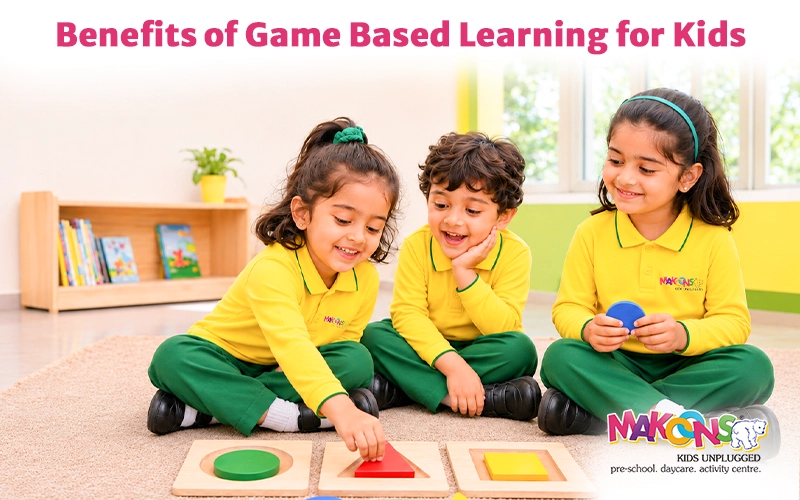
Children learn best when they are interested, involved and challenged to learn. Children can learn important skills without being instructed to learn them, through play activity such as solving puzzles, matching shapes, playing number games and pretend play activities.
This is where game based learning comes in handy. It is the combination of learning goals and playing goals which will help children practise new goals, utilize their problem solving skills to make decisions and learn from what has occurred.
Educational games can improve the learning process by engaging and meaningful learning for parents and teachers, especially for pre-school children. When played intelligently, games can aid in the development of cognitive abilities, communication skills, creativity and social skills, and can help to build a positive attitude toward learning.
What is Game-Based Learning?
Game Based Learning is an educational process that employs games for children to learn concepts, practice skills or meet learning goals. Children are not only provided with information to learn, they are also involved in thought-provoking activities exploring, experimenting and making choices.
These games may be software or non-software based. These may be board games, puzzles, storytelling games, movement games, role play games, construction games and interactive learning apps.
For example, counting can be taught using coloured blocks by the preschool teacher. Children will be able to count the blocks, organise the blocks by colour, compare amounts and create basic patterns. This activity is both fun and addresses early mathematical ideas.
Game-based learning doesn't mean screen based learning. The learning opportunities using everyday resources and physical activity is very effective as is conversation and interaction with other children.
7 Important Benefits Of Game-Based Learning For Kids
The learning activities provided by game support several areas of child development when the activity is age-appropriate, purposeful and supported by adults.
1.Improves Cognitive Development And Problem-Solving
Children make observations, comparisons, predictions and decisions about games. The experiences enable them to develop significant thinking skills.
There are some cognitive benefits, such as:
Developing logical thinking and reasoning skills.
To practise memory and attention.
Recognising patterns and relationships.
Developing alternative strategies to problem solving.
2.Makes Learning More Engaging
Repetitive activities without interaction could be challenging for young children. Games make things interesting, challenging, choice and engaging.
Instead of children stating the numbers, a teacher could provide them with an object hunt that they can perform and count the amount of objects that they find.
This way can assist children to:
Increase their involvement in lessons.
Maintain children's interest in learning activities.
Discover new ideas with inquiry.
Be motivated to do a challenge.
Develop a more positive attitude towards learning.
3.Develops Language and Communication Skills
There are many educational games that get children to listen closely, follow directions, describe, question or discuss others.
New words may be introduced in familiar contexts, using word games, story, picture cards and role play.
Useful examples include:
Identify objects during a picture matching game.
Creating animal sounds and describing the animals.
Creating a story using picture cards.
Role-playing game: Customer and shopkeeper role.
4.Promotes Social Skills and Co-Operation
Children are given opportunities to take turns, listen and share when playing together and learn to work towards a shared goal.
Children may participate in a group building game in which they can build a tower with blocks. They must select which pieces to work with, describe their concept and respond to the fall.
The benefits of Game-based learning to a society may include:
Importance of turn taking and sharing.
Hearing others' perspectives.
Collaborating to find a solution.
Understanding simple rules.
Having tolerance and being kind to others.
Children also learn that others can have other ideas and approaches. Games can be helpful to practise respectful interaction if they are guided by adults.
5. Builds Emotional Regulation and Resilience
Not all of the games are successful. A child may also not be able to take a turn, or not complete a puzzle the first time or take more attempts to complete a challenge.
Children can learn how to be disappointed; how to seek help and go back to the start during these experiences.
Encourage emotional development in adults through:
Praising effort in addition to getting right answers.
Supporting children to label their emotions.
Demonstrating to them how to respond to errors in a cool way.
Coaching them towards alternative strategies.
Reminding them that it takes practice to learn.
It is not the objective to remove all obstacles.
6.Supports Creativity and Imagination
Games provide opportunities for kids to develop ideas, story and suggest solutions and test out ideas.
Pretend play is a very special tool as children are able to create new experiences using ones they know!
A pretend grocery store, for instance, would enable children to put things together in a grocery store, make a list to buy things, find items, and play the part of a customer or a shopkeeper.
There are other creative activities such as:
Using blocks to make structures.
Designing imaginary animals.
Working with picture cards to make stories.
Using objects of colour to make patterns.
Re-enacting familiar stories or situations.
These activities enable children to talk and try out alternative ways of solving a problem.
7. Enhances Early Maths Skills and Early Literacy Skills
Academic experiences can be introduced in a non-formal context using an educational game.
Number Games help children learn to count, compare quantities, identify patterns and simple relationships. Early literacy introduced in activities: Letter Games and Sound Matching.
Examples include:
Corresponding numbers to sets of objects.
Sorting shapes according to colour or size.
Recognising the initial sound in common words.
Correspondence of letters with pictures.
Creating a story using picture cards.
Findings show that guided play can have a positive effect on specific learning outcomes in particular, early maths and shape knowledge. Another systematic review published in 2022 examined the effect of guided play on children's development and found that the effect of guided play is dependent on the learning outcome and activity design.
How Can Parents and Teachers Make Game-Based Learning Effective?
Here are some useful tips:
1. Set a learning objective. Determine if activity will be used to practice counting, language, coordination and/or social interaction.
2. Choose age-appropriate games. Activities should be 'not too hard, not too easy' and not be frustrating.
3. Promote independent thinking of the children. Give hints and ask questions – don't tell all.
4. Allow children to learn from their mistakes. Remind them to think of other ways of doing it and to describe its results.
5. Facilitate balancing of guided and free play. Children also require the opportunity to explore on their own, engage their imagination and make their own decisions about their activities.
6. Adjust activities as necessary. Use visual cues, instructions that are easier to understand, extra time, change materials as necessary.
7. Observe progress. If children are becoming confident, if there is more communication or if a concept is used in a different context, be aware of this.
Is Digital Game-Based Learning Good For Children?
Online games for kids can provide the kids with various different kinds of interactive components such as sound, images, puzzles and instant feedback. However not all Apps which claim to be educational are effective.
When evaluating digital learning tools, the National Association for the Education of Young Children recognizes the following traits as key for digital tools that are active, meaningful, engaging, and socially interactive:
The following should be taken into account by parents and educators:
Choose games that have Learning Objectives.
No commercials, add age-appropriate content.
Play with the child, if possible and explain to him.
Digital games are designed to complement these experiences, and cannot replace them.
Conclusion
Games in learning can stimulate children's interest in learning and learning through games can give children practice in thinking, communicating, creating, cooperating and regulating emotions.
Children can join in with experiences that encourage their curiosity and give them skills through some simple counting games, challenges to build, and deliberately chosen digital experiences, such as stories.
The best way is to get some purposeful activities going with a bit of encouragement, a little challenge and opportunity for the children to explore on their own. It doesn't need special equipment for parents and teachers to take the initiative. A few things, a picture book or a simple game which makes a meaningful learning episode is nothing more satisfying.
Finally, the games are helpful for teaching children that learning can occur outside of the book/worksheet setting.
Frequently Asked Questions
1. What do you mean by ‘game-based learning in ECE’?
Game Based Learning is an educational method which applies game and play-based learning activities to students in teaching a specific skill or concept. Children will learn through Puzzles, Matching games, Storytelling, Movement and Interactive games and build up their Counting, Language, Problem Solving and Social skills. The games may be real or virtual depending on intended learning and age of the child.
2. What are the advantages of Game-based Learning?
The benefits of the game based learning approach are greater engagement, problem solving opportunities, language development, learning how to cooperate, creative learning and emotion regulation. There are also good provisions for early maths and literacy, with the use of well planned activities. This will vary depending on the child's needs, the quality of the game and adult's facilitation of learning.
3. What kind of Educational Games Can Preschoolers Play?
Some suitable games for education are: Colour hunt game, Shape hunt game, Counting games, Picture matching games, Simple puzzles game, Story telling game, Pretend shops, Alphabet games, Building challenges game. Select activities that are developmentally appropriate, interesting and able. Ordinary items can be used to provide valuable learning.
4. How does game-based learning help cognitive development?
Children develop skills of observation, memory, comparison, pattern recognition, decision making and problem solving through play. Puzzles, for instance, help develop visual reasoning, and counting games give the opportunity to learn number relationships. Children can have many opportunities to face up to challenges and thus practise the skills in a positive and enjoyable way.
5. Is game-based learning better than traditional teaching?
But, there are no rules of thumb when it comes to which is the better way to go in each circumstance. Active participation and experimentation by means of games can be useful, and direct teaching can be useful for explaining a concept, a tool or a skill. A balance of planned teaching, purposeful play, practice and opportunity for independent exploration are used.
