
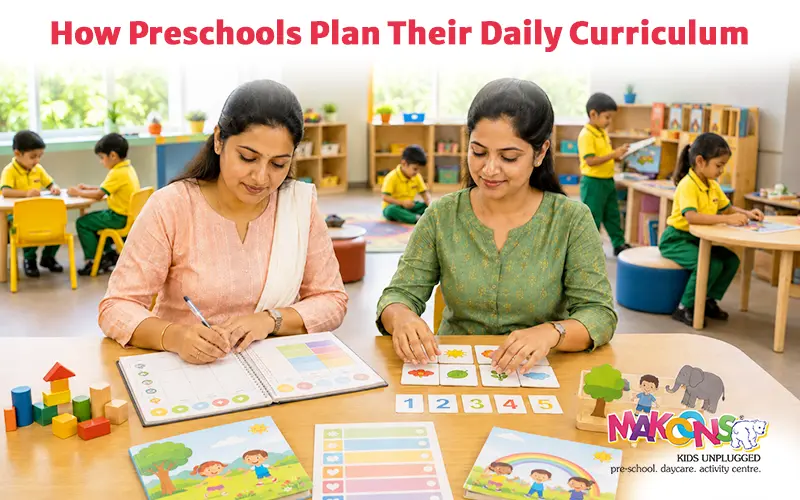
Children in a preschool might be singing songs, listening to stories to read, painting, playing with blocks, and playing outdoor games when parents visit. They seem to be enjoying themselves but all activities are planned with a purpose. Children learn new skills, they grow in confidence and they enjoy learning each day in a well planned preschool daily curriculum.
A good Preschool Curriculum isn't one that helps the children to learn to remember facts, or to fill in worksheets. Rather, it assists them to learn through play and creativity, hands-on activity and identifying the world in which they live. All activities are planned based on the age, interest and learning needs of the child, and learning is fun and meaningful.
This article will outline how preschools plan the day, what is included in a lesson plan, and why a planned and structured approach to preschool education is beneficial for all children.
What is a Preschool Daily Curriculum?
A Daily Preschool Curriculum is a plan that provides a framework for the learning and experiences that children will have during their school day. Has a balance of learning, creative, physical and social activities to help support overall development.
A quality curriculum is not just about the academic curriculum; it fosters confidence, communication, curiosity, independence and emotional resilience of the whole child.
To provide a fun and engaging learning environment with a focus on future school success.
Why is a Preschool Curriculum Important?
The early years of a child's life are a time of rapid brain development. At this point, children learn by observing and playing and participating in practical activities.
A well planned preschool curriculum will enable children to:
Develop language and communication skills.
Enhance social and emotional abilities.
Enhance creativity and imagination.
Enhance problem-solving abilities.
Develop independence and confidence.
Establish healthy habits and routines.
A good preschool routine helps children to learn discipline and helps them to feel confident, independent and curious about learning.
What Is Included in a Preschool Lesson Plan?
All teachers have a written lesson plan for the preschool which includes a plan of the day, learning objectives, teaching strategies and materials.
While each preschool may have their own method, most lesson plans will contain:
1.Circle Time
Children greet each other, sing songs, talk about the weather, the day and introduce the day's theme.
Circle time promotes communication, listening, confidence and social interactions.
2.Early Literacy Activities
Letters, sounds, vocabulary, rhymes and storytelling are introduced to teachers in an interesting manner, not in a formal way.
Preschool language development activities are designed to enable children to acquire language in a natural way.
3.Early Numeracy
Numbers are explored by a variety of counting games, sorting activities, matching games, building blocks and puzzles for children.
Children learn math by playing and it helps them understand math.
4.Creative Arts
Imagination is fostered through painting, colouring, cutting and pasting, clay modelling and craft making activities, which also develop fine motor skills.
Creative expression also enhances confidence and emotional growth.
5. Outdoor Play
For preschool, physical activity is an integral component of all daily activities. Playing outside games helps to develop balance, coordination, teamwork and general fitness.
Exploration and curiosity are further promoted by nature walks, obstacle courses, ball games and free play.
6. Storytelling and Music
Using stories, rhymes, music and dance, vocabulary, listening skills, memory, rhythm and emotional expression are enhanced.
They are fun, memorable and meaningful learning sessions.
How Teachers Plan Learning Activities for Preschool Children
It takes more than choosing games when planning preschool learning activities. Children's learning needs and aims are taken into account when planning each activity.
They ask questions such as:
What is a skill that children should learn today?
Age appropriate activity?
Will children remain engaged?
Does the activity encourage exploration?
Are there opportunities for kids to engage in things on their own?
Can it facilitate social interaction?
Careful planning ensures that all activities support a child's development and learning is fun.
The Early Childhood Curriculum’s Role
A good ECD curriculum is one that caters for holistic development and not pressure. It appreciates the importance of allowing young children to be active in their surroundings.
A balanced curriculum is used to promote a number of areas of development.
1.Cognitive Development
Puzzles, matching games, science explorations and building blocks help build memory, reasoning and problem solving skills.
2. Language Development
Vocabulary and communication are enhanced with daily conversations, storytelling, songs and interactive reading.
3. Social Development
The group activities promote sharing, co-operation, empathy, patience and team work.
4. Emotional Development
Children are supported to identify emotions, express emotions in a suitable way and have confidence in themselves, with positive feedback.
5. Physical Development
Activities like climbing, jumping, running, playing with balls etc. develop gross motor skills, and activities such as drawing, colouring, threading beads, crafts etc. develop fine motor skills.
Why Play is an Essential Part of Preschool Education?
Many parents may wonder why children play for so long. The answer is straightforward: Play is one of the most effective teaching approaches in preschool teaching.
Through play children will:
- Explore new ideas.
- Ask questions.
- Solve problems.
- Build creativity.
- Develop independence.
- Strengthen friendships.
- Improve communication.
All play activities are carefully planned with a learning aim in mind, ensuring enjoyable and effective learning.
A Typical Day at Preschool - From The Child's Point of View
While each preschool will have minor differences, a typical routine for preschool will follow the sequence of:
- Arrival and free play.
- Circle time
- Theme-based learning
- Literacy and numeracy activities
- Healthy snack break
- Outdoor play
- Creative art and craft
- Music and movement
- Storytelling
- Lunch
A period of calm, recuperation and rest.
- Group games
- Departure
This routine can help children feel secure, manage transitions and establish healthy routines.
How Preschools Make Adaptations To The Curriculum
All children are unique learners. Teachers make regular observations to inform the curriculum of children's interests, strengths and progress.
For example:
Children who require extra language support will be offered further storytelling sessions.
Interested in nature, can engage in more science-based exploration.
Age appropriate play is provided with additional challenges for advanced learners.
This is a flexible approach, enabling all children to benefit from the curriculum at their own speed.
How Parents Can Help With Learning At Home
The role of parents in reinforcing the things learnt at the preschool is very significant.
Simple activities include:
Reading together every day.
Sharing with others what has happened today.
Counting in everyday activities.
Promoting drawing and colouring.
Reciting rhymes they have learnt at school.
Offering opportunities for independent play.
Regular daily schedules.
Children are confident when home and preschool work together, and enjoy a richer learning experience.
How To Select a Preschool That Offers a Good Curriculum
A well organised preschool daily programme.
Appropriate and competent teachers.
Play-based learning opportunities.
Safe and stimulating classrooms.
Age appropriate preschool learning activities.
Regular communication with parents.
Well-balanced emphasis on academic work, creativity and physical development.
Give attention to each child.
A good preschool provides a setting in which children feel valued, encouraged and excited to learn on a daily basis.
Conclusion
A good preschool curriculum is more than just a daily timetable. It is a well-planned learning program that enhances children's intellectual, social, emotional and physical development through stimulating experiences.
Each lesson plan in the Preschool section is designed to have clearly defined learning objectives and to be flexible for exploration, creativity and play. The range of activities from circle time and story telling through to outdoor play and work-based projects are all part of a child's life development.
So, a good preschool uses an early childhood schedule and a daily routine which helps children to become confident, independent and curious about learning. Choosing a right preschool gives you the best possible academic success and helps them grow and learn things.
Frequently Asked Questions
1.What is a Daily Curriculum for a preschool?
Preschool Daily Curriculum is a plan for learning, play, creative activities, meals and routines throughout the day that will help a child to develop.
2.Why is it significant to have a lesson plan for preschool?
A preschool lesson plan assists the teacher to plan age-appropriate activities that have clear learning objectives, and to provide children with a balanced and meaningful learning experience.
3.What are preschool learning activities?
The learning activities in preschool are in the form of story telling, phonics lessons, counting games, art and craft, music, sensory play, outdoor game, puzzle and holistic development group activity.
4. What is an early childhood curriculum?
An early childhood curriculum is a learning plan that aims to develop children through play-based learning to help them in their cognitive, language, physical, social and emotional development.
Also Explore:
What is a Preschool Franchise Business in India? A Complete Beginner’s Guide
How To Increase Preschool Admissions After Opening
