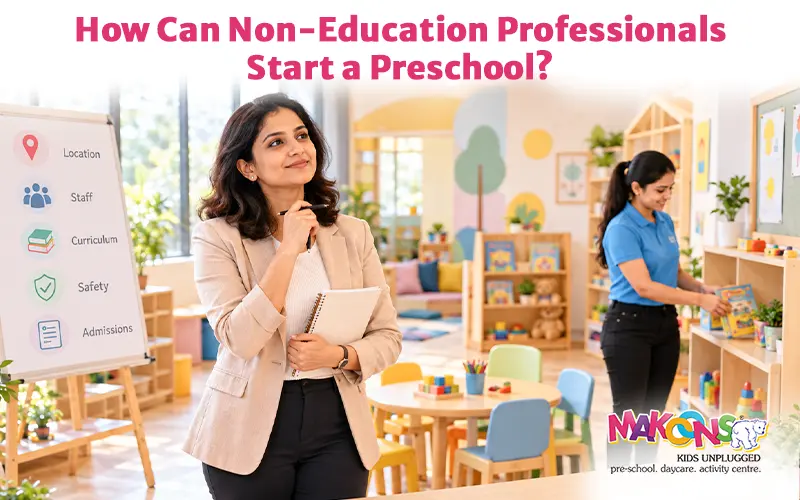
If you don't have a background in teaching or education, then opening a preschool might seem like a daunting task. You might be good at managing people, handling finances, running a business and building a local customer base, but not have the skills to design a preschool curriculum and manage a classroom of three-year-old children.
This does not mean that preschool entrepreneurship cannot be achieved.
A non-education professional can be successful running a preschool business if they are aware of a critical difference: They don't have to be the one teaching every class, rather they're responsible for creating a setting where a qualified teacher can do his or her work well.
The first eight years of life are a period of critical development and the National Curriculum Framework for the Foundational Stage of School Education in India has termed ECE as a field that covers physical, cognitive, language, social and emotional development. It also stresses play, activity and the right kinds of learning experiences rather than dealing with young children like older students.
If you're looking for a preschool business with no teaching experience, it's not just a question of, “Am I qualified to teach?”
It is:
“Can I establish and operate a safe, well-managed and competent preschool staff team and systems?”
Can You Start A Preschool Without An Education Background?
The awarding of a franchise is not always awarded to those who have a previous teaching career. But, the needs differ from brand to brand as well as location to location so they ought to be checked prior to signing an agreement.
For instance, according to Makoons' website, There's no specific education requirement for Makoons' franchise partners; and support includes curriculum, teacher training, operations, marketing and admissions.
This is not to say that education experience is not important.
Ideally, a team should consist of a non-education professional and the following:
High quality and trained preschool teachers
A centre or academic coordinator or the equivalent.
Support staff
Admin support as needed
Utilise external experts if there is a need for specialist advice.
Your responsibilities as owner can be more in business management and in human resources, finances, parent relationships, operations, admissions, and quality management.
Why a Preschool Franchise Can Help Beginners?
Starting out alone, one will need to construct the majority of the components from scratch:
Curriculum
Teaching methodology
Classroom resources
Brand identity
Admission processes
Teacher-training systems
Marketing materials
Parent communication systems
Operational procedures
Safety protocols
For an education entrepreneur who has not had the experience before, that can be a big curve to learn.
Instead, a preschool franchise for beginners can offer an existing structure.
The support provided may vary by franchisor and may involve:
Curriculum and teaching resources
Teacher training
Preschool setup guidance
Branding
Marketing assistance
Admissions support
Operational manuals
Site-selection guidance
Staff-recruitment assistance
Ongoing academic support
For instance, at present Makoons offers support including site evaluation, infrastructure design, legal documentation, curriculum, training, marketing, admissions and operations.
Franchise support must not, however, be seen as a sure path to success. The owner still must have a knowledge of the local market, control expenses, hire the right people and keep quality up.
Read More: Best Education Franchise In India Under ₹20 Lakh: A Guide For Entrepreneurs
8 Steps To Start A Preschool As A Non-Education Professional
1. Understand The Preschool Business First
Take time to learn about a preschool and how it operates before investing.
Learn about:
Age groups served
Typical preschool programmes
Teacher-to-child considerations
Daily routines
Play-based learning
Parent expectations
Admissions cycles
Staff requirements
Safety procedures
Local competition
Operating costs
Do not become an overnight child development expert!
However, you should be able to ask some questions and understand good practice.
The NCF for the Foundational Stage puts emphasis on the significance of play, activity, exploration and appropriate developmental experiences in learning of foundational skills and that young children learn in a different way.
2. Decide Between An Independent Preschool And A Franchise
The two general pathways are.
Independent preschool
You make your own:
Brand
Curriculum approach
Policies
Teaching resources
Marketing strategy
Operations system
This will give you extra independence and extra responsibility.
Preschool franchise
You run a school or school system that is part of an established education brand and typically have access to the brand's systems and resources as determined by the terms of the franchise agreement.
Useful to a first-time entrepreneur who seeks a blueprint to get a start on the business.
Occasionally the education company franchise model can be compared;
Initial investment
Recurring fees
Royalty structure
Agreement duration
Renewal terms
Territory rights
Exit provisions
Curriculum support
Teacher training
Marketing support
Admissions assistance
Technology systems
Procurement requirements
Ongoing operational support
Don't pick a franchise based on its start-up price.
The overall cost of ownership is more important.
3. Research Your Local Market
A preschool is a local business which serves as a nursery school for children.
Not all locations are suitable, just because it is a national brand.
Research your proposed neighbourhood.
Look at:
The number of families that have young children.
Existing preschools
Nearby schools
Residential density
Household income patterns
Working-parent population
Competitor fees
Daycare demand
Parking and accessibility
The safety of surrounding area
Access to appropriate facilities.
Talk with parents in the community.
Ask them what they REALLY want!
For instance, a neighbourhood that has a higher demand for:
Preschool only
Preschool + daycare
Extended hours
Activity-based learning
Affordable programmes
Premium facilities
Convenient transport
Do not base the answer on assumption, but on research undertaken in the local area.
4. Choose The Right Location
The location can play a significant role in admissions.
Convenience is often important to the parents of young children as these children may attend the centre regularly.
Check out area with:
Easy accessibility
A family friendly residential catchment area
Safe entry and exit
Adequate classroom space
Child-friendly toilets
Good ventilation and lighting
Safe activity areas
Outdoor / indoor physical activity space
Arrangements for picking up and dropping off, in practice.
Makoons specifies that its built-up space requirement is about 1500+ sq. ft. and play area is 500+ sq. ft. (and investment requirements should be verified for the proposed location with the franchisor).
5. Build The Right Education Team
This is a key role of a non-education entrepreneur.
You can run a business, but you need to recruit, train and appoint individuals who are suitable and qualified to care for and educate children in early childhood.
When selecting teachers to hire, keep in mind:
Relevant qualifications
Early childhood experience
Communication skills
Patience
Warmth toward children
Classroom-management ability
Knowledge about play-based learning.
Skill in communicating with parents.
The students' willingness to take part in training.
Never hire someone just because they take the lesser pay.
The adult-child relationship is fundamental to the overall learning environment in preschool.
A high-quality franchisor will train teachers, but it is important to know who is training the teachers, how often training is taking place and how teachers' performance is being tracked.
6. Learn The Basics Of Early Childhood Education Yourself
While you don't have to be a preschool teacher, you should be a preschool informed owner.
Know about:
Child development
Recognise the development of children at different rates.
Play-based learning
Young children learn by exploring, interacting, moving, stories and play.
Foundational literacy and numeracy
Know the stages of children's early language, communication and mathematical pre-literacy development.
Social-emotional development
Children require opportunities for the development of relationships, emotional awareness, cooperation and self-regulation
Observation
Good early childhood programmes consider children's development, not just in terms of formal tests.
Foundational learning is defined as being developmentally appropriate and play, activity and interaction are stressed as important means for children to learn in the NCF-FS.
Multisensory, enjoyable learning experiences, storytelling, conversations and constant observation are also a part of the foundation of learning as promoted through government supported learning resources.
7. Understand The Financial Side
Your preschool is an education business, but it's also a business.
Before you launch your preschool business, create a financial plan you could realistically put into practice.
The start-up costs include:
Lease deposit
Interiors
Furniture
Classroom equipment
Learning materials
Outdoor/play equipment
Signage
Technology
Registration and professional costs
Branding
Initial marketing
Staff recruitment
Pre-opening salaries
Working capital
Recurring costs can be:
Rent
Salaries
Electricity
Maintenance
Marketing
Learning materials
Technology
Cleaning
Security
Insurance where appropriate
Any applicable franchise fees
Don't use admissions as a measure of profitability.
A better idea is to make an estimate:
Potential annual revenue = Expected admissions x Average annual fee
Then deduct your feasible operating costs.
Have a contingency fund as well in case it takes time to establish admissions.
Currently, Makoons has different investment figures for each of its properties across the franchise pages, with its main franchise page showing a wider range of ₹12-25 lakh, and its explanation that the investment will vary based on the factors including the tier of the city, size of the property and whether it is owned or rented. The potential franchisee should therefore request a cost sheet in writing from the franchisor for the specific location before he or she invests money in a franchise.
Read More: How to Choose the Best Education Franchise in India
8. Treat Compliance And Child Safety As Non-Negotiable
It is a place where a new business man should not take chances.
Requirements may differ by state, local, property and operating model.
Before opening, take professional advice on applicable requirements relating to:
Business registration
Local permissions and premises
Fire and building safety
Child protection
Staff verification
Health and hygiene
Food handling, if food is provided
Emergency procedures
Insurance
Employment requirements
Display and local ordinances
Any State requirements for preschool
While a franchisor may provide assistance to the owner on the process and documentation, the legal obligations for operating the centre must be fully understood by the owner.
What Skills Does A Non-Education Preschool Owner Need?
It's not necessary to have a teaching certificate, but it's important to have “business and people skills.”
Business management
Should feel comfortable with budgets, expenses and basic financial planning.
Leadership
There is a need for consistency in teachers and support staff regarding expectations and management.
Communication
Regular communication will be with parents, staff, vendors and the franchisor.
Marketing
It's important to know where and how families in your community find and assess preschools.
Customer service
You are entrusted with the little ones of your parents. What they are concerned with should be treated with respect.
Organisation
Preschool operations include schedules, admissions, staff, supplies, events, parent communication.
Willingness to learn
Most importantly, be ready to continue to learn about early childhood education.
Questions To Ask A Preschool Franchisor
If you are thinking of investing in a preschool franchise but have no experience in teaching, you should ask:
What are the up-front costs?
What is not included in the costs?
Are there royalty or recurring fees?
Are there any marketing fees?
What support is provided for teachers' training?
Who does recruitment these days?
How frequently are the curriculum supports updated?
What happens if admissions are slower than expected?
Do you have any current franchisees who I can speak to?
What kind of protection is there for territories?
What are the renewal conditions?
What are the implications if I want to quit?
What items do you have to buy?
What support do they have ongoing after their launch?
What is verifiable independently with regard to returns or break even?
Answers to these questions can reveal more than a promotional presentation.
Why Non-Education Professionals Can Still Bring Valuable Skills?
A pre-school does not only require teachers.
It also requires individuals who have the ability to:
Build systems
Manage finances
Lead teams
Understand customers
Market locally
Negotiate with suppliers
Organise operations
Solve problems
Develop a relationship with the parents.
In the case of banking, for instance, a banker could impart financial discipline. A marketing professional will know how to acquire customers in the local area. If an entrepreneur is already familiar with managing teams and operations, they might not require this training.
What's crucial is to have those assets coupled with qualified early child professionals.
Is A Preschool A Good Business Opportunity For Beginners?
A preschool can be a business option for an individual who is interested in a business and early childhood education and is not offered as a business where one is sure of profit.
The economics are affected by demand, fees, rent, staff expenses, competition, admissions and local demographics.
While a franchise can save some of the effort in establishing systems and educational material, it can't eliminate business risk.
Prior to investing, create a conservative financial model and run it through the following scenarios:
Lower-than-expected admissions
Higher rent
Higher staff costs
Delayed break-even
Marketing expenses
Seasonal admission patterns
Unexpected maintenance
Working-capital requirements
If the business continues to make sense even on the more conservative side of the equation, then you're in a better position to make that decision.
Final Thoughts
You can start a preschool business as a non-education professional but it's important to have the right mindset.
You don't have to pretend that you're an educator.
Rather, be a responsible education entrepreneur.
Have an understanding of the way young children learn. Hire capable teachers. Establish robust safety systems. Get to know your local market. Handle money responsibly. Listen to parents. And only pick a franchise partner after comprehending what obligations and support are involved in the deal.
Structured education franchises may offer the curriculum, training, branding and operational support for the beginner; however, the quality of such support needs to be researched before taken for granted.
For instance, Makoons says it is currently supporting entrepreneurs who have no education background and mentions education assistance from set up to curriculum, training, marketing, admissions and operations.
The best business to have in preschool is not the cheapest or the most over-ambitious in its marketing. It's one in which the business model, local demand, educational approach, people, costs and responsibilities all fit together.
Frequently Asked Questions
1. Can I start a preschool if I have no education experience?
Yes, depending on the business model and local regulations that apply. A curriculum, training and operational support might be offered by a franchise. But the owner must hire staff with the proper qualifications and know about early childhood education, safety and compliance.
2. Is a preschool franchise suitable for beginners?
A preschool franchise can offer a beginning person an established brand, curriculum, and training and operation framework. But it's important for new investors to review the franchise contract, total investment, on-going expenses, local market and support as well.
3. Do I need to be a teacher to own a preschool?
Not necessarily. Being a parent employer of a preschool is not the same as being a parent teacher in a preschool. A non-education professional may specialise in business and centre management and qualified teachers in classroom education, as long as the relevant requirements are satisfied.
4. What are the initial start-up expenses for a preschool?
A single cost can't be used in every preschool. Investment requirements include location, property, size, interior, equipment, staff, working capital requirements, franchise fees etc. Currently, Makoons has a range for investment of ₹12 lakh to ₹25 lakh on its main franchise page, but the actual investment amount will depend on the proposed centre and should be confirmed in writing before making an investment.
5. What should I check before choosing a preschool franchise?
Review the full investment cost, regular fees, royalty terms, franchise agreement, territory rights, curriculum, teacher training, marketing support, admissions help, required purchases, terms/conditions for renewal, and exit terms. Discussions with current franchisees can also offer valuable, practical experience.
6. Can a non-education professional run a successful preschool?
A non-education professional can run a preschool if they combine business management, qualified teachers, systems of operation, child-safety practices and educational support. The odds of success are not guaranteed, however, and rely on factors including location, admissions, cost, team quality, parent trust and day-to-day management.