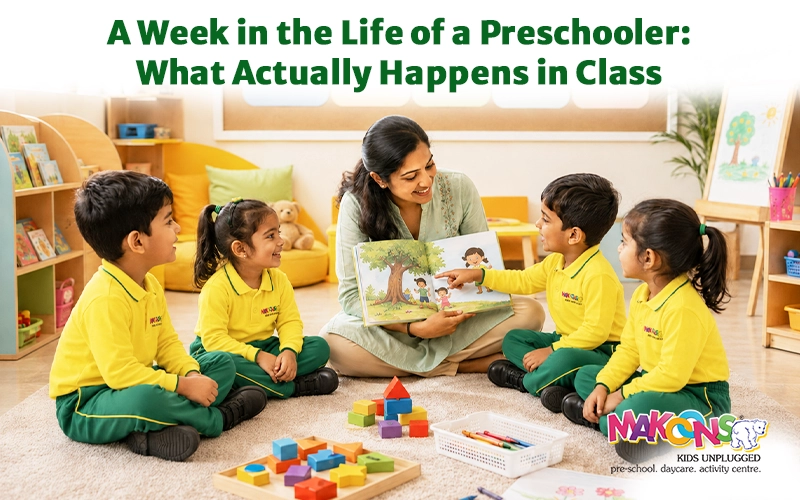
One of the biggest problems many parents have before sending their child to preschool. “What does the day look like for my child?” children may be having fun but still parents are anxious about it. Each and every activity in a preschool is planned in such a way that helps them physically, emotionally, mentally, and socially grow.
A good planned preschool schedule gives children a sense of discipline, confidence and opportunity to learn more. Teaching children is fun but they get easily learned by creativity, outdoor play and storytelling.
Each day prepared for lifelong learning through experiences.
We'll learn what actually happens in a preschool.
The Importance of a Preschool Daily Routine
Young children feel safe and secure when they are aware of what to expect. A regular routine helps children know what to expect, feel safe and confident and be prepared to be involved in the daily activities. Predictable routines also provide an early introduction to responsibility, independence and time management.
A well planned preschool morning schedule provides learning, play, meal time, rest, creative time and physical activity. This variety will help keep children occupied and develop various skills.
Monday: Welcome and Circle Time, Building Friendships
The week starts off exciting as the children arrive at the Preschool classroom and greet their teachers and friends. Free play is generally the first activity of the morning and is used to help children to feel comfortable.
Following, circle time with songs, chat about the weather, the days of the week and other simple discussions. These activities for preschool classrooms promote communication, listening and confidence.
Monday can be a time to get children up and active again after a weekend of rest, through team building, sharing and positive social interaction.
Children have story times, music and some simple games with the class throughout the day that make learning fun.
Tuesday - Learning Through Exploration
Tuesday is a day dedicated to hands-on experiences. Children are not taught by rote, but make discoveries through interactive experiences during preschool.
Teachers may introduce:
- Colours and shapes
- Numbers and counting
- Alphabet recognition
- sorting and matching games.
- Building blocks
- Sensory play
These experiences develop observational skills, problem solving and early mathematical thinking.
Wednesday Is All About Creativity
In preschool, creative expression is an integral component of learning. Children have art and craft activities on Wednesdays, where they learn to paint, colour, cut and paste, and make simple crafts.
Creative Activities support children to develop:
- Fine motor skills
- Hand-eye coordination
- Imagination
- Self-expression
- Confidence
There are also music and dance sessions. Children sing rhymes, play musical instruments and play movement games that develop co-ordination and rhythm.
These fun preschool classroom activities help with language development and expression as well.
Thursday: Outdoor Learning and Physical Development
Physical activity is essential for children's health. Outdoor play is a key component to the daily routine in every preschool which gives children the opportunity to learn, exercise and connect with their local environment.
Activities to create outdoors in the preschool setting may be:
- Running races
- Ball games
- Obstacle courses
- Sand play
- Gardening
- Nature walks
- Group games
These exercises enhance balance, strength, coordination and teamwork, and get children moving.
Children also develop confidence, independence and problem solving skills in outdoor contexts.
Friday: Review, Celebration and Fun Learning
Revision and celebration go hand-in-hand on Fridays. Teachers assess the week's content through games, stories, songs, quizzes and engaging conversations.
Children showcase their art work, perform in groups or acknowledge birthdays or classroom successes.
This positive conclusion aids learning and builds confidence and pride in children's achievements.
Children have had a balanced week of learning, creating, socialising and exercising.
A Typical Schedule For Preschool
Although all schools vary, they typically have a set preschool program routine of learning and play.
A day may consist of:
- Arrival and free play.
- Circle time
- Learning activities
- Healthy snack break
- Outdoor play
- Storytelling
- Art and craft (creative)
- Music and movement
- Lunch
- Rest
- Group activities
- Departure
This is a routine that helps children understand transitions, lowers their fear and promotes independence.
Preschool Learning Through Play
Kids really love learning while having fun. This is just a myth that kids play all day but in reality playing is the most effective way of preschool learning.
Children learn to:
- Solve problems
- Ask questions
- Communicate effectively
- Work in teams
- Think creatively
- Build confidence
- Develop language skills
Designing activities to be developmentally appropriate, and fun for children, is an important part of the teacher's job.
The Role of Preschool Education in Children's Overall Development
Good preschool education is much more than just about school reading and writing. All activities are designed to foster the whole child.
Children build:
Cognitive Skills
The puzzle games, counting activities, science exploration and storytelling enhance memory, reasoning and critical thinking.
Social Skills
Children learn to share, cooperate, be patient, to feel for others, and respect others in group work.
Emotional Development
Children are encouraged to share their emotions and opinions, develop positive conflict resolution skills and grow their confidence.
Physical Development
These activities help children build up their gross motor skills, such as indoor games, and fine motor skills, such as drawing, colouring and crafts, outdoors.
Language Development
Vocabulary and communication skills are developed through daily conversations, storytelling, rhymes and songs.
The Role of Teachers In The Preschool Classroom
Teachers play a very important role in a child’s life. They provide a sustainable learning environment where children feel safe and confident. They patiently teaches them and calmly handle them.
The following descriptions apply to a nurturing preschool classroom where teachers:
- Monitor children's progress.
- Foster exploration and imagination.
- Support emotional wellbeing.
- Foster independence.
- Keep in regular contact with parents.
- Design effective learning activities.
The Importance of having a Structured Preschool Routine For Parents
Parents may see improvements in their child's situation right from the start of preschool. A routine helps children to develop independence, confidence and organization in the preschool setting.
Many families find they see improvements in:
- Communication skills
- Social behaviour
- Listening ability
- Confidence
- Daily habits
- The preparedness of children for primary school.
These enhancements enable easier and less stressful transition to school for children and their parents.
Conclusion
The week of a Preschooler is full of great learning, creativity, friendships and fun. All of the preschool programme is carefully planned to help the children to develop physically, emotionally, socially and intellectually.
Children need some skills that help them in future learning, from their preschool learning experiences to the activities that they enjoy and learn from outdoors. Preschool is not just a place where children learn numbers and alphabets , it is a place where children feel safe , confident, curious and to love learning. A good preschool helps children to grow emotionally, physically, mentally and intellectually.
Selecting a preschool with qualified teachers and a balanced routine helps children to learn something new every day and discover new things around them.
FAQs
1.What is a typical preschool schedule?
Typical preschool includes learning activities, snacks time , outdoor time, storytelling.
2. Why is it so crucial to have activities in the preschool classroom?
Because children learn easily by fun activities and it helps them to engage in class.
3. What are the advantages for children of having a schedule in preschool?
It offers:
Consistency, Confidence, Reduce anxiety, Encourage healthy habits & make independent learners.
4. How does preschool education pave the way to school?
Preschool education forms the foundation of children's academic, social and emotional development, ensuring they are ready for primary school with the ability to develop good learning habits and be independent.