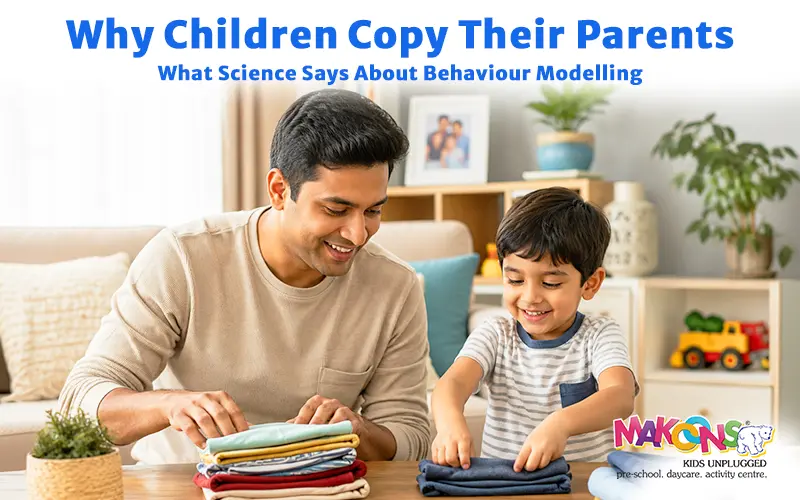
Those parents that have been forced to experience the odd time when their child says something that they use daily or mimics how they answer the phone call have been lucky.
Sometimes it's adorable. At times a bit of an embarrassment.
In the exact same tone as a parent, a child may say, “That I'll do later.” Or they may imitate the way Mom folds clothes or the way Dad's voice sounds when driving in bumper-to-bumper traffic.
These moments offer a window into a truth: Kid's Watch.
Children know a lot before they can follow instructions. The experts in the field of child psychology say this is one of the best ways in which children learn about the world and they call it behaviour modelling.
Children Learn With Their Eyes First
Often parents pay attention to what their words say to their children.
We remind them to:
Be polite
Share with others
Tell the truth
Stay calm
Children's eyes are also trained!
When a parent is rude to others, the child is aware of this behavior when the parent asks the child to be kind.
Young children imitate everyday behaviour. They observe adults' behaviors and interactions with others when they have difficulties and obstacles.
Doing is believing.
Why Parents Have Such A Strong Influence?
Children's first teachers are their parents.
From the moment they are born, they watch:
Facial expressions
Body language
Tone of voice
Reactions to stress
Interactions with family members
Parents are an intrinsic part of a child's life and behaviour is a role model for children.
One of the explanations for why parenting influences children is a determinant of child development.
The Science Behind Behaviour Modelling
Children's observation learning has been a subject of study for many years now.
It is one of the most accepted that kids tend to copy behaviors that they observe over and over.
If they continue to see them in this way, they begin to assume that this is their way of doing things.
For example:
Respectful communication can be contagious—the children who see this are more likely to exhibit it.
Patience is a trait that is passed on to children when they observe it in others.
Children may be confused if they observe adults yelling all the time and think that this is an acceptable conflict resolution.
This learning is unplanned and spontaneous at times.
Everyday Habits Children Copy
For parents, what children see is a surprise.
Children commonly copy:
Words and phrases
Manners
Eating habits
Problem-solving styles
Reactions to frustration
Screen habits
Exercise routines
Little deeds can go a long way.
When a parent says "thank you" that much the kid will say it back to him or her at some point.
How Children Learn Emotional Responses
Expressing feelings is something children do, mimicking their parents.
Children are unable to control:
Anger
Frustration
Disappointment
Stress
They observe adults and learn from them.
When parents are a bit relaxed in difficult situations, children become aware that problems can be handled in a non-panicky manner.
Some children will be more at ease with expressing their emotions if parents are open with their emotions.
This helps to develop emotional health and confidence.
The Good News: Positive Habits Are Contagious Too
The great thing about behaviour modelling is that positive behaviours are as effective as negative behaviours.
Children imitate their parents a great deal:
Help others
Show patience
Apologize when wrong
Keep promises
Express gratitude
Treat people respectfully
The lessons learnt in these lessons can be remembered beyond their home.
In many ways, many adults can identify some of their strongest values as having been taught to them by their parents.
When Parents Make Mistakes
No mom or dad is a patient parent all the time and all day long.
There are stressful times in all of our lives.
The positive part of this is that children don't require flawless parents.
Parents make mistakes and in some instances, children will learn more from their mistakes.
For example:
"I got upset earlier and shouldn't have spoken that way."
"I'm sorry. I'll try to handle it better next time."
This is the time to be taught to take responsibility and emotional development.
Children realize that it's okay to make mistakes, that it matters to take responsibility.
Small Changes That Matter
It's not a rule that parents must dramatically change their life to become good role models.
Little things can make a big difference:
Discuss family members in a respectful manner.
Be kind to others.
Manage disagreements calmly.
Express gratitude regularly.
Turn off cellphones when talking to family.
These behaviours are observed daily by children.
Final Thoughts
Children are said to be little mirrors and that's a good description of them.
They watch their parent's speech patterns, interactions with others, and approach to problem-solving and treatment of others. They develop their understanding of the world through behaviour modelling.
Parents don't have to be perfect. That every day action counts, to remember.
A lot of the commandments the child hears as a kid might be forgotten, but chances are that the child will remember the model that she sees every day at home.
Lastly, that sample is usually one among their most significant influences in their growth.
FAQs
1. What is meant by behaviour modelling?
One of the ways children learn is through behaviour modelling, which is done by observing and imitating behaviours of others in one's environment.
2. What makes children imitate their parents?
The behaviors that are observed repeatedly by children are readily imitated and parents are the first role models for children.
3. Do children imitate negative behaviour?
Yes. Children can copy positive or negative behaviour they see at home.
4. How does children's behaviour change due to behaviour modelling?
It impacts on social skills, emotional functioning, communication and on-going behaviour.
5. What positive behaviours should parents model?
These qualities include being kind, honest, patient, thankful, respectful, and having good communication skills.
Explore Other Topics:
What Do Children Learn In Indian Preschools?
Common Fruits Names, Uses & Health Benefits For Kids