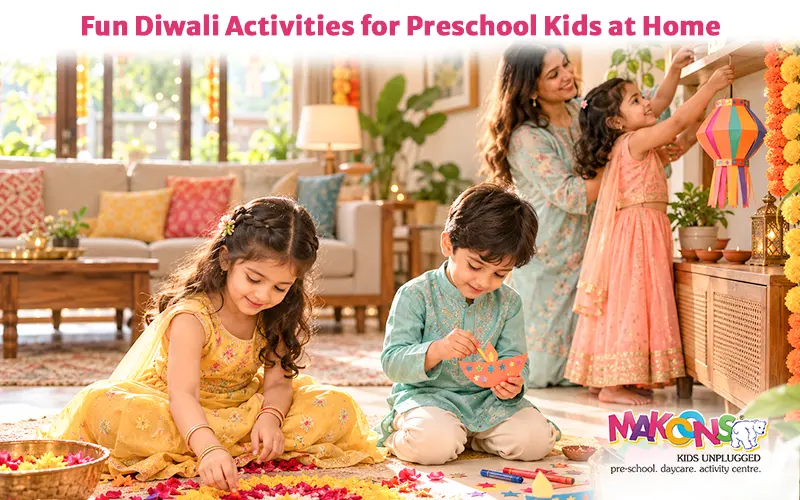
The festival of Diwali is an incredible one where one gets to hear from the members of the family, decorate the house, share the sweets and make happy memories. The festival also allows the little learners to gain knowledge of colours, Indian culture, be creative and learn how to be kind to others in simple day to day activities.
No special time and elaborate preparations are necessary to make up the festival. Armed with just a few pieces of coloured paper, some crayons, a little bit of recyclable craft supplies, some music and a little bit of family time, this could well be a very special afternoon!
If you're looking to have some fun with Diwali but find it easier to organise with a family, then this guide has 10 ideas for children in the early learning stages too! Activities can be modified for toddlers and older pre-school children as required by age and needs with the assistance of an adult.
Why are Diwali Activities Important For Preschoolers?
In the Foundational Stage, the primary focus of learning in NCERT's National Curriculum Framework is via play, conversation, storytelling, art, music, movement and hands-on exploration. These methods enable children to gain knowledge through fun experiences and not by pure memory.
Well planned activities at home during Diwali can be rewarding for children as they can learn to:
Practicing fine motor skills: Children learn to control their hands when they are crayoning, tearing and sticking their paper.
Add vocabulary: New words will be added to Enhance language skills: Diya, rangoli, lights and family traditions.
Explore early maths: Children learn about early numeracy activities such as counting decorations, sorting colours and recognising shapes and this helps them develop early numeracy skills.
Be creative: Children may invent their own patterns and designs and do not need to be faultless.
Develop social/emotional skills: Sharing materials, taking turns, assisting members of family to cooperate.
Understand cultural traditions: Children are taught about cultural tradition via story and family discussion – they find out about why people celebrate Diwali.
The goal is to get learning to be second nature, and fun! Provide opportunities for children to explore for themselves, to mess up and to express themselves.
10 Fun Diwali Activities For Preschool Kids At Home
1. Make Colourful Paper Diyas
Paper diyas make for one of the easiest diwali crafts for the preschoolers. They bring kids into the symbolism of the holiday season, and encourage creativity and hand-eye co-ordination.
Materials required:
Colour paper/cardstock
Washable markers/crayons
Glue stick
Child safe scissors (with adults supervision)
Paper in various colours to decorate - in small pieces and cut out
How to do it:
On a piece of paper sketch a basic outline for the diya.
Make a cut and help your child with it.
Have your child colour the diya and place some dots, circles or strips on it.
Create different types of diyas and display them on a festive diya sheet.
Learning opportunity: Inquire your child about the colours and the number of diyas and the shape of objects used to decorate diyas.
For younger children: Give big cut out shapes to colour in and glue.
Safety Note: Do work on paper. Don't place actual fire near paper decorations.
2. Create a Paper Rangoli
Rangoli is an excellent beginning of children's learning of patterns, symmetry, colours and traditional festive decorations.
What they will need: Coloured paper, Large paper, Glue, Crayons.
Steps:
On a piece of paper draw a large circle or flower in the center of the sheet of paper.
Bend, cut or rip colored paper into simple shapes.
Have your child placed the shapes in the design.
Help them to use colors or shapes to make a pattern by repeating.
Make rangoli and hang it up at the entrance or in the child's activity area.
Learning opportunity: Ask questions such as, “Can you find two red shapes?” or “What comes next in this pattern?”
For any fan of indoor project activity for kids, this is a fantastic activity. If creating large shapes, then make them beforehand and remind young children to not put in their mouths or swallow small pieces.
3. Decorate a Diwali Greeting Card
A hand made greeting card conveys to kids that festivals are additionally about affection and gratitude.
Materials required:
Paper or cardstock which is folded
Crayons
Stickers / large cut-outs of paper
Glue stick
How to make it:
Fold paper in half to make a card.
Allow your child to make something like diya, star, flower or a string of colored lights.
Encourage them to write ‘Happy Diwali' on the front.
While at home, have them make a drawing or a short Christmas letter.
Send to a Grandparent, Family Member, Neighbour or Friend.
Child Learns: Writing, drawing, communicating and enjoying the creation for someone else.
The drawing is not even and the letters are not perfect so don't worry. The goal is to allow the child to express himself/herself—and not make a professional looking card.
4. Play The Diwali Colour And Shape Hunt
Make it an easy adventure game at home! This activity is quick to set-up and suitable for energetic kids.
How to play:
Select 3 or 4 colours (red, yellow, green and blue).
Ask your child to find items in the house that are edible that are the same colour as the colours they are looking for.
Identify familiar shapes in decorations or in craft materials, e.g. circles, squares and triangles.
Count and colour sort objects.
Make a request to your child to describe one of his favorite items.
Search must be conducted in a safe and supervised area.
5. Make a Festive Paper Lantern
A colourful paper lantern can brighten a child's room without needing candles or electrical lights.
Materials required:
Coloured paper
Crayons or markers
Glue or tape
Child-safe scissors
Steps:
Let your child decorate a rectangular sheet of paper.
An adult can fold the paper and make the necessary cuts.
Roll it into a cylinder and secure the edges.
Add a paper handle and decorate it with large shapes.
Hang it in a safe place away from flames, heaters, and ceiling fans.
6. Enjoy A Diwali Storytelling Session
In India there are various mythologies and traditions about Diwali. Families can be involved in the festival either by retelling the story of Lord Rama's return to Ayodhya, by offering worship to Goddess Lakshmi and Lord Ganesha or by following any of the local traditions.
A storytelling approach that is interactive is best carried out through:
Use a picture book, pictures or simple puppets.
Include some words such as diya, celebration, kindness and welcome.
Stop and discuss with the child what is happening in the pictures.
Invite your child to draw a favourite part of the story.
Ask the family, what does the family do to celebrate Diwali?
“Children's language and understanding should be supported by familiar stories, conversation, drawing and role play” is recommended by NCERT.
Learning opportunity: Story telling develops listening and imagining skills, word-learning and cultural knowledge.
Use a succinct description and be encouraging. Children don't have to read a whole book to enjoy it, and that is certainly true when it comes to reading a book to preschoolers!
7. Organise A Diwali Music And Dance Party
Music and movement can go a long way to making your family's celebration fun.
How to organise it:
Select age appropriate and positive holiday music.
Provide a small area in which a child has room to move about.
Sing a "freeze dance" with children, have them dance while the music plays and when it stops, they freeze.
Encourage them to march, clap and swing to the rhythm and copy basic actions.
Have each child propose a movement to him/her for the group to perform.
Learning opportunity: Children listen, co-ordinate, rhyme and balance and take simple instructions.
Play music at a volume that is suitable for children's enjoyment, remove rugs or any corners of sharp furniture from the area for children to play in and allow children frequent breaks if necessary.
8. Play a Diwali Memory-Matching Game
This is one of the easiest Diwali games for kids and utilises pictures to make it accessible, and suitable, for varying levels of ability.
Tools needed: Diyas, flower, sweet, lantern, rangoli designs or festive clothes picture cards (2 sets per pair).
How to play:
Ensure 4-6 pairs of pictures are face up for younger children
Get your child to do a picture matching activity.
With older preschoolers, flip over the cards facedown.
Each turn, players will select two cards.
Have them name the pictures and remember their place.
Learning opportunity: Matching games can be used to learn visual memory and concentration, use vocabulary, and practice turn taking.
Just use a couple of pairs initially. If your child likes the challenge then gradually add more numbers; make it a non competitive game.
9. Create A Diwali Kindness Jar
Diwali could also be an opportunity to discuss with the children the concepts of sharing, thanking others and caring for others.
Materials you will need: Clean container, paper strips, crayons and a pencil.
How to do it:
Create a container and label with a paper label, “Our Kindness Jar.”
Write or draw simple actions on pieces of paper.
Give your child a choice of which action he/she will try each day.
Discuss how the person will feel and look when finished with the action.
Include new ideas as they occur to your family.
Here are some ideas for what to fill the jar with:
Playing with siblings around toys.
Assisting with book setting up.
To thank a person for his or her help or support.
Creating a card for another family member.
Assisting adults in setting up tables.
Making another friend a friend of the game.
Learning opportunity: Learning of skills empathy, responsibility, communication, positive habits is promoted.
Don't make the actions "too grown-up" for the child.
10. Set Up A Pretend Diwali Celebration Corner
Children like copying familiar activities that adults do. They may act out a celebration with their pretend corner, and use it to engage in imaginative play with festive routines.
Materials required:
Toy plates and cups
Paper Diyas and lanterns.
Designed clothes and festive material for graphic design.
empty and clean sweet boxes
Handmade greeting cards
How to set it up:
Select an area in the room that is small.
Place fake decorations and toys at the child's height.
Try to get your child to pretend and welcome visitors, decorate and give imaginary sweets.
Participate in play with children, asking questions like ‘Who is coming in to see us today?', ‘How are you going to decorate this room?'.
Let your child experiment and create another story and characters.
Learning opportunity: children learn to be imaginative, to use language to communicate, interact socially and to problem solve as they play pretend.
Don't use real candles, matches or hot cooking implements to pretend with; use clean, safe materials, which have no sharp edges, small detachable parts etc.
Related Topic: How to Make Diwali Greeting Cards with Kids
Diwali Safety Tips For Preschool Kids
A warm home is welcoming and comforting. If you're looking for ideas for celebrating Diwali, here are a few tips:
Avoid having open fires when children are participating in activities. Decorate with paper diyas, special candles to be lit for diyas or non-flamable decorations.
Supervise craft materials. Utilize non-toxic materials, colours and select material that is suitable for the age.
Be aware of any choking risks. Try to remove all beads, small decorative stones and small craft items from the reach of toddlers.
Avoid using heat for decorating. Paper lanterns, ribbons and fabric should be avoided in candles/diyas, headdresses, cooking regions.
Do not overload electric connections. Lighting products need to be used responsibly and cords should not be situated on the children's walking path.
Provide room for activities. Clear floor of obstructions before dancing, playing games etc.
Government of India, Directorate General of Fire Services has advised the families to plan the children's safety and not to let children come in contact with fire.
Related Topic: Diwali Essay for Kids: Simple and Easy Essay for Children
Related Topic: Easy Diwali Rangoli Designs and Ideas for Kids
Tips For Choosing The Best Diwali Activities For Your Child
For ages 1-2: select short carefully supervised experiences such as observing colourful decorations, listening to music and creating marks using washable crayons. Small loose parts are not suitable to use.
For ages 2–3: Employ large cut-outs of shapes, simple coloring, short stories and a few simple matching games.
For ages 3-4: Present simple craft, colour sort, and simple counting.
For ages 4-6: Offer more in-depth crafts, pattern making, stories and games.
These are only guidelines and not rules of development. Select activities based on your child's interests, abilities and comfort level.
Final Thoughts
To create a special memory for your child with Diwali you don't need to be very hard working. Creating a homemade greeting card, favorite story or family dance party will be a lot of fun and the kids will get a few new skills.
Quality Diwali games for children enable them to explore, create, enquire and enjoy time with family.
Frequently Asked Questions
1. What are the most suitable activities for preschool children to enjoy at home in the lead up to Diwali?
Ans: Paper crafts such as Paper diya, Paper rangoli, Greeting Card, colour hunt, storytelling, music and dance, memory games, and kindness activities are appropriate. Just need basic materials and can be modified to various ages. Choose activities that are related to your child's interests and allow plenty of time for exploration to be free.
2. What are some of the simple diwali crafts to make for pre-schoolers?
Ans: Using coloured pieces of paper, crayons and glue, children can create paper diyas, paper lanterns, rangoli designs and greeting cards. The adults may be able to make some difficult patterns beforehand and the children can focus on decorating. Utilize material not toxic or decorated with items that can be swallowed.
3. How can I celebrate Diwali with toddlers safely?
Ans: Select activities which are brief and managed, such as listening to music, sighting displays, colouring large paper shapes and listening to simple stories. Prevent toddlers from coming into contact with fireworks, open flame, hot surfaces or small craft materials. Decorate with flameless lights, and allow the children to decorate as time goes on.
4. What are some fun indoor Diwali activities for kids?
Ans: Happy colours, colour hunt, pretend party area, paper lantern making, story time and freeze dance are fun activities indoors. These activities will use no expensive equipment or space, and will focus on creativity, language and memory and movement.
5. What improvements will there be in the learning of the pre-school children as a result of the diwali activities?
Ans: Children have fine motor play sessions, identify colours and shapes, practise counting items, enlarge their vocabulary and listen to stories during the Diwali activities and learn to cooperate with others. Parents should also comment on the activity when the children are playing, this can also be useful to help the children learn about culture and have social development.
6. How many Diwali activities should I plan for my preschooler?
Ans: A couple activities will suffice for a home-like celebration. A small craft and game time and story/music time can help provide variety without overstimulating the child. Listen to your child's interest, provide him/her with breaks and remember that the aim is for your child to have fun, not the aim to complete the activity.