
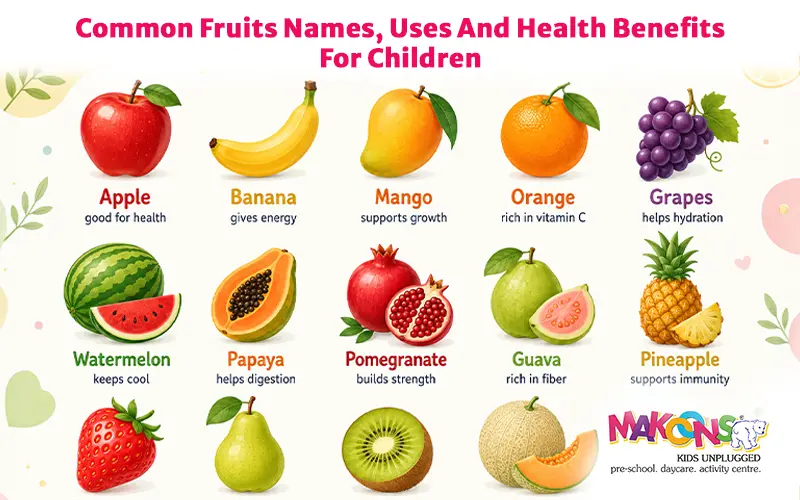
Fruits are easy to eat, delicious, and can be used in a variety of ways to help get them into kids' eating habits. Children can eat fruits healthily, whether they are eating a banana for breakfast, or a bowl of papaya or watermelon on a hot afternoon.
It's also good for children to learn the names of the fruits. Children will know the names of fruits, their colours, shapes, taste and texture as well as increase their vocabulary and healthy eating habits.
However, no one fruit has all the nutrients needed for a child. It is best to provide a selection of whole fruits, with vegetables, whole grain, protein foods and other nutritious foods.
In this guide, you will learn about 15 most popular fruits names, daily uses along with main nutrients and health benefits of the fruits for kids.
Why Are Fruits Important For Children?
Fruits contain a number of nutrients and compounds that benefit children in many ways.
Depending on the fruits they are able to offer:
Vitamin C
Vitamin A, Carotenoids
Potassium
Folate
Fibre
Water
Natural carbohydrates for energy
Polyphenols and carotenoids in plants
According to the Indian Council of Medical Research – National Institute of Nutrition (ICMR – NIN) having a diverse array of vegetables and fruits are an important part of a healthy diet. It's also important to choose diverse foods, instead of relying on just one for nutrition, as part of its dietary recommendations.
Fruit can also be a functional substitute for very sweet snacks for kids.
The advantages of providing a variety of fruits are:
Fibre is necessary for proper digestion.
Contributing to hydration
Vitamins and minerals that are required by the body.
Ways to add variety to meals.
Making children more familiar with various flavours and consistency
Focus on making foods more tasty that are high in nutrients
Common Fruits Names, Uses And Benefits For Kids
A simple fruits names and benefits guide for parents and teachers to be familiar with and plan meals with.
1. Apple
Fruit name: Apple
Common uses:
Fresh to eat as a snack
Serving as fruit salad garnishes.
Chopped into oatmeal
The juice is used to make homemade smoothies.
Evaluated and provided with yoghurt or nut/seed butter where relevant
Health benefits:
Apples also are a source of fibre (e.g., pectin) and have a little less vitamin C. If appropriate, the edible skin can be removed, but if it is appropriate and is washed properly, then it is possible to increase the fibre contribution.
Apple is a sweet and crunchy, easy-to-eat snack for kids.
Kid-friendly fact: Apples are available in a variety of colors, such as red, green and yellow.
2. Banana
Fruit name: Banana
Common uses:
Snacked raw, snack food is eaten quickly.
Fruit or oatmeal and porridge.
Blended into smoothies
Mashed into yoghurt
Banana fruits used in making home made banana recipes.
Health benefits:
Bananas are a source of carbohydrates for energy, and contain potassium. They also are a source of vitamin B6 and some fibre.
Ripe bananas are soft and can be mashed by young children.
Kid-friendly fact: Bananas are ready to pick when green but will continue to ripen after they're cut.
3. Mango
Fruit name: Mango
Common uses:
Eaten fresh
Put in fruit bowls
Blended into smoothies
Mixed with yoghurt
It is employed for preparing home-made mango drinks.
Health benefits:
Mango is rich in Vitamin C and carotene, especially beta-carotene which is converted to vitamin A.
Assists in normal immune function, Vitamin A required for normal vision and normal immune function and Vitamin C required for normal iron absorption from plants.
Kid-friendly fact: There are many different varieties of mangoes, and they can be different colors, sizes, smell and taste.
4. Orange
Fruit name: Orange
Common uses:
Eaten fresh
Used for making fruit salads.
Add to homemade smoothies.
Topped with yoghurt or other foods
Health benefits:
Oranges are known for their vitamin C. They are also a good source of folate, fibre and water.
The vitamin C is particularly important because of its contribution to normal immune function and to improve the absorption of non-haem iron from plant foods.
It is better to offer orange segments than orange juice to children as they will get fibre from the fruit and have to chew the fruit as well.
Kid-friendly fact: Oranges are citrus fruits and contain some natural compounds that create the aroma that makes them kid friendly.
5. Papaya
Fruit name: Papaya
Common uses:
Eaten fresh
Pick up and throw to your fruit bowls!
Mixed with yoghurt
Used in smoothies
Health benefits:
Papaya is a good source of vitamin C, carotenoids and fibre. Ripe papaya is soft, and if handled correctly, can be easily eaten by younger children.
It contains carotenoid pigments for its colour.
Kid-friendly fact: Papaya contains a number of tiny black seeds, which are usually removed before serving papaya to children.
6. Guava
Fruit name: Guava
Common uses:
Eaten fresh
Pulverized for use in fruit salad.
Added to smoothies
In self-made fruit products.
Health benefits:
Guava is especially rich in vitamin C and is a source of fibre too.
The flesh color of guavas may vary as white, pink or reddish.
For younger children the guava should be prepared by the parent and the texture should be considered according to the age of the child and their ability to chew the fruit, plus seeds.
Kid-friendly fact: Some guavas that are so perfumey scented, that they are “scented” just a few moments before being cut open, kid fact!
7. Watermelon
Fruit name: Watermelon
Common uses:
Chilled/fresh food.
Add to fruit salad.
Blended into smoothies
A delicious snack!
Health benefits:
A very watery fruit, it's a refreshing fruit in summer. It is also high in vitamin C and carotenoids.
Watermelon should be given along with the normal drinking water, however.
Did you know that watermelon is available in a variety of colours that have red, yellow or orange.
8. Pomegranate
Fruit name: Pomegranate
Common uses:
Eaten as seeds/arils
Added to fruit bowls
Sprinkled over the top of porridges and yoghurt.
Added to salads
Health benefits:
Pomegranate is rich in fibre, Vitamin C and has a number of plant compounds, including polyphenols.
It is also juicy – something kids will appreciate because it will provide them with a juicy texture in their arils.
Kid-friendly fact: There are juicy arils around each seed inside a pomegranate, that you can eat.
9. Grapes
Fruit name: Grapes
Common uses:
Eaten fresh
Serve with fruit salad.
Served with yoghurt
Be a component of the well-known homemade items!
Health benefits:
Grapes contain a lot of: water, carbs, vitamin K and plant compounds.
They make a great snack for anyone, but are particularly important when making snacks for your children.
BEWARE: Grapes may be a choking risk with young children. Children under 4 years of age should be fed small amounts of food and broken into various shapes to reduce the possibility of choking, the American Academy of Pediatrics recommends. Adhere to feeding guidelines and supervise young children feeding.
Grapes come in a variety of colors, including green, red, purple and nearly black!
10. Pineapple
Fruit name: Pineapple
Common uses:
Eaten fresh
Adapted to use in fruit salad.
Mixed into yoghurt
Used in smoothies
For self-prepared foods
Health benefits:
Vitamins and minerals that are found in pineapple include vitamin C and manganese. It also has a bunch of enzymes referred to as ‘bromelain'.
Fresh pineapple has a distinctive sweet and tart taste and is juicy.
Kid-friendly fact: Pineapple is a bunch of small fruitlets that are fused together!
11. Strawberry
Fruit name: Strawberry
Common uses:
Eaten fresh
Added to yoghurt
Mixed into oatmeal
Used in smoothies
Serve on top with fruit salad.
Health benefits:
Strawberries contain lots of vitamin C, fibre and plant compounds.
They are sweet or tart and are quite colourful and may be attractive to children.
The fruit grows on these tiny "seeds" on the top of the fruit - these are called achene fruits.
12. Pear
Fruit name: Pear
Common uses:
Eaten fresh
Added to oatmeal
Served with yoghurt
Fruit, finely cut-up for fruit salad.
Feed by feeding soft food.
Health benefits:
Pears are a good source of fibre and water, and can be a good source of variety for a child's diet.
Ripe pears cooked to the level of children's ability are very soft.
Did you know, the variety of pears are available in different colours and textures, suitable for kids!
13. Kiwi
Fruit name: Kiwi
Common uses:
Eaten fresh
Topped with fruit salad
Mixed with yoghurt
Added to smoothies
Health benefits:
Kiwi is rich in vitamin C, fibre, vitamins K and other vitamins and minerals.
The green flesh may be fun for kids to investigate and so are the small black seeds.
Kiwi should only be given to children that have a known food allergy as advised by their health care professional.
To help children learn about kiwi: Kiwi is fuzzily brown from the outside and green from the inside.
14. Chikoo (Sapota)
Common name: Tree-fern.Another name for Sapota Trees / Chikoo Trees.Botanical Family: Sapotaceae.
Common uses:
When ripe eat fresh
Can be used in fruit salad.
Blended into smoothies
Mixed with yoghurt
Health benefits:
Chikoo contains a lot of carbohydrates, fiber and other micro-minerals. May be appealing to children due to the softness and natural sweetness.
It's a sweetness that is inherent, so it should be mixed with other fruits, rather than taking the place of them.
In the process of ripening, the Chikoo becomes soft and sweet – kid friendly fact.
15. Peach
Fruit name: Peach
Common uses:
Eaten fresh
Washed and incorporated in fruit salad.
Mixed into yoghurt
Added to oatmeal
Used in smoothies
Health benefits:
Peaches are a source of vitamin C, fibre, carotenoids as well as a great source of water.
Ripe peaches will be sweet and soft to eat.
So did you know that peaches are in the cherry, plum and apricot family of fruits?
How To Encourage Children To Eat More Fruit?
While it helps to know the advantages of eating fruit, it can be difficult to have kids eat them.
Here are some tips on how to do it:
1. Keep Fruit Visible
Made accessible fruit readily available for children.
2. Offer Variety
Rather than giving the same fruit over and over again, try to change things up with the following:
Banana
Apple
Orange
Papaya
Guava
Watermelon
3. Make Fruit Colourful
Create a simple rainbow fruit plate of a range of naturally coloured fruits.
4. Let Children Participate
Children can help:
Wash fruit
Choose from 2 alternatives
Arrange fruit pieces
Make a fruit face
Serve with fruit on yoghurt.
5. Don't Force Eating
Often children need several tries of a new food before they will eat it. Allow children as much choice as possible, but do NOT make eating times a fight.
6. Choose Whole Fruit More Often
Fruit is higher in fibre and will take longer to chew compared with fruit juice, which is able to supply a high amount of sugars with less fibre.
Important Fruit Safety Tips For Children
Safe serving of healthy foods is still required.
Prevent Choking
Some fruits need to be altered for young children.
Examples include:
Grapes
Whole berries
Chunks of apple
The pieces of melon are large.
Large pieces of mango.
Feed fruits cut, mashed or otherwise prepared based on the child's feeding developmental ability.
Wash Fruit Properly
When eating or cooking fresh produce, wash under running water. Although the fruit is supposed to have its skins removed, it is important to wash the fruit to prevent contamination from the outside surface from infecting the inside of the fruit.
Remove Pits And Hard Seeds
Always remove:
Mango pits
Peach stones
Chikoo seeds
Pits or seeds other than those described above that are hard.
Watch For Allergies
Introduce foods at the appropriate time and seek medical advice if a child has any symptoms after eating a food, such as; swelling, hives, difficulty breathing or repeated vomiting.
Fun Ways To Teach Fruit Names To Kids
Fruits can be a great learning topic for preschool.
Fruit Matching Game
Use cards with images of fruits to have children identify them with actual fruits.
Colour Sorting
Ask children to sort the fruits into colour groups:
Red: Strawberry, apple
Yellow: Banana, mango
Green: Kiwi, pear
Orange: Orange, papaya
Taste And Texture Activity
Give children the opportunity to discuss fruit; as:
Sweet
Sour
Soft
Crunchy
Juicy
Smooth
Fruit Alphabet Game
Help children to ask for:
A – Apple
B – Banana
M – Mango
O – Orange
P – Pear
This is kindergarten vocabulary AND nutrition education!
Final Thoughts
Common fruit names can be more than just a learning vocabulary. Children are able to taste, smell, play with and learn about colours and flavours whilst eating fruits and learning healthy eating.
Apples and bananas are different in terms of nutrients and qualities to mangoes, guavas, papayas and strawberries.
The goal for parents should be to encourage them to have some kind of fruit instead of a particular 'superfruit'. Rather, establish a pattern to regularly serve a variety of whole fruits as part of a well-balanced diet.
For teachers, fruits can also be an interesting topic in the classroom via:
Fruit-name games
Drawing and colouring
Sorting activities
Storytelling
Discussions about taste and texture
Fruit-themed counting activities
Children will find it easier to learn and remember food education when it is in action.
Frequently Asked Questions
1. What are some common fruit names for kids?
Apples, bananas, mangoes, oranges, papayas, guavas, watermelon, pomegranate, grapes, pineapple, strawberry, pear, kiwi and chikoo, peach are some common fruits for children.
2. Which fruits are healthy for children?
In addition to a well-balanced diet, most whole fruits can be a part of a children's healthy eating plan, provided they are offered in an age-appropriate portion. Apples, bananas, oranges, mangoes, guavas, papayas, berries, pears and watermelon are healthy options to have.
3. What is the health benefit for children that they should eat fruit?
They can give fibre, vitamin C, potassium, folate, carotenoids, water and other good plant nutrients depending on the fruit. These nutrients play a role in healthy digestion, growth, immunity and health.
4. Is whole fruit or fruit juice good for kids?
The whole fruit is a good choice for day-to-day eating and is a source of fibre, which needs to be chewed. Fruit juice is less fibre and may enable you to consume more sugar in a shorter time period. Generally juice is restricted, particularly for younger children in order to encourage health.
5. How many fruits should children eat every day?
The amount of fruit that a child needs depends on their age, appetite, nutritional and activity demands. Parents should not focus on a specific amount of fruit at a time, but should provide the correct amount based on their child's age, giving them some variety of fruits to have a balanced diet. Guidance for the national diet must be taken into account with the needs of the specific child.
6. What fruits do you think would be appropriate to use to teach preschoolers the names of their fruits?
Preschoolers will enjoy activities which they will recognize as familiar fruits: apple, banana, mango, orange, watermelon, grapes, strawberry and pear. Help the children to remember the names using real fruit, pictures, colouring, sorting games and some simple songs.
Read More Helpful Blogs from Makoons:
Human Body Parts For Kids Their Uses
Ocean Names: Teaching Kids About Earth's Biggest Water Bodies
