
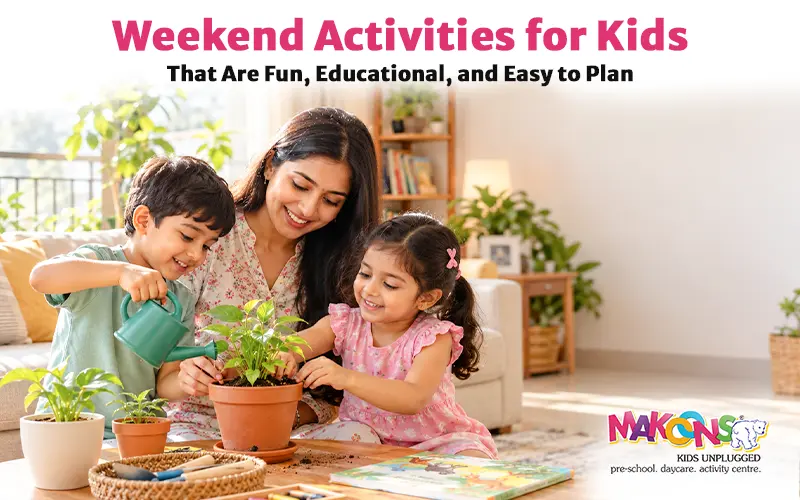
It's often a weekend that allows families to relax. For kids, however, when there is nothing exciting scheduled for the two days, it can easily become hours of screen time.
The happy part is that a productive weekend needn't be costly, a complex craft project or an overstuffed agenda. A trip to the park, a cooking project, a storytelling moment or even a treasure hunt around the house can be a good learning experience.
Indeed, the play is at the heart of early learning in India, as per the National Curriculum Framework for the Foundational Stage (NCF-FS). It acknowledges that activities like storytelling, conversation, games, art, music, physical play and exploration are ways that young children learn.
Likewise, “Aadharshila” curriculum for children 3-6 years of age by the Ministry of Women and Child Development covers play and activity based learning for all developmental domains with special focus on experiential learning.
Therefore, instead of, "What should my child study this weekend?," parents should ask a better question:
"What can my child explore, create, discover or experience this weekend?"
Why Weekend Activities Matter For Children?
Children should not have to study all the time every weekend. They require opportunities to be physically active, to communicate, to make decisions, to create and to explore, to be with others in a quality manner.
Well planned activities can help to support:
Language and communication
Early mathematical thinking
Creativity and imagination
Problem-solving
Fine and gross motor skill development
Observation and curiosity
Social skills
Confidence and independence
Family bonding
The NCF-FS sees play as an active learning opportunity, and sees the difference between free play and guided play, where children take the lead and adults support children's exploration with gentle guidance.
15 Fun And Educational Weekend Activities For Kids
1. Plan A Family Nature Walk
It's not a long distance trip. There is plenty to be explored if there is a nearby park, garden or safe walking area.
Challenge your child to make an observation task as easy as possible:
Find three different types of leaves.
Find an object that is red, yellow and green.
Hear various bird and insect calls.
Identify rough and smooth objects.
Record the number of different flowers you can count.
Observe changes in the sky.
With younger children discuss colours, shapes, sounds and textures. Older children may have a simple nature journal.
Nature walks are a great learning opportunity for the weekend and involve walking and observing as well as talking.
2. Organise A Home Treasure Hunt
An afternoon can turn into an adventure with a treasure hunt!
Hiding a small item somewhere safe, and giving your child clues.
For preschoolers:
“Locate something close to the sofa.”
For older children:
Find an object under and beside a book that is blue.
You can introduce:
Directions
Position words
Counting
Memory
Problem-solving
Reading clues
Vocabulary
Change the clues as per the age of the child so that they get increasingly difficult.
3. Cook A Simple Recipe Together
The Kitchen can be an effective learning environment when children work safely and safely with an adult present.
Opt for a simple recipe like fruit chaat, sandwiches, lemonade or a no cook snack.
Let children:
Wash suitable ingredients
Count fruits
Identify colours
Use measuring instruments with assistance
Mix ingredients
Arrange food
Discuss flavors and textures
Introduce mathematical terms like more, less, half, full, empty, first, next and last.
It's not about making the perfect dish. The actual learning happens when you get involved in what you're learning.
4. Have A Storytelling Afternoon
Turn off the screens and have a family story time!
You can:
Read from a picture book.
Tell a story from one of your childhoods.
Have your child think of a character.
Include toys as story characters.
Stop at a point and ask "what could be next?".
Give the child the opportunity to write another ending.
Storytelling, read-alouds, shared reading, conversation, rhymes and question and answer interactions are identified by the NCF-FS as examples of play-based learning.
Storytelling can be one of the easiest weekend learning activities for kids learning to tell a story!
5. Build Something From Recycled Materials
Extend your child's thinking before discarding a clean cardboard box, paper roll or container, by asking him or her what they might make from it!
Try building:
A cardboard house
A toy garage
A rocket
A puppet theatre
A small shop
A robot
A bridge
A cardboard city
Provide kids with materials and allow them to choose what they create.
Don't fix their design, ask:
“What can we do to make it better?”
“What could we use for the roof?"
“What if the base is expanded wider?”
This promotes creativity, planning and problem solving.
India's early childhood system also promotes the use of DIY and cheap materials in the children's learning processes.
6. Visit A Library Or Bookstore
The use of a library on a weekend may be a simple way to foster a reading habit.
Let children select appropriate books to their tastes.
Visit areas including:
Animals
Space
Stories
Dinosaurs
Nature
Art
Indian culture
Rhymes
Once your child has finished reading, have him or her ask the following questions:
Who was your favourite character?
What happened first?
What might you have done?
Can you draw your favourite part?
To make reading more of a pleasant experience instead of a necessary chore.
7. Try A Simple Science Experiment
Kids are inquisitive about the functioning of things.
Do simple experiments with everyday objects that they can supervise.
Sink or Float
Fill a container with water and collect safe objects. Before putting each item in the water, ask the child to predict whether it will sink or float.
Now test the prediction.
Ice Investigation
Pass your child an ice cube and see what happens as it melts.
Ask:
Where does it melt faster?
How does it behave in a warmer environment?
What does it become?
It is not important to remember scientific terms. Encourages children to watch, guess, try and talk.
8. Create An Indoor Obstacle Course
Don't have to endure rain or heat all day long.
Make a safe obstacle course with cushions, floor markers, cardboard Tubes, etc. available at home.
Children can:
Crawl
Jump
Balance
Walk around obstacles
Pitch a softball into a basket!
Follow movement instructions
Ensure free of sharp, breakable or slippery items.
This offers a chance for exercise and teaches children sequencing and directions.
9. Have A Family Board-Game Session
Thinking and social interaction can be supported with age appropriate board games and simple homemade games.
Try: Depending on child's age:
Matching games
Memory games
Picture bingo
Simple board games
Counting games
Dominoes
Homemade number games
Children develop skills of taking turns, understanding rules, waiting in turn and coping with winning or losing.
With younger children, stick to the rules and concentrate on the participation.
10. Start A Small Gardening Project
No need to have a big garden.
Just a couple of pots on a balcony/ windowsill will do.
Let your child:
Fill a pot with soil, with assistance.
Plant suitable seeds.
Water the plant.
Observe leaves.
Measure growth.
Draw what they see.
Monitor changes over several weeks.
Seek answers, don't just provide information.
“What different things have happened since last week?”
“Why do you believe the plant requires water?”
The art of gardening is science, responsibility, observation and patience.
11. Set Up A Pretend Restaurant
Make a section of the house the dining room of a pretend restaurant.
One of them can be the customer, another the chef and another the server.
Children can create:
A simple menu
Food names
Prices
Table numbers
Pretend money
Restaurant rules
This can be used to count, write, introduce vocabulary, role play and social communication.
It's also a wonderful example of how fun activities for kids can help them acquire a number of developmental skills without the formal learning atmosphere.
12. Make An Art Corner
Provide children with limited and appropriate art supplies.
For example:
Paper
Crayons
Coloured pencils
Child-safe scissors
Glue
Reusable cardboard
Leaves
Cotton
Paper scraps
Rather than instructing children on what to draw, set a more open-ended challenge for them:
“Can you create a picture of your dream park?”
Or:
“Can you make an animal that doesn't exist?”
This provides children with space for choice and their ideas.
13. Go on a Family Photo Walk
Walk around and let children take photos of interesting objects – with parental guidance.
They may seek out:
Different shapes
Interesting buildings
Flowers
Vehicles
Shadows
Signs
Birds
Textures
After arriving home, select a couple of observations and discuss them.
If your kids are not using a device, just use it as an "I Spy" game.
14. Make A Weekend Music Session
Music can be played without formal instruments.
Create rhythms using clapping, tapping and simple domestic items, in a safe way.
Try:
Copy my rhythm.
Make a fast rhythm.
Make a slow rhythm.
Clap five times.
Make a phonetic pattern with your name.
Follow a song and stop dancing when the music stops.
India's Framework on the Foundation Stage includes music, movement and rhythm amongst the play-based experiences being recognised.
15. Let Children Help With A Real Family Task
Certainly one of the most underutilized family activities for children is letting them get involved in daily life.
Children can contribute to:
Sorting toys
Folding simple clothing
Setting the table
Organising books
Watering plants
Putting away safe objects
Assisting with the preparation of a simple snack under supervision
Through these activities children learn to take responsibility and be independent; they also learn to count, sort and classify, communicate and follow instructions.
In the Ministry of Women and Child Development specific mention is made of household materials and household activities as opportunities for early stimulation and learning.
Also Read: Simple Home Activities That Help Kids Learn
Indoor Activities For Kids When You Cannot Go Outside
Weather, sickness or family plans (that require you to travel somewhere) can make it hard to do things outdoors.
Have a small 'weekend activity box' to the side with:
Crayons
Paper
Puzzles
Blocks
Storybooks
Clay or dough
Safe recyclable materials
Matching cards
Colouring sheets
Then you can simply select an activity without having to spend a lot of time in preparation.
Here are some fun activities that you can do inside with your children:
Construct a tower with blocks.
Indoor treasure hunt
Storytelling
Puppet show
Drawing challenge
Sorting games
Puzzle time
Pretend shop
Dance and freeze
Simple science experiments
Recorded materials created by the Government of India are available that include activities with blocks, puzzles, clay, music and movement, dramatization and pretend play.
How To Plan A Weekend Without Overplanning?
Sometimes parents over-schedule their kids.
You do not need to.
A balanced weekend could be made up of:
Saturday
Morning: Crafts and messy play with water and sand
Afternoon: Free Activity and rest.
Evening: Cooking/ Creative activity
Sunday
Morning: Family outing
Afternoon: Storytelling/reading
Evening: Simple household task and family game
Allow lots of "free time" in between.
Free play is good to have as there is the opportunity for children to select what they want to do and how they want to do it. Free play promotes social and self-regulation skills and guided play enables adults to provide gentle support for targeted learning objectives, the NCF-FS says.
How To Make Weekend Learning More Meaningful?
This activity is just a small portion of the experience. If the adult engages with the child it can be so much richer.
Ask Open-Ended Questions
Attempt to include questions which are not limited to a single correct answer:
"What do you think will happen?"
"How could we do this differently?"
"Why do you think that happened?"
"What would you change?"
"Can you show me another way?"
Allow Children To Have Choices
Provide 2-3 alternatives:
"Would you like to paint or build something?"
Children's sense of ownership is based on choice.
Don't Correct Every Mistake
If a child's tower has fallen, don't rush towards its reconstruction.
Ask:
“What are the things that we can do better this time?”
Errors can be a part of the learning.
Focus On The Process
Not everything has to make a pretty craft or the correct answer to a kid's weekend project.
The more desirable results might be:
Trying something new
Asking questions
Solving a problem
Communicating an idea
Working with another person
Persisting after something goes wrong
Read More: 10 Easy Classroom Activities Parents Can Try at Home Too
A Simple Weekend Activity Checklist For Parents
Consider before you decide to take – ask the question:
Do any safety concerns exist with regards to age?
Is there an opportunity for my child to be involved?
Does it involve movement, thinking, creating or communicating?
May I use materials that I have at home?
Does my child have sufficient freedom and opportunity to explore?
Can we talk about what we discover?
Is there sufficient room for free play and relaxation?
If it's mostly yes, you might have a worthwhile activity.
Read More:Fun Activities to Help Kids Focus in Class
Final Thoughts
It doesn't have to be a fancy weekend and an expensive event to make a fun weekend with the children.
A family can learn at the same time as they stroll through a park, prepare their breakfast, read a story, assemble the cardboard blocks, talk about planting seeds or playing a simple family game.
To provide opportunities for children to move, explore, create, communicate and ask questions during a weekend.
Most parents should not make the weekend another school day. Offer children a range of structured play and activities, family time and time outdoors, for free exploration.
When learning is part of a child's routine, they are more likely to have a positive experience of learning.
Frequently Asked Questions
1. What are some easy weekend activities for kids at home?
Storytelling, cooking together, cardboard building, indoor treasure hunts, art projects, puzzles, pretend play, simple science experiments and family board games are simple choices. The majority use cheap or readily available materials.
2. What good activities are there for preschoolers to do on the weekends?
Nature walks, counting games, sorting games, storytelling, music and movement, gardening, simple cooking and pretend play are appropriate. The activity should be geared to the child's age and capabilities—not just as a lesson.
3. How can parents make weekend learning activities fun?
Allow children to make choices, use familiar objects, incorporate movement, ask open-ended questions and allow the children to experiment. Don't make it a test/don't just be concerned with right answers.
4. What can children learn from family activities?
Children can practice communication, early mathematics, creativity, problem solving, coordination, cooperation, patience and independence in all activities, depending on the activity. One activity can be used to target more than one skill.
5. What are some indoor activities for kids during rainy or hot weather?
Examples of activities parents could consider are indoor treasure hunts, building challenges, stories, puppet shows, creating art, puzzles, board games, pretend shops, music and movement games, and simple supervised science experiments
6.Do weekend activities need to be educational all the time?
No. Children require free play, rest and time for just plain fun. The NCF-FS recognises free and guided play as a good thing in early learning. A good balance between child-led and some organised activities and family experiences can be achieved in a balanced weekend.
