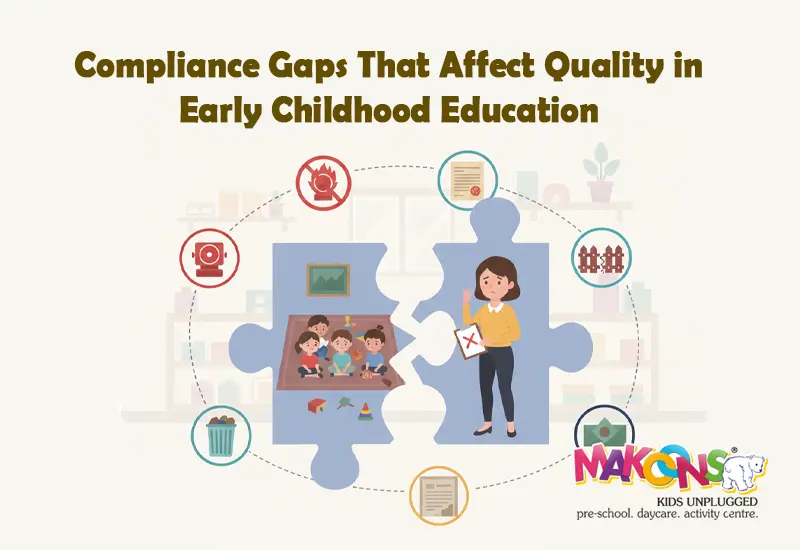
Early childhood education is central in determining cognitive, emotional and social development of a child. The current parents are more aware of the need to select quality preschools and early learning centers. Nevertheless, even with an increasing demand and awareness, the issue of compliance gaps in early educational institutions has remained a major problem concerning the overall quality of the offered services in most of the institutions. Such loopholes are normally created by inconsistent regulations, absence of supervision and operational difficulties in the preschools.
Preschools and childcare centers have been spreading fast in India and compliance has become a burning issue. The pledge of holistic early learning is usually not fulfilled without the adequate respect to the standards of preschool quality. This paper examines the key compliance lapses that affect the quality of early childhood education and in the Indian context, and why the two gaps are important in determining sustainable and ethical development in the field.
Understanding Compliance in Early Childhood Education
The concept of compliance in early childhood education means that you are following the legal, safety, academic, and operational guidelines that are implemented by the authorities and the governing bodies. These are infrastructure standards, teacher qualifications, safety of the children, curriculum system, hygiene requirements, and administration procedures.
In India, childcare policies in India are different in each of the states and are managed by several authorities which include the Ministry of Women and Child Development, state education departments and local municipal authorities. Such a disjointed regulatory landscape can be confusing and can be met by the occurrence of accidental or unconscious compliance obligations.
The inability of preschools to comply with these standards directly influences the quality of early childhood education, which has an effect on children and parental trust.
Major Compliance Gaps in Early Education
1. Unpredictable Regulatory Structure
The lack of a common national regulatory framework of the preschools is one of the greatest compliance gaps in early education. Early childhood education does not have any standardized implementation throughout the nation as compared to formal schooling.
Various states have various policies regarding license, infrastructure and staffing. This discrepancy causes disparity in quality levels with some preschools being well run whereas others are narrowly controlled.
2. Safety Non-Compliance and Infrastructure
Physical infrastructure is a very important aspect of the quality standards of the preschool but it is one of the most neglected. Examples of common compliance problems in preschool kids are:
- Inadequate classroom space
- Misplaced lighting and ventilation.
- Unsafe play equipment
- Lack of fire safety measures
- Lack of CCTV surveillance.
These loopholes undermine the safety of children and limit good learning. The shortcomings may not always be known by parents until an incident happens.
3. Gaps in Teacher Qualification and Training
Any quality preschool depends on the services of qualified educators. Nevertheless, a good number of early learning centers utilize underqualified or unqualified personnel because of constraints on costs or absence of regulations.
The impact of this compliance gap is directly related to the quality of early childhood education where the teachers who lack training may find it difficult to manage the classroom, child psychology, and age-appropriate instructional strategies. Contrary to its importance, professional development is usually overlooked in management of the early learning programs.
4. Problems of Curriculum Implementation
Although most preschools assert they follow structured curriculums, the reality is that this is not actually being done. It has little checks on whether learning outcomes are consistent with developmental milestones or not.
Poor assessment techniques, absence of lesson planning and inadequate documentation are indicators of severe preschool compliance problems. On the one hand, in the absence of curriculum accountability, early learning becomes inconsistent and ineffective.
5. Health, Hygiene and Nutrition Compliance
Quality childcare is based on the health and hygiene environment, particularly in the case of young children whose immune system is not well developed. However, most centers neglect such practices as:
- Regular sanitization
- Safe drinking water
- Clean washrooms
- Proper food handling
Any of these basic requirements could have resulted in the contravention of childcare regulations in India and ultimately the children would have been put at a risk which would have adversely affected parental confidence and credibility of the institution.
6. Inadequate Records and Records
Compliance does not only refer to practices but documentation as well. A lot of preschools do not have appropriate documents with regard to admissions, attendance, staff qualifications, medical history, and safety training.
The existence of weak administrative systems is a source of transparency problems and complicates the ability of authorities to determine the quality of early childhood education. The management of the early learning programs should have systematic record keeping that is backed by technology.
Impact of Compliance Gaps on Early Childhood Education Quality
There are non-regulatory consequences of compliance failures, which extend well beyond regulatory fines. They have a direct impact on the learning environment of a child and its future development.
- Minimal Learning Comprehensive: The lack of adequate infrastructure and low learning levels by the teachers reduce the cognitive and social development of the student.
- Safety Risks: Failure to comply will result in higher accidents and health problems.
- Loss of Parental Trust: Parents will not recommend or continue business with non-compliant institutions.
- Brand Reputation Damage: In the case of preschool chains and franchises, compliance is a factor that influences scalability and sustainability.
Finally, lack of compliance gaps in early education defeats the spirit of early childhood education.
Difficulties in Preschools in Ensuring Compliance
A lot of preschool operators are not complying because they are negligent, it is rather that the system creates difficulties:
- Ignorance regarding new rules.
- Lack of finances to address infrastructure standards.
- Lack of centralized directions.
- Paper work and old systems.
It becomes a continuous battle without professional assistance and proper management of early learning programs.
Role of technology in Minimizing Compliance Gaps
Preschools and digital solutions are finding it easier to resolve preschool compliance. ERP and school management software make possible:
- Computerized record keeping.
- Staff credential tracking
- Roll call and security records.
- Openness of communication with parents.
The early learning program management that is technology based does not only make the process of compliance easier but also increases the efficiency of the operations and the quality of education.
Better Preschool Quality in India
Policymakers, educators and operators need to work together to overcome compliance loopholes. Some key steps include:
- Development of national standards of preschools.
- Periodic quality evaluation and audit.
- Compulsory certification of teacher training.
- Heightened childcare laws consciousness in India.
- Standardization of preschool quality standards.
These kinds of measures will assist in matching compliance and quality results.
Conclusion
Guaranteeing compliance is not just a legal requirement but an assurance of quality, which ensures the safety of the children and reinforces the early learning ecosystems. The significant role in improving the quality of early childhood education and establishing trust among parents is to address the compliance gaps in early education.
With the ever-growing nature of the preschool industry in India, bridging these gaps by enhancing regulation, training and management of early learning programs will make up the future of early childhood education. Preschools, who are more concerned with compliance today, will become reputable and quality institutions tomorrow.