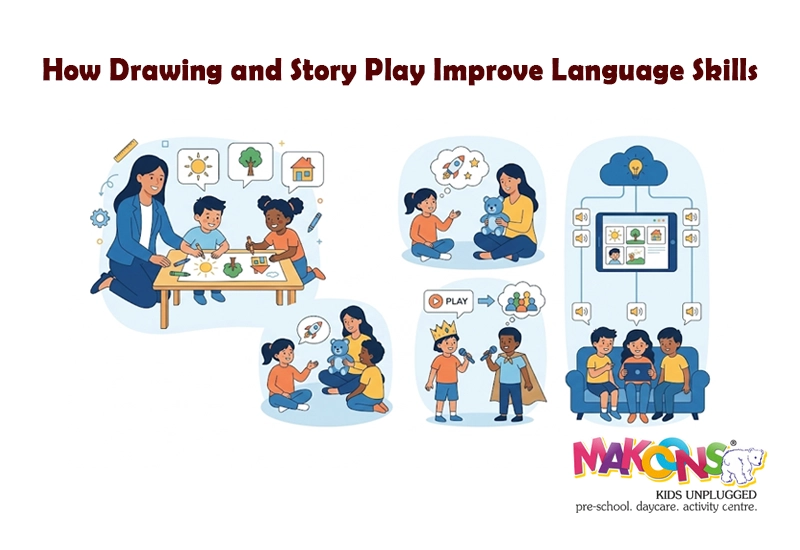
During preschool, children acquire language through experience, imagination and interaction. Though the practice of phonics and alphabet is also essential, the creative approach such as drawing activities with children and story play with children has a strong force in enhancing language development in preschool.
Such activities can assist children in expressing ideas, vocabulary and confidence in the speaking process. We will discuss how creative learning can help develop effective early communication skills and why learning creativity should be central to language activities in preschools.
The Importance Of Language Development In Preschool
The formative years are critical to forming:
- Vocabulary growth
- Sentence structure
- Listening skills
- Emotional expression
- Social communication
Children who acquire good language skills at a tender age are likely to:
- Demonstrate improved performance in school.
- Communicate confidently
- Build stronger friendships
- Demonstrate improved reading preparation.
This process is natural and fun due to creative learning among kids.
The Way Drawing Activities Among Kids Enhance Language Skills
Drawing is not just an art, it is a communication tool. Children can write with clarity, this does not mean that they will not write using pictorial and nonverbal means.
Drawing helps the language development this way:
1. Promotes Verbal Expression
When drawing is finished, children are commonly questioned such as:
- What did you draw?
- Who is in the picture?
- What is happening here?
The response to these prompts is useful to them:
- Form sentences
- Use descriptive words
- Practice storytelling
The mere image may become a significant dialogue.
2. Expands Vocabulary
During the drawings, children are taught words connected with:
- Colors
- Shapes
- Animals
- Objects
- Emotions
- Actions
As an example, they can learn to say not only trees but branches, leaves and trunk. Language is developed instinctively.
3. Improves Listening Skills
When teachers make the following instructions:
- Draw a small red circle.
- Bring two tall trees beside the house.
Children learn to listen attentively and take instructions, which enhances their understanding.
4. Develops Confidence In Speaking
There are children who are reluctant to speak. The sketch provides them with a point of departure. They become more at ease when describing their artwork.
self-esteem increases with every discussion.
The Process Of Communication Has Been Improved By Story Play With Children
Story play is the act of enacting stories, character creation or reenactment of events. It is an activity that incorporates speech and imagination and as such, it is one of the most useful activities of language among preschoolers.
1. Develops Narrative Skills
Children learn through story play:
- Introduction, body and conclusion.
- Sequencing events
- Cause and effect
- Character dialogue
These are the skills that are significant to comprehension in reading in the future.
2. Promotes Rich Vocabulary
Expressive words used in story play by children include:
- Brave
- Angry
- Hungry
- Excited
- Dangerous
They learn to use vocabulary in a context and memorize it and comprehend more.
3. Acquires Social Communication
Story play can be and usually is in groups. Children learn to:
- Take turns speaking
- Listen to others
- Respond appropriately
- Express emotions
Such experiences enhance general early communication.
4. Enhances Innovation And Thought
Creative learning in children enables children to:
- Imagine new scenarios
- Solve imaginary problems
- Create dialogue
Imagination stimulates spontaneous speech and adaptability of thoughts.
Integrating Story Play And Drawing
Language development is further intensified when drawing and story telling is integrated together.
For example:
- A child draws a park scene.
- Then narrates one of the happenings in the park.
- Play with peers.
This process strengthens:
- Vocabulary
- Sentence structure
- Public speaking confidence
- Listening skills
Combined creative practices are best in promoting language development.
Easy Preschool Language Play
The following are classroom or home activities that are easy:
Drawing-Based Ideas
- Write about your family and characterize its members.
- Make up a fake animal and describe its characteristics.
- Draw a favorite story and read it.
- Elaborate your daily routine and describe it.
Story Play Ideas
- Puppet storytelling
- Simulating a doctor visit or a grocer visit.
- Acting out fairy tales
- Composing alternative plots to tales.
Such activities render learning interesting and interactive.
Benefits Beyond Language
Although aimed at communication, the drawing and story play are also enhanced:
- Fine motor skills
- Emotional expression
- Memory
- Social bonding
- Problem-solving skills
Language learning is incorporated in general development.
Parents And Teacher Tips
To stimulate the language development:
- Ask open-ended questions.
- Hear without responding.
- Do not bother to correct every minor error right away.
- Reward hard work and innovativeness.
- Promote fantasy at all costs.
Positive instructions create faith.
Why Creative Learning Works?
Words are taught by traditional repetition, but the creative activities:
- Encourage face-to-face communication.
- Promote free-flowing speech.
- Enhance emotional attachment to language.
- Improve retention
- Make learning enjoyable
When children are relaxed and interested, they talk a lot.
Long-Term Impact
Good communication abilities in early life result in:
- Better reading readiness
- Clearer writing ability
- Easy interaction in the classroom.
- Better academic performance.
Drawings of children and reading stories to the child form the background of communication throughout his or her life.
Conclusion
Preschool language development is more than worksheets and memorization. Drawing creates a voice of the visual and story play creates a voice of the spoken. They foster good early communication abilities together in a natural and happy manner.
Incorporating creative learning in the daily lives of the kids by parents and educators will help in promoting confident expression, vocabulary, and enhanced social interactions among the kids.
Promoting imagination in the present develops assured communicators in the future.
FAQs
1. What is the benefit of drawing activities to language development?
They make children talk about their drawings, develop vocabulary and sentence structure.
2. What are story plays among children?
It entails posing and enacting stories to develop imagination and verbal language.
3. When do children start such activities?
Simple drawing and storytelling may begin as early as at the age of two.
4. What is the frequency of the practice of these activities?
Regular improvement should be done by short sessions every day.
5. Are these activities assisting shy children?
Yes. Drawing is a comforting means of expressing oneself, and one slowly gains confidence through verbal means.
6. Do creative activities facilitate reading?
Yes. Storytelling and language development make children ready to read.