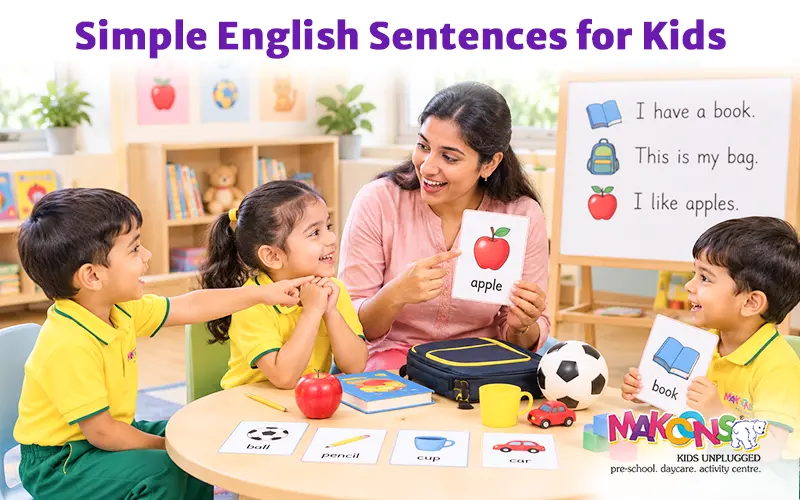
Children will find it easier to learn English if they start with sentences that are short and familiar and make sense to them. Learners can practice words and sentences they hear that they use daily, rather than memorizing difficult grammar rules. Simple English sentences for children: helps children learn words, gain confidence and communicate naturally, at home, at school and when playing.
The main objective for parents and teachers is not to have to achieve perfect English from the outset. This language guide presents practical sentences in English for children, which can be learned in everyday activities.
What Are The Benefits of Children Learning Simple Sentences in English?
Language learning in children is best achieved by repetition and through real communication. With easy sentences, they will grasp the interaction between words. Children gradually learn sentence patterns when they hear the phrase “I am hungry” or “Please give me water” repeated over and over.
Practising basic English for children can support:
Better communication
Stronger vocabulary
Improved listening skills
Greater speaking confidence
Regular exposure is more important than immediate fluency; parents should be aware of this.
Simple English Sentences for School-Age Children at Home
Home is one of the most effective environments to begin spoken English for children, as children will be able to relate language to familiar activities. Use simple sentences at mealtimes, getting ready, cleaning or at bedtime.
Here are some helpful examples:
1. Good morning, Mom.
2. I am hungry.
3. I am thirsty.
4. Kindly provide me with water.
5. Where is my bag?
6. I am ready.
7. Come with me.
8. Please help me.
9. I am getting sleepy.
10. It is time to eat.
11. Wash your hands.
12. Don't put your toys away.
13. Open the door please.
14. Close the window.
15. I want to play.
16. I have completed my task.
17. Can I watch TV?
18. I need my shoes.
20. Go outdoors.
20. Good night, everyone.
These sentences may be taught naturally, instead of just as part of a memorisation exercise.
English Sentences for Kids at School
There are numerous opportunities for children to apply English learning for kids in meaningful ways at school. Instructors can add classroom related sentences, friends, activities and learning.
Examples include:
1. May I come in?
2. May I go out?
3. Is there any water I can drink?
4. Give me a pencil please.
5. I have a question.
6. I know the answer.
7. I don't know.
8. Please repeat.
9. This is my book.
10. Where is my Notebook?
11. Can you help me?
12. Let us read together.
13. I have finished my work.
14. Can I use some crayons?
15. I can do the activity.
16. My friend is absent today.
17. I really like this story.
18. This is my picture.
19. Thank you, teacher.
Children can learn when and how to use these sentences during daily interactions in the classroom, using them as a model.
Simple sentences for different situations in English
If sentences are related to situations that children recognise they learn faster.
For Greetings:
Hello!
Good morning!
How are you?
Nice to meet you.
See you later.
For Polite Communication:
Please help me.
Thank you.
You are welcome.
Excuse me.
I am sorry.
For Expressing Feelings:
I am happy.
I am sad.
I am tired.
I am excited.
I am scared.
For Expressing Needs
I am hungry.
I need water.
I need help.
I want to sleep.
I want to play.
For Describing Things
This is my toy.
The ball is red.
The dog is small.
The sun is shining.
How Parents Can Help Their Children Improve English Speaking Skills
There is no need for parents to do long sessions at home. Practicing for a few minutes can be effective. To begin, select five sentences and use those sentences all day long. When the child is comfortable, add sentences to the list.
Try these strategies:
Speak spontaneously: Make short sentences in English in daily life.
Repeating key sentences: Repetition aids children's recall of words and sentence structures.
Point to pictures and objects: Point to something as you talk, such as a toy, a book or food.
Pose simple questions: Children answer questions like, “What is this?
Praise effort (don't push): Even if pronunciation or grammar is incorrect.
Read aloud: Picture books and short stories introduce children to helpful vocabulary.
Don't correct all the little errors. Rather, use the correct sentence form naturally. When a child states, "He goes to school," a person might respond, "Yes, he goes to school. This provides a good model for the child without demoralizing them.
How Teachers Can Support Children's Learning of Basic English?
Teachers can develop an English rich classroom that children hear and use the language all day long. Speaking opportunities can be provided through greetings, instructions, story-telling, role play, picture cards, songs and group activities.
When choosing sentences, teachers should think about how comfortable the child is with the words they have available and how old they are. Younger children may start off with 2 or 3 word sentences, and older preschools can work with a little longer sentence.
For example:
Younger Learner: “I want water.”
Developing learner: “Can I have some water, please?”
More confident learner: “Can I please have some water?”
This gradual approach ensures that it is manageable and helps children to make progress in learning English.
Avoid These Common Mistakes
Teachers of English sentences for children should not create stress when teaching them English sentences.
Don't try to teach long lists of words to children without meaning.
Children learn language at different rates, do not compare one child's speaking to another.
Use of worksheets for support is good, however children need to speak in real life situations.
Conclusion
Kids' simple English sentences form a solid basis for both communication and language development. As children learn and practise useful phrases at home and school, they acquire vocabulary, sentence patterns and confidence all in one. Parents and teachers can make the process effective by speaking in age appropriate language, repeating sentences, asking questions, and relating English to daily life.
There's a simple recipe to follow: talk, listen, practice, encourage, talk, listen, practice, encourage, etc.
Also Read: Common Fruits Names, Uses & Health Benefits For Kids
Also Read: Ocean Names: Teaching Kids About Earth's Biggest Water Bodies