
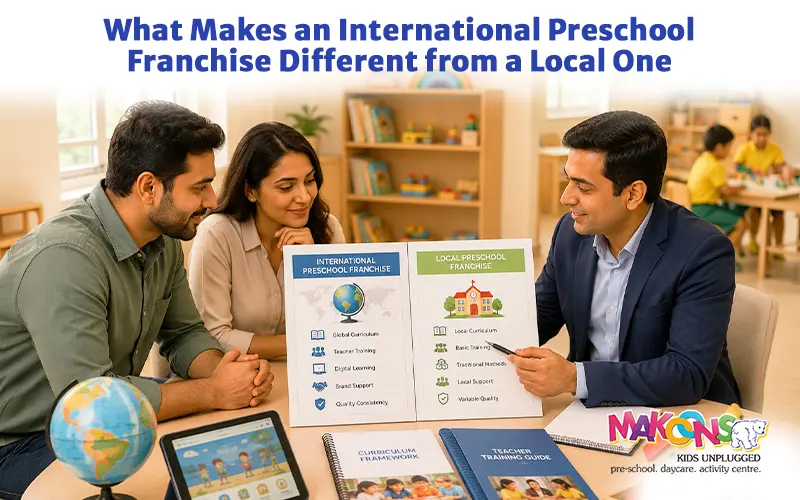
The last decade has seen tremendous growth in the preschool sector in India. The demand for quality preschool programs is growing as parents realize the value of early childhood education. The industry is also expanding, leading to a variety of franchise opportunities for entrepreneurs. Of the choices, one prevailing question might be: International preschool franchise or a local preschool brand?
Both models intend to deliver quality education to young children but there are substantial differences in terms of curriculum, brand value, training, operational systems and growth potential. Being aware of these differences can enable investors to make a suitable choice among the various preschools in India.
Understanding the Preschool Franchise Model
Preschool franchise means that an entrepreneur runs a school under a known brand name and implements the educational program and the rules of the school. The franchise owner receives tried and tested systems, marketing assistance and learning materials.
As a whole, an education franchise can be categorized as either local or international brands, and their methods of teaching and business management can be very different.
What Is an International Preschool Franchise?
A global preschool chain is a preschool chain that operates in various countries based on the same educational approach recognized throughout the world. These systems tend to involve international instruction and learning models, learning plans, and internationally accepted standards for early childhood education.
Years of educational research, professional development systems, and innovative teaching tools are offered by many international brands that are geared toward preparing children for a world in constant flux.
What is a Local Preschool Franchise?
The typical local preschool franchise is run within a particular country or area. Often, these schools tailor their educational programs to match the educational needs, cultural values, and community expectations for their area.
A locally-developed preschool franchise in India might zero in more on regional languages, traditions, and educational practices that meet Indian families' needs.
Local franchises can be very successful, but the scale and operational mechanisms may differ to those of the international franchise network.
The Selection of The Curriculum & Approach To Learning
One of the most noticeable differences between an international preschool franchise and a local preschool is the curriculum.
International Preschool Franchise
Many international preschool brands adopt a global approach to curriculum with a focus on:
- Inquiry-based learning
- Critical thinking
- Creativity
- Problem-solving skills
- Communication development
- Global awareness
The global curriculum promotes whole child development and may sometimes integrate the best practices of education systems from around the world.
Local Preschool Franchise
Local schools might concentrate more on:
- Regional educational expectations
- School readiness programs
- Language-specific learning
- The values and traditions of culture
A very large number of schools in the locality are good, but the curriculum may be more in line with national standards.
Engaging in brand recognition and market value.Participating in brand awareness and market value.
Brand Recognition and Market Value
A globally recognised reputation is a great advantage to an international preschool franchise. The parents might think that international brands are known for their standards, better teaching techniques, and high quality educational programs.
If you're considering a franchise, the brand recognition factor can assist in the marketing and admissions process.
They can have excellent local reputation and community connections, but are not well known to an international network.
Teacher Training and Professional Development
School Franchising is greatly affected by Educators.
International Preschool Franchise
Brands or companies that run internationally spend a lot on:
- Continuous teacher training
- Global teaching standards
- Professional development programs
- Educational workshops
- Quality monitoring systems
These trainings ensure uniformity at every franchise location.
Local Preschool Franchise
Local franchises also offer training, though the level and frequency of professional development might differ depending on the franchise.
Before investing in any education franchise, the level of support that is being provided should be carefully considered.
Operational Systems and Support
The success of a preschool business relies on more than just education quality, though it's important to have that too—it's necessary to be as efficient as possible.
Franchises from other countries typically offer:
- Standardized operating procedures
- Admission management systems
- Learning assessment tools
- Marketing support
- Technology integration
- Quality assurance mechanisms
These systems ease operation and ensure uniformity among the franchisees.
Some local franchises can also provide operational support, though this is not always as developed as the sophistication of the systems.
Technology Integration
In today's society, technology has become a very important part of learning.
Numerous international brands of preschools have a variety of options they include:
- Digital learning resources
- Parent communication apps
- Classroom management systems
- Interactive educational tools
This type of technology enriches the learning experience and helps to communicate better between schools and families.
There are some local schools that also accept technology, although implementation is different depending on the resources and infrastructure, and may not be as developed.
Global Exposure for Children
One of the benefits that's commonly listed with an inter-national preschool franchise is the exposure to global perspectives.
Children can benefit from:
- Multicultural learning experiences
- International educational practices
- Broader world awareness
- Diverse teaching materials
Children learn to be adaptable and culturally aware from a young age with a strong world curriculum.
This aspect is much appreciated by the modern parents who are looking for future oriented education for their children.
Cost and Investment Differences
When looking at franchise opportunities, cost should be taken into account.
International Preschool Franchise
Typically involves:
- Higher franchise fees
- Greater infrastructure requirements
- Premium branding costs
- Ongoing royalty payments
The costs, though, can be offset by increased brand value and fee structures.
Local Preschool Franchise
Generally offers:
- Lower initial investment
- Reduced operational costs
- Flexible infrastructure requirements
When starting up any business, entrepreneurs with low capital may be able to reach local brands as a starting point in the preschool business.
Scalability and Growth Potential
The structured growth path and long-term prospects are among the primary reasons many investors opt for an international preschool franchise.
Often, international brands have:
- Established business frameworks
- Expansion support systems
- Standardized quality controls
- Wider market appeal
These can foster sustainable growth and long-term success of the business.
The school may also gain popularity from parents, who are looking for good education services among those who are well-established and internationally recognized.
Parent Expectations and Demand
Urban families are demanding educational programs that prepare them for academic success, foster creativity, communication, and a sense of global awareness.
Parents who choose an international preschool franchise are likely to be interested in:
- International teaching standards
- Holistic child development
- Modern learning environments
- Future-focused education
In the meantime, nearby schools could draw families that value cultural familiarity, affordability and community-based learning.
Which Is Better?
There is no right or wrong answer. A better selection is determined by:
- Investment budget
- Target market
- Business goals
- Location
- Long-term vision
Entrepreneurs looking for top-tier positioning, brand awareness, and an education that is inspired by the world, may be interested in an international preschool brand.
For individuals who wish to invest in a local education franchise and get closer to their community, this could be an excellent option.
Conclusion
There are many opportunities in the expanding early learning industry for both global and local preschool brands. In contrast, there exist international preschools that excel in their global curriculum, consistent systems, advanced teacher training, widespread brand recognition and their international educational practices.
It is important to educate entrepreneurs on these differences before investing in a preschool business if they are looking into franchise opportunities. In the fast-growing preschool franchise in India market, success can be achieved either by selecting a globally well-known school brand or a reputed local brand, but the key is to provide quality education and fulfill the expectations of the parents.
FAQs:
1.Define international preschool franchise.
An international preschool franchise is a preschool chain that adopts internationally recognised principles and education methods, and may have a presence in various countries.
2. What is the difference between a global curriculum and a local curriculum?
A local curriculum may be more the one that includes more emphasis on regional educational needs and cultural values, whereas a global curriculum may be more the one that emphasizes creativity, critical thinking, communication and international perspectives.
3. Is an international preschool franchise more expensive?
Yes, an international preschool franchise usually necessitates more investment in branding, infrastructure, training and standards.
4.Why is it essential for teachers to be trained in a school franchise?
Good teacher development leads to equal educational standards, good classroom management and improved learning outcomes for children.
5. What is the cost of a preschool franchise in India?
In India, a well-managed preschool franchise can be profitable because there has been a rise in the demand for quality early childhood education and awareness of parents.
Explore Other Blog Topics
FOFO vs FOCO Preschool Franchise Models Explained Simply
Top 10 Preschool Franchise Brands in India: Costs, Fees, Profits & Brand Comparison
