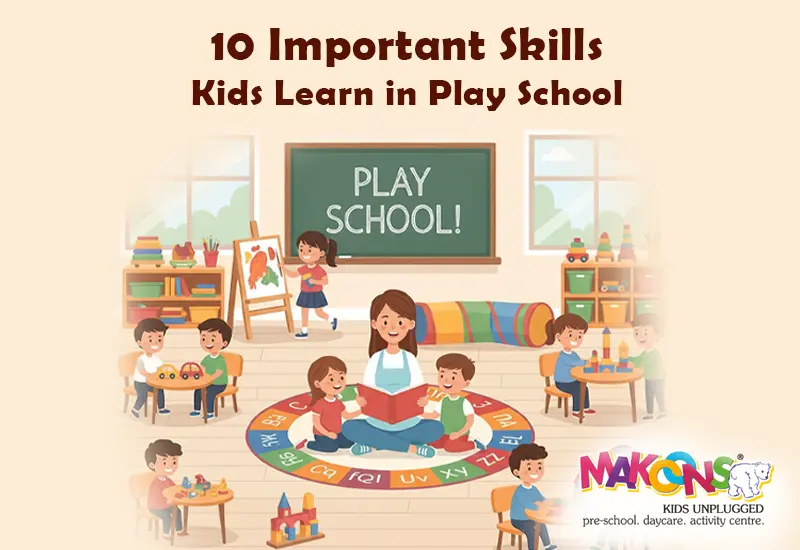
One of the most important developmental stages is early childhood. The brain of a child develops fast within the first five years of life and the environment that is provided to the child influences the way he/she thinks, the way he/she feels, and the way he/she behaves. That is why play school has been playing a significant role in creating a path to success in the future. The abilities gained in preschool are not academic skills only but also social, emotional, physical and practical life skills which enable children to mature into self assured and independent persons.
Play schools are a safe, structured and interesting environment in which learning is achieved through plays, fun activities, and peer interaction. Such experiences at a tender age will assist the children in adapting to a school-like atmosphere and learning to enjoy the process even prior to the start of the school year. This paper will discuss the best preschool skills, the importance of play school and how preschool learning outcomes do relate to general development of the preschool child.
Socialization and Communication
One of the greatest advantages of play school is the development of good preschool social skills. Children learn how to:
- Share toys and take turns
- Talk and listen to others
- Show their needs in a polite manner.
- Follow an instructor's instructions and classroom rules
Educators promote group activities and interactions, enabling small children to master language and make friends. The interactions make children have empathy, cooperation, and respect towards others.
Cultivating of Emotions and Trust
Play school teaches the children how to handle emotions positively. Kids learn:
- The way of revealing emotions such as happiness, sadness, or frustration.
- Separated parents: adjustment.
- How not to be scared of trying new things.
Educators encourage pupils and give them compliments and mild advice, which increases their self-esteem and emotional resilience. Gradually, they become independent and feel safer in a social set-up.
Language and Early Literacy Skills
Play school encourages good language development through telling of stories, use of picture cards, rhymes, and conversations. Children learn to:
- Identify letter and sounds
- Build vocabulary
- Speak full sentences
- Develop listening skills
These early literacy skills equip them with reading and writing in primary school.
The Cognitive and Problem-Solving Skills
Practical activities in preschool are also specific activities aimed at developing thinking and reasoning skills. For example:
- Solving puzzles enhances reason.
- Memory is enhanced by matching games.
- Compared to sorting and counting can build up initial math knowledge.
Children will start giving questions such as why. and How? and demonstrating interest and eagerness to learn. This assists in moulding critical thinking and innovativeness.
Fine Motor Skills
With the help of several creative and practical activities, young children develop the small muscles of their hands and fingers which include:
- Coloring and painting
- Cutting paper using safety scissors
- Threading of the beads and stacking of blocks.
- Gripping pencils and crayons in the right way.
These abilities are subsequently useful in writing, personal care and daily living.
Gross Motor Skills and Physiological Development
One of the significant factors in preschool child development is physical development. The outdoor activities such as running, hopping, jumping, climbing and ball games enhance:
- Coordination and balance
- Body control
- Strength and endurance
- Teamwork and healthy habits are also promoted by sports and movement games.
Creativity and Imagination
Play schools promote learning by use of art, music, drama, and pretend-play. Creative activities are useful in children:
- Explore ideas freely
- Show themselves in a special manner.
- Train narration and creativity.
Students should be taught creative thinking as a useful skill, which will enable them to resolve issues and change their perspectives in relation to various life situations.
Simple Numeracy and Early Academic Ability
Children begin to acquire the basic academic skills in a simple and fun manner before they go into formal school. They are introduced to:
- Numbers and counting
- Colors and shapes
- Plants, animals and weather Early concepts in science.
- This is easy when it comes to transferring to primary school.
Practical Life Skills
Daily life habits also at play schools can assist children to become independent. These include:
- Eating properly
- Hygiene and washing of hands.
- Getting their bags packed, getting things packed up.
- Taking care of classroom materials.
- These early life skills inculcate responsibility, discipline and self awareness.
Attitudes to Cultures and Ethics
Children get to interact with peers of various backgrounds and they get to learn to appreciate diversity. Educators present such values as:
- Kindness and sharing
- Honesty and gratitude
- Admiration of the old and the earth.
Being aware of the traditions and learning about them through celebrating national holidays, wearing some cultural clothes, and so on, bring a sense of belonging and social awareness.
Key Benefits of Play School
In conclusion, play school has many more advantages than those of an academic level. Kids benefit by developing:
- Self-disclosure and trust.
- Powerful words and socialization.
- Sound physical and psychological development.
- Good habits and life skills
- Interest in learning and love.
Play school provides all the children with a head start which will translate into future success.
Preschool Learning Outcomes: What Parents should Expect
At the end of the preschool, the majority of children will be capable of:
- Be effective in communication with people.
- Engage in team work.
- Identify letters, figures, shapes, colors.
- Demonstrate better writing/drawing accuracy.
- Be able to handle simple tasks on her own.
- Show tolerance, collaboration, and sympathy.
These preschool learning outcomes make sure that children join formal school in a smooth sailing manner.
The importance of Preschool Child Development
The initial school experience determines the personality of the child, his or her learning habits as well as behavior. Play school has a solid foundation due to:
- Exposure at the right age.
- Secure and arousing experiences.
- Orderliness and regularly drilled routines.
- Global emotional and social development.
The parents who invest in preschool education provide their child with the opportunity of learning early and having a balanced development.
Conclusion
Play school does not only serve the purpose of keeping the kids busy but rather the place where they develop, explore and find their talents. The abilities acquired during preschool encompass all the significant fields of development including communication and confidence, creativity and responsibility. These are the preliminary years where success in future academics and individual development are founded.
Selecting an excellent preschool guarantees that children receive the finest beginning in life, one that is full of delight, fun, and meaningful learning experiences.