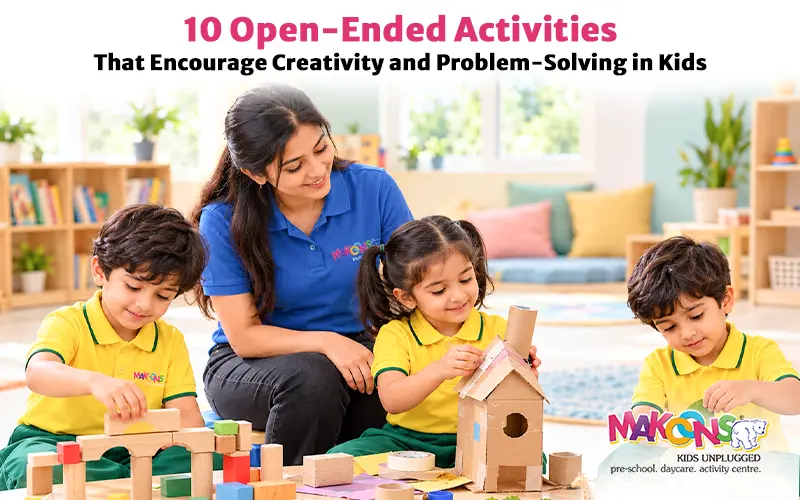
Kids are inquisitive and curious. To them, they may just see a house, a car, a rocket or a shop in a cardboard box or carton. You can put blocks in their hands and they'll probably create a tower, bridge or something you never dreamed of.
The beauty of open-ended activities for kids! Open-ended activities provide children with opportunities to make choices, to experiment, to change their mind and to find their own solutions as compared to activities where the answer is always one or there is a fixed final product.
This is especially applicable in the early years. The Indian National Curriculum Framework, Foundational Stage (NCF-FS) also advocates for minimal direction in open-ended art and craft experiences for children, so that they think independently and differently. It also emphasises that, for young children, the process of creating is more important than producing a particular finished product.
The Ministry of Women and Child Development's Aadharshila curriculum also centres play-based and activity-based learning in early childhood education and incorporates activities that can help children to observe, experiment, solve problems and be creative.
Therefore, sometimes parents and teachers do not have to instruct children on what to create or how to do an activity.
It turns out sometimes the question that's better to ask is:
“What are your ideas about what you could do with this?”
What Are Open-Ended Activities?
An open ended activity is an activity that has more than one possible answer, design, approach or outcome.
For instance, if you ask a child to duplicate a specific drawing, then you know what the result will be. Provide paper and crayons and ask the child to draw a scene where he/she would like to play – the possibilities are endless.
Open-ended activities may be used to encourage children to:
Make their own choices
Generate ideas
Experiment with materials
Find different solutions
Explain their thinking
Learn from mistakes
Work independently
Collaborate with others
Try again when something does not work
Thus, they are suitable activities for children and encourage their early problem solving and critical thinking skills.
10 Open-Ended Activities For Kids
1. Build Something With Blocks
One of the most basic materials available to promote creativity is blocks.
Rather than asking, "Make a tower using six blocks," set a challenge when there are several ways to build a tower.
Try:
“Could You Make a Bridge?”
“Can you create something that will stand?
“Could you construct a house for this toy?”
"Can you make a road for the cars?"
"Can you build something taller than your book?"
Once you have done this, step back and let the child have some fun.
Don't rush to stabilize the structure as soon as it collapses. Ask:
"What could we change so it stays up?"
This makes construction play one of the most useful problem solving tasks for children.
What children practise
Spatial awareness
Planning
Balance
Fine motor skills
Creative thinking
Trial and error
Problem-solving
Large blocks are easier to manage for younger children. Older children can use smaller construction blocks and gradually more challenging tasks.
2. Give A Cardboard Box A New Purpose
A cardboard box can be made into just about anything.
Set up a craft box in front of your child that has paper, crayons, tape and other appropriate craft materials.
Ask:
What might this box be used for?
It might become:
A house
A bus
A rocket
A shop
A puppet theatre
A robot
A post office
A garage
No need to give a model for children to copy.
The NCF-FS allows children to discover various ways of exploring materials and using their own ways of doing so, instead of relying on the traditional or predetermined uses.
Make it more difficult
After the child has created something, ask:
"What does it do?"
"Who uses it?"
“What else could we add?”
“What could you do more to make it stronger?”
“What is the problem it addresses?”
Children are prompted to elaborate their thoughts with these questions.
3. Create A Loose-Parts Challenge
Loose parts are everyday or inexpensive items which children can manipulate, combine and arrange in a variety of ways.
Materials may include:
Cardboard pieces
Large bottle caps
Paper rolls
Wooden blocks
Fabric pieces
Ice-cream sticks
Large pebbles
Leaves
Twigs
Cups
Show the child a set of materials and not state specifically what they are to create.
Say:
"Can you make something using these materials?"
One child can make a house and another child can make a vehicle or an imaginary animal.
The key is that there's no right or wrong answer.
Also household materials and natural materials are identified as useful play materials by the Ministry of Women and Child Development and DIY resources for early childhood are provided.
Safety note: Select materials suitable for the child and steer clear of items that may cause choking.
4. Design A Solution For A Toy
Create a mini-engineering project with a child's favorite toy.
For example:
Your toy animal must have a bridge to cross the river. Can you build one?"
Use blocks, cardboard, paper or other safe materials.
Some other difficulties can be:
Make a bed for a toy.
Construct a house to keep a toy safe from "rain".
Construct a ramp for a toy car.
Design and make a mini boat for a toy animal.
Create a box which will fit multiple small toys.
Never do the solution first, but do model the solution.
Let children try.
If they have a first effort that is unsuccessful, ask:
"What happened?"
“What do you think we could do differently?”
“What else can we do?”
A basic overview of the engineering process (imagine, build, test, change, try again).
These practices are closely related to the focus on experimentation and problem solving in the Indian guidance for play based learning.
5. Open-Ended Art: "Draw Whatever You Imagine"
Art is one of the simplest activities to be creative at for preschool children – but it's more useful if the children are allowed to be creative rather than to copy what their parents have done.
Provide:
Paper
Crayons
Coloured pencils
Paint
Child-safe brushes
Reusable cardboard
Where appropriate, use natural materials.
Next give a general question:
“Create a picture of something you dreamed of today.”
Or:
“Is it possible to design a habitat for animals and humans?”
There is no requirement for the child to draw a recognisable picture.
The NCF-FS specifically calls for open-ended art experiences, and discourages it from imposing ideas of "right" and "wrong" upon children's art expression.
Instead of asking:
“Why doesn't your house look like a real house?”
Try:
“Describe your house.”
This helps to focus the discussion from fixing the product to understanding the child's thinking.
6. Create A Story With No Fixed Ending
Storytelling can be a very effective critical thinking activity if children can have a say in what transacts.
Start with:
“One morning, a little bird noticed an unusual box outside his nest..."
Then stop.
Ask:
"What do you think was inside?"
Let the child make his own choice.
Follow up the answer with a continuation.
You may add new problems:
The bird is unable to open the box.
The box is too heavy to lift.
Help the bird:
It starts raining.
The box disappears.
Inquire with the child on how the character would react.
This encourages:
Imagination
Language development
Sequencing
Prediction
Cause-and-effect thinking
Decision-making
Problem-solving
Storytelling, story making, conversation and dramatic play are among the meaningful early-learning experiences provided in the NCF-FS.
7. Create Your Own Marble Or Ball Run
Make a path for a ball using cardboard tubes, blocks, paper, boxes and other safe materials.
The challenge:
"Can you make the ball travel from here to there?"
Children will find out that:
The ball travels faster if the slope is steep.
A structure that is not strong fails.
The ball can be blocked by gaps.
The angle affects the motion.
Ask:
"What happened?"
“What do you think caused it to stop?”
“What changes could we make?”
“Can you make it go further?”
Children learn through experimentation instead of simply listening to an explanation—this is a wonderful example of creative learning activities.
8. Turn Recyclable Materials Into An Invention
Provide a limited amount of recycled recyclables to children and set up an invention challenge.
For example:
“Can you design something that will assist people in their houses?”
The invention could be:
A toy organiser
A toy vacuum cleaner
A robot
A plant-watering device
A pencil holder
Toy delivery car
An imaginary communication device
Allow children to choose what the problem is their invention is solving.
For older children, ask them to sketch their concept, and then create a basic prototype.
Ask questions such as:
“What does your invention do?”
"Who would use it?"
“What is the problem that this is solving?”
“What do you think needs to be improved?”
This gives meaning to creativity and helps children to link ideas with real-life situations.
9. Nature Art With No Model To Copy
Go outside and pick up safe, natural objects like fallen leaves, small sticks, fallen flowers and pebbles, if applicable.
Invite children to create something.
They could create:
An animal
A face
A pattern
A pretend village
A garden
A road
An imaginary creature
Never demonstrate to them what the finished product is supposed to look like.
Ask:
“What might you be able to make from what you've discovered?”
This is an integration of observation, creativity and fine motor development.
It also helps children to identify the differences in texture, colour, size and shape.
The NCF-FS makes emphasis on observation and exploration of materials as an integral part of children's artistic and learning experiences.
10. Solve A "What Could We Do?" Problem
Problem-solving activities for kids don't have to be physical.
Present children with a real life problem and have them come up with ideas to solve it.
For example:
Situation 1
"We have three people but only two chairs. What could we do?"
Situation 2
"Your toy is under the bed but you cannot reach it. What could you try?"
Situation 3
“It's raining but you wanted an outdoor play! What alternatives are there to that?"
Situation 4
“We must bring 5 toys but our hands are full. What could we do about the problem?”
Do not immediately give the answer.
Ask:
"Can you think of another way?"
The goal is not to come up with the definitive answer. The idea behind it is to make children realize that there can be multiple solutions to a problem.
How Parents Can Encourage Creativity Without Taking Over
The role of the adults is important, but an excess of adult direction can also limit the opportunities for children to think independently.
Instead Of Giving The Answer, Ask A Question
Rather than:
“Place this block in this place.”
Try:
“Where would you like to put this block?”
Instead Of Correcting Immediately, Observe
When the child's structure collapses, allow time for him/her to react.
Ask:
“What do you see?”
Encourage More Than One Solution
Say:
"Can you think of another way?"
Accept Unusual Ideas
The solution of a child might not be the solution of an adult.
Allow them to investigate it if it is safe and feasible.
Praise The Thinking Process
The food is good.Rather than saying: The food is good.
"That's beautiful!"
try:
“When it didn't work, you tried another way.”
“I saw that you made the design changes."
“You have two different ideas.”
“Explain how to make that.”
“Why did you pick that?”
This assists in focusing the attention on thinking, experimenting and persisting, rather than just producing a "good" result.
How These Activities Support Critical Thinking?
Kids' critical thinking activities don't need to be complicated worksheets.
These habits can begin to be instilled in young children through a few simple steps in play:
Observe
What is your observation?
Predict
What do you believe will occur?
Test
Let's find out if your idea is successful.
Compare
Which one was more successful?
Explain
What do you believe is the cause of this?
Improve
What do we need to change?
Try again
What if we try it another way?
This cycle can begin to develop habits of curiosity, reasoning and reflection over time.
The Ministry of Women and Child Development defines play as a "learning by doing" process and explicitly links play to observation, experimentation, problem solving and creativity.
How To Adapt Open-Ended Activities By Age?
A different level of support will be needed for children of varying ages.
Ages 3–4
Focus on:
Simple building
Drawing
Pretend play
Sorting materials
Simple storytelling
Investigating shapes and textures
Be brief and give freedom of instruction.
Ages 4–5
Introduce:
Building challenges
Simple inventions
Story problems
Pattern creation
Nature-based projects
"What would happen if..." questions
Ages 5–6
Children may be able to manage more advanced tasks like:
Designing structures
Testing different solutions
Creating longer stories
Explaining their reasoning
Planning a project
Making changes to a design following testing
These are general guidelines and not strict developmental needs. Children grow at varying rates and activities need to be tailored to meet the interests and abilities of each child.
What Makes An Open-Ended Activity Effective?
It doesn't need to be a resource rich activity.
Identify the following characteristics:
Multiple possible outcomes
Child choice
Hands-on exploration
Room for mistakes
Learners have ample opportunities to ask questions.
Possibility of trying again
Relationship to authentic experiences
Age-appropriate challenge
Very little unwanted adult guidance/control
The NCF-FS explicitly calls for minimal teacher guidance in open-ended art activities and encourages children to think differently and for themselves.
You Don't Need Expensive Educational Toys
Sometimes parents think that creativity has to be learned through specialised learning kits.
It does not.
Open-ended play ideas can be planned for simple materials such as:
Cardboard boxes
Paper
Blocks
Clay or dough
Fabric pieces
Leaves
Sticks
Cups
Safe containers
Crayons
Recyclable materials
Possible resources of play include any household materials and DIY toys used by the Government of India for early childhood development and Aadharshila offers an activity compendium and weekly calendar to play based activities for ages 3-6.
The key factor is not how much does the toy cost?
It is:
"How much can the child do, change, imagine and discover with it?"
Final Thoughts
Children don't have to score 100% on every activity.
Learning is often best when they are given the opportunity to wonder, try things out, make mistakes, then try again.
Open-ended activities for children come in very handy that's why. Turn a cardboard box into a rocket! A stack of blocks can make a bridge. Some leaves can turn into an imaginary animal. Depending on the child's ideas, a simple story can go 10 different ways.
The aim is not to dictate the end product for parents and educators. It is to provide a setting in which children feel free to ask questions, experiment and find their own solutions.
Play can be more than a mere pastime when children are allowed to play and problem solve. It becomes a natural way to work towards creativity, critical thinking, communication, experimentation and confidence.
Frequently Asked Questions
1. What are open-ended activities for kids?
Open ended activities are those that give opportunities for children to make choices and for a variety of possibilities to emerge. These can include building with blocks, making artwork without a reference, making objects from cardboard and making up stories.
2. How do open ended activities promote creativity?
They allow children to make choices, mix materials, try out ideas and make up their own things, based on their imagination. No unique model for all children to emulate.
3. What are some good problem solving activities for Preschoolers?
Examples include building challenges, creating bridges for toys, designing structures, making simple inventions, and solving everyday "What could we do?" situations, and experimenting with ramps.
4. What can parents do to foster creativity without taking over the activity?
Provide children with appropriate resources, use open-ended questioning and give children time to explore. Let them show you what they think to do and allow them to experiment with various methods rather than telling them what to do.
5. Are open-ended activities suitable for children aged 3–6?
Yes. There are many learning opportunities that are open-ended and play based. Aadharshila is an Indian curriculum for children ages 3-6 that features play-based activities to nurture all aspects of their development.
6. Do open-ended activities require expensive toys?
No. Many things you find around the house or in nature can give them opportunities for creative exploration when they use safe cardboard, paper, blocks, clay, leaves, sticks and other materials. Household or DIY materials are also considered as a useful play resource by the Ministry of Women and Child Development, India.