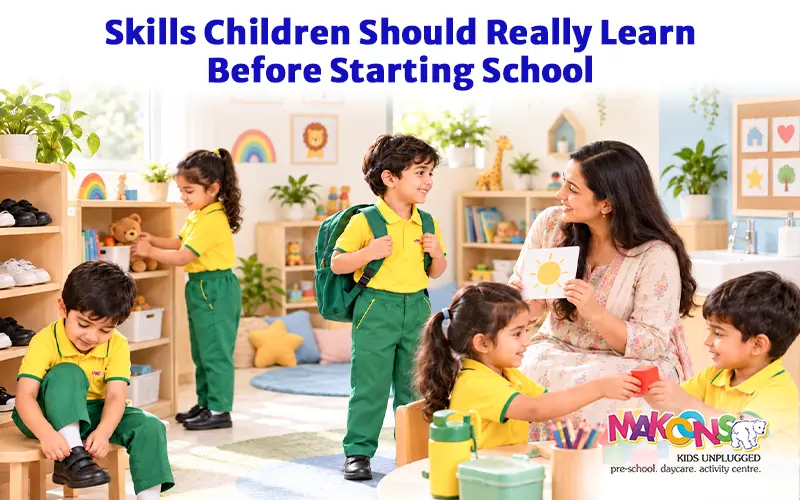
It's a big change to be starting school. The parents have to spend months teaching letters, numbers, colors and shapes for the sake of preparation of small children. These are good preliminary school skills, but knowing ABCs and 123s isn't all the preparation an adult needs to be ready for school.
Feeling comfortable in a classroom requires children to have social, emotional, communication, physical and self-care skills. The skills children learn are important for helping them to get involved in activities, making friends and communicating with teachers as well as dealing with everyday challenges. Knowing these skills that will help your child get ready for school can help you focus on the most important aspects for the first day of school.
1. Listening Carefully
One of the most important skills before starting school is to be able to listen. Children must listen to teachers, stories, instructions and others. Parents may foster this skill through reading short stories to children and asking questions, but trying to listen without interrupting.
2. Following Simple Instructions
There are a lot of common instructions that happen every day in school: Set toys aside, line up, wash hands, open books, etc. Children need to be gradually introduced to simple one or two-step directions and taught to comply. Do these as part of everyday life.
3. Communicating Needs
Children should be able to express basic needs in an effective way. They should be able to communicate to an adult when they need food, drink, when they are uncomfortable, tired or need help. Communication doesn't need to be flawless. Simple words, sentences or gestures are sufficient.
4. Expressing Feelings
Early childhood development includes learning to recognize and express emotions. Children feel happy, angry, sad, frightened and frustrated. Introduce them to the basic language of emotions and give them opportunities to express themselves verbally rather than with their bodies.
5. Managing Small Disappointments
At school children are not always going to get what they want. They might need to wait turns, take turns at a toy, or settle for an end to an activity. Supporting children when things don't go their way helps them to learn to be patient and emotionally resilient.
6. Sharing and Taking Turns
Helping children develop the social skill of sharing can be difficult for young children. Play cooperative and turn-taking board games, role plays, and group games. Inform the children that everyone will have a chance to play with a toy or do something.
7. Making Friends
It doesn't have to be a very outgoing kid before they go to school. They should be given opportunities to greet others, join in simple games, introduce themselves and play with other children, however. These experiences promote positive social development.
8. Asking for Help
Teach your child to ask help from adults or teachers because sometimes a kid can't figure out a solution. Teach them to use simple language when asking for help like “Can you help me?” or “I don't understand.”
9. Basic Self-Care
Self care is personal hygiene. Children should know how to wash their hands, eat on their own, wipe their nose and put personal belongings.They still need assistance at times and that's okay.
10. Using Simple Tools
Children should be given the chance to practise with age appropriate equipment like pencils, crayons, child safe scissors, glue and spoons. Children use these activities to build up hand muscles and coordination and to prepare them for classroom activities.
11. Replacing the use of personal devices and paraphernalia during class time
When children are young it is unrealistic to expect them to sit and listen quietly for a long period of time. They can slowly work to concentrate on a short story, puzzle, drawing activity or simple game, however. Introduce activities they will enjoy and gradually extend time.
12. Cleaning Up
Responsibility is developed by helping children to clean after playing. Help them to replace books in the book shelf, put toys in their box and keep the activity area tidy. Making transitions easier in the classroom can be as easy as simple cleanup routines.
13. Comfortable with routines
Schools have daily schedules for eating, playing, learning, outdoor activities and resting. Routine is good for children. Set up basic schedules at home for sleeping, eating, playing and waking up.
14. Developing Problem-Solving Skills
The children have to deal with minor issues throughout the day. A toy can break, a puzzle piece can be missing or two children want the same one. Don't solve the problem right away, ask questions like, “What could we try?” This promotes independent thought and creativity.
15. Showing Curiosity
Curiosity is one of the most valuable preschool learning skills. Support children to ask questions, investigate their environment, notice the natural world and learn how things work. Learning should be fun and not a test.
School Readiness Checklist
There is a checklist to help parents identify where they can practice with them before school starts. Prior to school, help your child build his or her ability to:
- Follow simple directions.
- Communicate basic needs.
- Express feelings appropriately.
- Share and take turns.
- Ask adults for help.
- Follow simple routines.
- Practice basic self-care.
- Concentrate on short activities.
- Wash up after play.
- Solve simple problems.
- Play with other children.
- Use crayons and other child-safe tools.
- Handle small disappointments.
- Try new activities.
- Be interested in the world around them.
This checklist is not a test. All children learn at their own rate and require assistance with some skills—this is normal.
How Parents Can Prepare Children?
These skills are best developed through the support of daily experiences. Parents don't have to learn complicated lessons or practice for long periods of time. Learning can be supported by reading together, playing games, cooking, dressing up, visiting a park and doing simple household tasks together.
Allow children to make small decisions – which book to choose, which outfit to wear, etc. Let them try things on their own and then intervene. Most of all, acknowledge that effort, not perfection is expected.
Parents can also be positive about school too.
Describe the activities they could encounter there, such as: meeting teachers, making friends, listening to stories, singing songs and playing games. Pre-visit the school if you can, to make the setting familiar.
Conclusion
Preparing children for school is not creating the perfect learner before they start. It's about teaching them everyday skills that will help them feel confident, capable and comfortable in an unfamiliar setting.
These pre-school skills provide the basis for future learning and development, including listening and communication skills, sharing, problem solving and managing emotions. Preschool preparation doesn't have to be a chore with a parent, but it can be made enjoyable and meaningful with patient guidance, playful practice, and a lot of encouragement.
Simple aims that are sought: Children to be ready to explore, connect, learn and enjoy in school.