
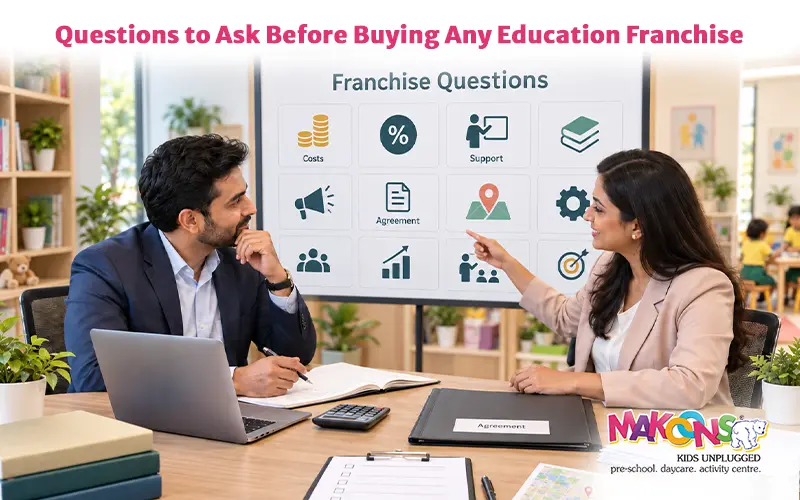
It may seem easy on the surface to purchase an education franchise. You discover a recognized brand, you pay the franchise fee, you establish your center and you begin to enroll students.
In fact, there's a lot more to the choice.
An education franchise is a long term business relationship, and capital investment, contract, staff, parents, students, and the reputation of the franchisor are involved. A great brand can offer great systems and support, but it doesn't mean they are going to guarantee profits.
This is why it is crucial for the entrepreneur to ask the right questions about education franchises before they sign a deal.
This franchise buying guide provides you with an understanding of the things you should look into before investing in a preschool, day care, coaching centre or other educational franchise.
Why Franchise Due Diligence Matters?
Of course a franchise presentation will be much more about the opportunity – brand recognition, curriculum, support, marketing and potential growth.
When you're an investor, you need to think about the other side of the coin.
Franchise due diligence involves doing your own research to determine if the opportunity is right for you:
Budget
Business goals
Location
Management capabilities
Risk tolerance
Expected returns
Time commitment
Quality is another important consideration in education.
The National Curriculum Framework for the Foundational Stage is building on the principles of play based, activity based and developmentally appropriate learning for young children. So when considering a preschool franchise, you need to think about the academic programme as much as the financial.
1. What Is The Total Investment?
Don't settle for the franchise fee that's advertised.
Request the franchisor to provide a detailed written price quotation for the following:
Initial franchise fee
Security deposit (if applicable)
Rent deposit
Interiors
Furniture
Learning materials
Play equipment
Technology
Branding and signage
Licences and registrations
Pre-opening marketing
Staff recruitment
Staff training
Initial salaries
Insurance, where applicable
Working capital
Taxes
Recurring fees
The important question:
"If I start this centre tomorrow, what is the realistic amount of money I need until the business becomes operationally stable?"
This is much more helpful than asking the question, "What is the franchise fee?".
Read More: Best Education Franchise In India Under ₹20 Lakh
2. What Exactly Is Included In The Franchise Fee?
An investment figure advertised by two different franchises can be the same, but the inclusions are different.
Request a list of all inclusions.
For example:
Is furniture included?
Do teaching materials include?
Is branding included?
Does staff training come as part of it?
Is software included?
What extent of pre-launch marketing is done?
Will future curricular changes be incorporated?
Do teachers have to pay extra for additional teaching material?
Get the answers in writing.
Contractual documentation is not to be replaced by verbal assurances made by a salesperson.
3. Are There Any Royalty Or Recurring Fees?
This is one of the most crucial education franchise questions.
Ask:
Does there exist a monthly payment?
Is it based on a percentage of revenue or is it a fixed amount?
Are there any marketing fees?
Do you pay the technology fees separately?
Do any curriculum renewal fees apply?
Does yearly membership dues apply?
Are there mandatory purchases from the franchisor or approved vendors?
Do they have a minimum purchase?
To have a low initial investment can mean that the franchise may become more expensive in the long term if it has high monthly fees.
Figure out the 3-5 year (as opposed to first year) cost.
4. What Does The Preschool Franchise Agreement Actually Say?
When signing a franchise agreement for a preschool, do not be persuaded by the sales presentation.
Please obtain legal advice from a professional with the proper qualifications before signing.
Pay particular attention to:
Term And Renewal
What is the period of the agreement?
What's the process for renewing?
Does it charge a renewal fee?
Does the franchisor have the right to terminate?
Termination
When can either party withdraw?
Does anyone have a notice period?
What is the consequence of termination of your investment?
What do you do with student records?
What happens to the branding and signage?
Intellectual Property
What are the trademarks that one can use?
Can you continue using any materials after termination?
Who owns locally created marketing content?
Restrictions
Check for:
Non-compete clauses
Confidentiality obligations
Territory restrictions
Supplier restrictions
Post-termination restrictions
A franchise agreement will specify the rights you have to run the business under the franchisor's name and business model as well as the operational and quality requirements. The legal relationship is essentially contractual in nature thus it is important to understand the actual legal agreement.
5. Do I Get An Exclusive Territory?
The economics of an education business can be significantly impacted by territory protection.
Ask:
"Can the franchisor open another centre of the same brand near my centre?"
Clarify:
Geographic territory
Radius protection
Minimum distance between centres
Online admission implications
Business or institutional bills.
Centres you currently know in your area.
The possibility of having another franchise in the vicinity of the existing one
A seemingly good area is less desirable if another centre can be opened a few months later by the next door neighbour.
6. How Strong Is The Curriculum?
Especially for preschool franchises, this is crucial.
Don't simply ask:
"Do you provide a curriculum?"
Ask:
Who develops it?
When is it updated?
Does it appear to be age appropriate?
Is it play based?
Are there developmental objectives?
How are teachers provided with teaching resources?
How is it implemented by teachers?
How do pupils' progress be monitored?
What is the teacher's flexibility in regards to this?
The NCF for the Foundational Stage focuses on a balanced approach to free play, guided play, and structured play, and allows children to be active participants in the learning experiences.
A franchise curriculum should therefore be judged on the quality of education it offers (not the number of worksheets, books or activities it contains).
7. What Training Will I Receive?
A first time franchisee might be familiar with business management, but may not be familiar with how to run an education centre.
Inquire about training provided to:
The Owner
Centre management
Financial processes
Admissions
Marketing
Parent communication
HR management
Teachers
Curriculum
Classroom management
Child development
Lesson planning
Activity-based learning
Safety procedures
Administrative Staff
Enquiry handling
Fee collection
Attendance
Parent communication
Record keeping
Also ask:
Does training occur on a one-off basis or is it a continuous process?
Two days of opening workshop training can be more valuable than continuous professional development.
8. What Happens After The Centre Opens?
It's here you have to separate the initial support from the continuous support.
Ask:
Who do I contact if I have an operational problem?
Do you have a designated franchise manager?
How often will the centre be assessed?
Do academic audits take place?
Does the company provide continuous marketing assistance?
What can the franchisor do if admission is refused?
Are refresher training sessions available?
What if one of your key employees quit or passed away?
Ideally, a franchise should give you a system to run the business, rather than open the doors.
9. How Will The Brand Help With Admissions?
The blood of a preschool or learning centre is its admissions.
Ask specifically about:
Lead generation
Digital marketing
Local marketing
Website listings
Enquiry management
Parent counselling
Open-house events
Admission campaigns
Contact relationship management (CRM) or lead-management software
Conversion tracking
Do not take it for granted that the centre will benefit from the provision of sufficient numbers of students by the franchisor.
Ask:
"How many leads can reasonably be expected, and what exactly is my responsibility for converting them into admissions?"
This is a very crucial one.
10. Can I Speak To Existing Franchisees?
This is one of the most valuable things in the franchise-evaluation list.
Don't only speak to the franchisees selected by the sales team.
Ask to talk with a number of current franchisees, such as:
A new centre has just opened.
A centre that has been running for many years
A centre in an urban location like in your city.A centre in a similar city.
If possible, a franchisee whose centre has struggled
Ask them:
Was the real investment approximately equal to the original estimate?
Were there unexpected expenses?
How helpful is the franchisor after launch?
How good is the marketing assistance?
How difficult was recruitment?
How long did it take you to create your admissions?
Are there costs that keep repeating that are reasonable?
Would you do it over again?
The final question may come back especially helpful.
11. What Are The Realistic Financial Numbers?
Watch out for high revenue or ROI projections.
Instead of asking:
“What is the maximum amount I can generate?”
ask:
"What does a realistic centre-level financial model look like?"
Request assumptions for:
Student capacity
Average fee
Average enrolment
Staff costs
Rent
Marketing
Utilities
Maintenance
Recurring franchise costs
Break-even enrolment
Now make three scenarios:
Conservative
Reduced attendance and increased expenses.
Expected
Appropriate student numbers by comparison to other local centres.
Optimistic
Excellent admissions and favourable operating conditions.
If it is only profitable in an optimistic scenario, then that's a red flag.
12. What Happens If Admissions Are Slow?
This is a question that is sometimes forgotten.
Ask:
Is there any extra marketing offered by the franchisor?
Is there a way for fees to be adjusted locally?
Are you able to introduce another day care or other programmes?
Are there any ways of minimizing running costs?
What is the lowest amount of a royalty?
Have a temporary support system?
Where did other centers that had a problem go?
Keep in mind: Local-market risk can't be avoided through a franchise system.
Execution, demographics, competition and price are still important.
13. What Are The Staffing Requirements?
Before investing, know your costs of manpower.
Ask:
How many educators do you need?
What kind of skills should be brought to the table?
What is the recommended or required teacher to child ratio?
Who employs the personnel?
Who pays salaries?
Does the franchisor help with the recruitment process?
What happens when teachers leave?
Do they have substitute teachers on hand?
One of the bigger ongoing expenses of a preschool business can be staffing.
14. What Safety And Compliance Responsibilities Will I Have?
An education business must go beyond the normal business operations responsibility.
When creating your preschool franchise checklist, consider asking yourself the following questions:
Building permissions
Fire safety
Sanitation
Child-safe infrastructure
CCTV policies
Emergency procedures
Staff background verification
Child pickup procedures
Medical/emergency protocols
Insurance
Local municipal requirements
State-specific education requirements
However, requirements may differ depending on the state, city, and specific educational institution, so seek out local professional counsel instead of relying on the franchisor's overall advice.
Safe and secure infrastructure, sanitation, developmentally appropriate curriculum and teacher professional development in preschool settings are also key focus areas of government guidance.
15. What Is My Exit Strategy?
This is one of the most crucial questions that investors also don't like to ask when purchasing a franchise.
Ask:
Can I sell my franchise?
Do the buyer's plans require the franchisor's approval?
Is there any transfer cost?
May I close the Centre?
How do you get the franchise fee?
So what's with the equipment?
What do you do with students' records?
Are there any restrictions after termination?
Before you join the business, you should be aware of the ways you can get out of it.
7 Red Flags To Watch For
Take extra precautions when a franchisor:
Guarantees were made of profits or admissions.
Does not hand over the agreement prior to the payment.
Make immediate decisions for you.
Is unable to describe the total investment.
Does not ask any questions regarding recurrent payments.
Will not allow you to talk to current franchisees.
Makes big monetary decisions without detailing the assumptions.
These are all indicators that a franchise may not be right for you, but that doesn't make it definitive.
The 10 Most Important Questions To Ask
If you don't have a lot of time with the franchisor, begin with these:
What is the total investment that I am making?
What additional costs should I expect after opening?
Will there be any recurring and/or royalties fees?
What do I need to do in the franchise agreement?
Are there any territorial protection restrictions?
How will I be supported once opened?
How are teachers recruited?
What does the curriculum include and how is it developed?
Can I speak independently with existing franchisees?
What happens if I want to sell or exit the franchise?
When a franchisor can give you a clear and concise answer to the questions and back it up with supporting documentation you're in a much better position to assess the opportunity.
Final Thoughts
The popularity of the brand, an appealing presentation and a low franchise fee are not a sufficient basis for an education business investment.
The best franchise opportunity is the one that fits your needs in terms of business model, educational philosophy, financial needs and contractual considerations.
Take your time.
Compare multiple brands. Visit operating centres. Talk to franchisees. Do research on the local market. Develop a financial model. Carefully read the agreement and seek independent professional advice, as needed.
Most importantly, don't just purchase a brand, you're investing in an education business.
In the case of a preschool, this should be achieved by weighing the profitability of the business with the quality of the education offered, the safety of the children and their parents or carers, and the level of trust in the school. Considering the current education system of India, quality ECCE and play/ development based learning are significant factors to be taken into account while making any serious assessment of a preschool franchise.
You can avoid unnecessary costs if you are careful regarding the choice you make prior to enrollment.
Frequently Asked Questions
1. What questions should I ask before buying an education franchise?
Begin by inquiring about the total cost of the investment, the franchise and current fees, territorial protection, curriculum, staff training, marketing support, admissions, operational support, the franchise agreement, renewal and termination policies, and the experiences of current franchisees.
2. What should I check in a preschool franchise agreement?
Review franchise term and renewal conditions, franchise fees, royalties, territory rights, IP, operating obligations, supplier requirements, termination, transfer rights, non-compete and post term obligations etc. Sensible to have the agreement reviewed independently by a qualified legal professional prior to the signing of the agreement.
3. What is the amount that I should save for a preschool franchise?
Don't just consider the franchise fee and centre set-up. Other costs to consider when making your education franchise investment are rent deposits, salaries, marketing, utilities, supplies, and working capital. The size of the reserve is very property-specific, city-specific, staffing-specific, and depends on the anticipated ramp-up in admissions.
4. Is there a better educational franchise that is low cost rather than high cost?
Not necessarily. A less expensive franchise might offer less support services or more recurring costs, while a more costly franchise might offer robust infrastructure, curriculum and operational support. Consider unit economics and TCO not just the initial franchise fee.
5. How can I verify whether a franchise's profit claims are realistic?
Discuss with the franchisor what each number is based on: Number of students, average fees, rent, salaries, marketing costs and other costs. Next, construct conservative, expected and optimistic scenarios. First-hand information may be gained from current franchise holders as well.
6. Why is franchise due diligence important for a preschool?
Preschools are both economically and instructionally responsible. Beyond evaluating profitability, an investor needs to assess curriculum quality, teacher training, child safety, infrastructure, parent communication and applicable local requirements. Safe infrastructure, developmentally appropriate learning and teacher development are also significant issues that are included in government frameworks for ECCE, and are therefore important considerations when assessing a preschool model.
