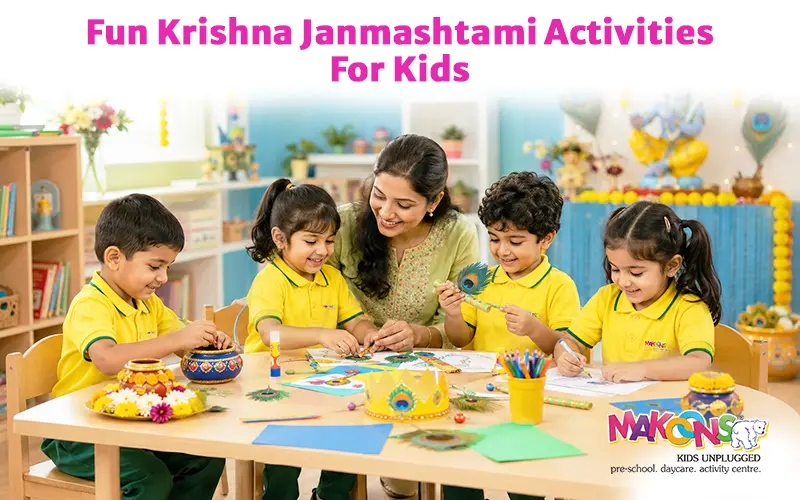
It is a great day to celebrate Krishna Janmashtami with kids, to experience Indian culture, stories, music, art and celebrate in a fun way. Parents and teachers can take children through various age-appropriate, Lord Krishna childhood inspired activities rather than limiting it to prayers or decorations.
Janmashtami celebrates the birth of Lord Krishna and is celebrated throughout India with devotional songs, narration, decoration, dance and cultural events, amongst other activities. Mathura and Vrindavan, where Krishna was closely associated, are most closely identified with the festival.
Preschool and young children enjoy simple, safe, hands-on and playful activities. Let's check out some innovative ideas for Janmashtami for children to be implemented at school, home, or community Janmashtami functions.
Why Celebrate Janmashtami With Children?
Festivals provide children with first-hand experiences of traditions.
Children can grow during a well organized Janmashtami celebration:
Creativity through art and craft
Fine motor skills by colouring & decorating.
Listening Skills through Storytelling
Confidence through singing and role play.
Gross motor skills through movement games
Social skills through Group Activities
Cultural awareness through traditional stories and music
Teamwork through collaborative games
The current Framework for the Foundational Stage of learning also supports children in their learning through play, exploration, story, art, music and meaningful experiences in the early years.
So instead of just having children remember the story of Krishna, have them listen and then create, move, sing and participate.
1. Make A Krishna Crown
One of simplest Krishna Janmashtami crafts for preschoolers is a peacock crown made from feathers.
Materials:
Coloured paper/cardstock
Child-safe scissors
Glue
Crayons/scratch pens
Decorative stickers
Artificial peacock feather
How to do it:
Take a piece of card to make a band that is long enough around the head of the child.
Allow children to be creative and put their own designs on it.
Add a peacock feather to the centre.
Tape or glue together the ends.
Get children to wear crowns during a Krishna song or story time session.
Learning benefit: Fine-motor coordination and creativity are encouraged through cutting, sticking and decorating.
2. Little Krishna Dress-Up Activity
The living room or classroom becomes a mini Krishna celebration.
Children can dress up as:
Krishna
Radha
Yashoda
Nanda Baba
Krishna's friends
Do not make the activity obligatory and uncomfortable for children.
Once all are ready, arrange a miniature Krishna "Theater" procession.
The kids can stroll and listen to devotional or traditional tunes.
Add a fun element:
Have each child read one simple sentence, for example:
"I am Krishna."
or
"I love playing with my friends."
This makes it a good activity for very young children.
3. Make A Paper Flute
The flute is often linked to Krishna in Indian culture and religious devotion and is a fun theme to create a children's craft activity around.
Materials:
Cardboard or thick paper
Crayons
Stickers
Ribbon
Child-safe glue
Children can use dots, stars, flowers or other patterns to decorate their own paper flutes.
Note: use of actual sticks requires bamboo pieces or other hard materials, and must be supervised by adults – do not use sharp pieces. Rolled paper is a better choice for young ones.
4. Peacock Feather Art
Peacock feathers are a common visual symbol and are a delight to be used in art.
Give each child:
A feather outline
Blue, green and yellow crayons
Paint
Cotton buds
The feather can be coloured or painted by children.
Preschool variation:
Don't try to make a perfect feather - let children create their own colourful patterns.
This helps to maintain the activity on the creative side of things, rather than on the artistic side.
5. Krishna Matki Decoration
Janmashtami's theme of the pot or matki is popular due to memories of Krishna's fondness for butter and curd.
It's a chance for children to decorate a paper or lightweight craft pot.
Materials:
Lightweight paper cups or pots
Paint
Colourful paper
Stickers
Ribbon
Glue
Encourage children to make their own designs.
Once the pots are completed, you can hang the completed pots on a classroom wall under the title:
"Our Little Krishna Matkis"
This is a simple toddler Krishna activity and can be done with various ages.
6. Dahi Handi Ball-Toss Game
The tradition of the Dahi Handi is to create a human pyramid to reach a pot hanging above the structure to make dahi. It is especially in evidence in western India, Maharashtra, and is based on the tales of Krishna's efforts to get at the pot of butter and curd.
But for young children, it is not advisable to duplicate the human-pyramid game.
Rather, design an "at school" game.
How to play:
Take a lightweight cardboard decorated "matki" to be placed on a table or low stand.
Provide soft balls.
Let them take turns to toss a ball to matki.
Simple titles you can give are:
Best Aim
Great Throw
Super Team Player
Cheerful Player
It's a great way to celebrate Dahi Handi without endangering young children by giving them an opportunity to climb or fall.
7. Krishna Storytelling Session
Storytelling is one of the most effective Kids Janmashtami Celebration ideas.
Share a brief story that is appropriate for your child's age about Krishna's childhood.
You can talk about:
Krishna's birth
He grew up in Gokul village.
He is a friend of other children.
His love for butter
His playful nature
His flute
His relationship with Yashoda
The Government of India's tourism website says that Janmashtami festivities consist of narration of stories, devotional songs, dance-dramas and enactment of the life of Krishna.
Make it interactive:
Don't narrate the whole story, ask:
"What do you think Krishna did next?"
This promotes child listening and child participation.
8. Makhan-Matki Relay
The game is simple and fun to play indoors or out and is based on Krishna's favourite pastime of eating makhan.
You need:
Lightweight bowls or cups
Cotton balls
Spoons
Cones or markers
Put cotton balls into one of the containers.
Children have to carry them using a spoon and transfer them to another container.
Rules:
Walk, don't run.
Use one spoon.
Take turns.
Cheers to everyone.
If you have toddlers, eliminate the competitive nature and just let them move the cotton balls as they can.
This develops:
Hand-eye coordination
Balance
Concentration
Fine-motor control
9. "Find Krishna's Peacock Feather" Treasure Hunt
Place paper peacock feathers in the classroom or house.
Provide children with easy hints like:
"Look near something blue."
or
"Look where we keep our books."
Together the children look for them.
When done, count the number of feathers that the group collected.
Make it educational:
Write a number on each of the feathers.
Collect them and then place them in numerical order.
A fun for Janmashtami coupled with early numeracy.
10. Janmashtami Colouring Activity
Offer children clear outlines with:
Krishna
Flute
Matki
Peacock feather
Cow
Butter pot
Radha and Krishna
Janmashtami decorations
Allow children to select the colour of their choices.
Do not refuse to let it be coloured "incorrectly".
To motivate preschool children to:
Creativity
Pencil control
Colour recognition
Concentration
11. Make A Mini Jhanki
Jhankis are decorative tableaux which represent a scene or story.
It's very easy for children to make a simple display of Krishna.
Possible scenes:
Krishna with Yashoda
The flute playing Krishna.
Krishna with cows
Krishna with friends
Krishna and the butter pot
Use:
Cardboard
Paper
Clay
Fabric scraps
Recycled boxes
Paper flowers
Children can be assisted by teachers or parents with cutting and construction, and can colour and decorate.
This can be a shared Janmashtami fun activity.
12. Krishna Musical Freeze Dance
Play kid-friendly devotional or traditional songs.
When the music is playing, children dance.
After it stops, all freeze!
Add simple instructions:
Freeze like Krishna!
Try to pretend and play the flute!
Display your peacock feather!
Pretend to hold a butter pot!
This is a merger of Music, Movement and Imagination.
13. "Pass The Matki" Game
This is a modified version of a traditional passing game for Janmashtami.
Music is played and children sit in a circle and pass the lightweight decorated pot.
Once the music has stopped, the child who has the matki can:
Say "Jai Shri Krishna"
Show a dance move
Name a colour
Create an action for playing the flute.
Speak one thing they learnt about Krishna.
Then re-start music.
Don't eliminate children in the game for toddlers – it should not be competitive.
14. Make Butter With A Simple Food Activity
Childhood legends of Krishna are linked with butter and milk products. The government's promotional literature also mentions makhan and dairy products as part of Janmashtami traditions.
For older kids, an adult can model the changes in the consistency of cream/butter using safe food preparation.
An easier choice is:
"Butter Spread Art"
Have each child spread a little butter on a small piece of bread or cracker with a child-safe utensil.
Discuss:
Explain the origin of milk.
How butter is made
Different dairy foods
Confirm any allergies and food restrictions before serving food.
15. Krishna And Radha Handprint Art
Pre-school children love handprint art.
Materials:
Washable, child-safe paint
Paper
Crayons
Googly eyes, optional
Children can create:
Krishna-themed handprint art
Peacock designs
Flute-themed artwork
Decorative flowers
Write each child's name and the date on the artwork.
The completed craft is given to parents so that they can keep it as a Janmashtami memento at home.
16. Janmashtami Bhajan And Action Songs
Music can help to make the celebration more memorable.
Select age appropriate Devotional songs or Krishna related Children's songs.
Include actions like:
Playing along with a flute
Clapping
Making a butter-churning motion
Simulating the act of rocking a baby Krishna
Walking like a peacock
It's not about a flawless rendition.
It is to assist children to participate confidently.
17. "Krishna's Favourite Things" Sorting Game
Make picture cards of various items.
For example:
Flute
Peacock feather
Butter pot
Cow
Flower
Ball
Book
Spoon
Have children guess the objects that are related to Krishna.
If your preschooler is older, have him/her sort the cards into:
Both terms, “Krishna-themed” and “Not Krishna-themed”, are used.
This helps to build observation and classification skills.
18. Janmashtami Puppet Show
Make basic paper puppets of:
Krishna
Yashoda
Nanda
Friends
Cows
Use them to write a short tale.
Children can narrate and move the puppets with their teacher.
Why it works:
Puppet stories can assist children to:
Follow a sequence
Listen carefully
Understand characters
Express emotions
Develop imagination
It can be a good team activity in a preschool class as well.
19. "Walk Like Krishna's Friends" Movement Game
Design a basic movement circuit.
Children can:
Walk like a peacock
Walk around like a little calf
Pretend to play the flute.
Bring a small "matki" (clay pot)
Walk around cones
Limit activities to appropriate and simple movements.
This can be helpful for children with lots of energy who might struggle to stay seated for a long festival programme.
20. Create A Janmashtami Celebration Corner
Rather than decorate the whole classroom, set up 1 learning corner.
Include:
Krishna-themed artwork
Children's crafts
A decorated matki
Paper peacock feathers
A flute craft
Storybooks
Images of traditional celebrations from the festival
Include a basic title:
“Our Krishna Celebration Corner”
This allows kids to enjoy the festival for the whole week.
Safe Dahi Handi Games For Kids
The essence of Janmashtami is actually the Dahi Handi, but the human pyramids that come along with it can cause accidents because of people falling and colliding.
Avoid asking preschool children to climb on top of each other, to be in human pyramids, standing on chairs or reaching for hanging pots.
Instead, try:
Safe Game 1: Matki Ball Toss
Throw a soft ball in a stationary matki.
Safe Game 2: Matki Bowling
Use light colored pots as bowling pins.
Safe Game 3 – Matki beanbag drop
Kids place bean bags in a large extravagant box.
Safe Game 4: Matki Relay
Take a light empty pot from one marker to the next.
Safe Game 5: Decorate-and-Display
Allow children to color on paper matkis and make a display.
The aim is to keep the theme and group spirit of dahi handi but not copy the physically challenging version done by adults.
Janmashtami Activities For Toddlers
Short and simple experiences for toddlers!
There are some great choices:
Finger painting
Peacock feather colouring
Flute decoration
Krishna-themed music
Simple storytelling
Matki sticker activity
Dancing
Handprint art
Sensory play
Pretend flute-playing
Keep toddler activities:
Short
Supervised
Non-competitive
Age appropriate
Contains no small choking hazards
Do not think that toddlers can watch a long programme in the cultural program.
It is better to do a 10-minute activity than a 45-minute session.
What Can Children Learn From Janmashtami?
It is not all about crafts and games, as there are ways to make a good celebration!
Children will be able to acquire the following skills:
Indian traditions
Storytelling
Music and dance
Cooperation
Creativity
Kindness
Friendship
Sharing
Cultural diversity
Community celebrations
Indian Janmashtami celebrations show how religious activities can also be a rich cultural event, which includes music, dance, art, story telling and community participation.
Final Thoughts
There's no need to make Janmashtami activities too difficult or costly for kids. This can be a very memorable event by using a paper crown, matki decoration, a short story about Krishna and a safe dahi handi activity.
The key to the game is to involve children not watching the game.
When planning activities for preschool children, if you are a parent, choose activities at home, and if you are a teacher, choose activities for your school, which will include creativity, movement, story telling and cultural learning.
Above all, prioritize safety and age-appropriate for the celebration. The game of Dahi Handi can be played with human pyramids for older children and ball tosses, relay games and pretend play for the preschoolers. The festival itself is based on the legend of the playful, childhood days of Krishna and butter and curd.
With some creativity Janmashtami can be more than a one day celebration it can be a learning experience for kids, creating, moving, sharing, learning and experiencing Indian culture in a joyous way.
Frequently Asked Questions
1. What are some easy Janmashtami activities for the kids?
Simple Activities are Krishna crown making, Peacock feather art, Matki decoration, colouring, Story telling, Flute crafts, Krishna dancing and safe Dahi Handi games. Activities can be carried out at home or in the preschool classroom.
2. What are good Krishna activities for toddlers?
Simple activities like finger painting, matki decorating with stickers, music and movement, peacock feather colouring, short stories about Krishna and handprint art can be enjoyed by toddlers. Control and supervise activities.
3. What are the different methods to conduct safe Dahi Handi with pre-school children?
Do not do human pyramids, climbing pots or pots hanging upside down. Instead, soft ball matki toss, bean bag drop, matki bowling or a light weight matki relay. These activities are continued with the same theme and are less falls/impact hazards.
4. What are some simple crafts to be made for Krishna Janmashtami?
Children can create Krishna crowns, paper flutes, peacock feather art, decorate matkis, Krishna colouring sheets and handprint artwork. Cut using washable materials for children and have adults supervising.
5. How can schools celebrate Janmashtami without making it too complicated?
It might be a little program, a short story about Krishna, a song, one craft, a safe Dahi Handi game and a short showcasing of children's art work. Children are given opportunities to learn through story telling, creativity, music and movement.
6. Why is Dahi Handi In Commemoration of Janmashtami?
Dahi Handi is associated with the Krishna childhood stories and he would play with his friends and would break the pots of dahi and curd, which were up in the air. This concept is replicated in the traditional celebrations with human pyramids and breaking of pots, especially in the western part of India.