
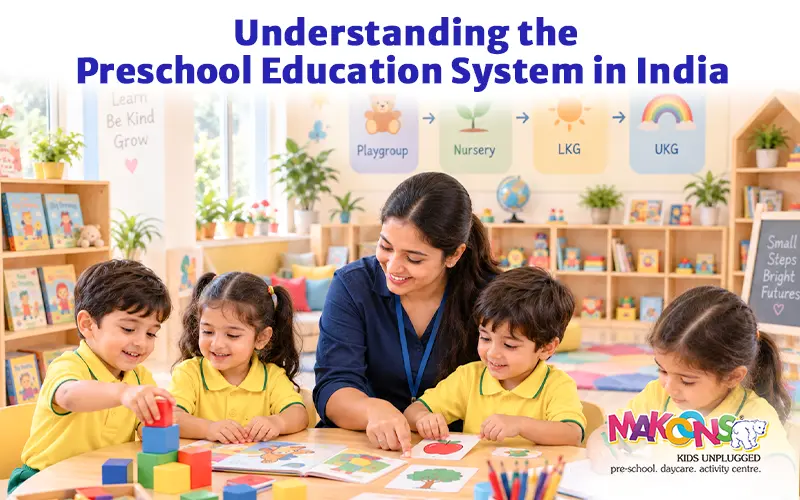
Preschool is the first structured school setting that many parents may have for their child. Whereas the learning in primary or secondary school is largely the same, at preschool, education can be quite different from one school to another. The preschool education system in India can be confusing to parents as they might encounter terms like play school, preschool, nursery, LKG, UKG, Balvatika and Anganwadi.
Fortunately, the determination of how India ought to approach early education is taking shape. The National Education Policy (NEP) 2020 lays emphasis on the role of Early Childhood Care and Education (ECCE) as a cornerstone of the education system and the National Curriculum Framework for Foundational Stage (NCF-FS) 2022 is framed for children of the age group 3-8.
Meanwhile, India has a diverse preschool environment with government Anganwadis, private preschools, play schools and nursery programmes and other early learning centres. For this reason, it is important to have a grasp of how the system works and make informed decisions.
What Is Preschool Education In India?
Preschool education is generally a term for learning and development experiences that children have before they go into the later years of formal learning.
In the Indian context, ECCE encompasses early years birth to eight years, while the Foundational Stage is for ages three to eight. Classes 1 and 2 are part of this stage which will typically be preschool/Anganwadi education for the first three years.
The concept of curricular and pedagogical structure 5+3+3+4 under NEP 2020 is introduced to the education system instead of the previous curricular and pedagogical structure of 10+2. The first 5 years is the Foundational Stage:
3 years of preschool/Anganwadi/Balvatika
2 years of Classes 1 and 2
The policy reinforces quality ECCE provision for children aged 3-6 and the learning that is play based, activity based and inquiry based.
This is significant because preschool is not meant to be the miniature of primary school.
How The Indian Preschool Education System Is Structured?
There is no uniform definition of preschool in India.
Early learning may be delivered in a number of settings such as:
1. Anganwadi Centres
Anganwadis are part of government schemes and are responsible for services for early childhood care, nutrition, health and preschool education.
The ongoing efforts of the Ministry of Women and Child Development under ECCE are the Aadharshila – National Curriculum for Early Childhood Care and Education for children three to six years of age which was developed in 2024.
2. Private Preschools
Private Preschools are run under various names and have their own management systems.
They can provide courses like:
Playgroup
Nursery
LKG
UKG
Kindergarten
The daycare program is integrated with preschool.
There can be a lot of variation in the curriculum, fees, school hours and admission requirements.
3. Balvatika Or Preparatory Class
NEP 2020 anticipates the availability of a preparatory class or Balvatika before Grade 1, which will be taught by an ECCE qualified teacher. Balvatika is a one-year programme designed by NCERT to develop cognitive and language skills required for reading, writing and number sense based on play-activity, according to the NCERT.
4. Other Early-Learning Settings
Children may also be offered early learning opportunities at a childcare centre, community programmes and other recognised or informal early-childhood settings.
What parents need to understand is that preschools are NOT all the same in India in terms of names and class set-up.
Read More: Top 10 Preschools In India Offering The Best Early Learning Programs
Why Early Childhood Education Matters?
Early years are a time of rapid development.
The first 8 years are deemed to be critical for children's physical, cognitive and socio-emotional development by the NCF-FS. It also acknowledges that young children do not follow a smooth path of development, development from year to year.
This does not just mean that preschool should focus on academic achievement.
Children should be helped to develop through a good early years programme:
Language and communication
Early literacy
Early numeracy
Physical and motor abilities
Social skills
Emotional awareness
Creativity
Problem-solving
Curiosity
Independence
Healthy habits
What Does The Preschool Curriculum Include?
Sometimes, parents think of a concrete list of contents when they think of preschool curriculum.
However, learning in the early years is far more integrated in reality.
The NCF-FS mentions a number of developmental areas such as Physical development, Socio-emotional and ethical development, Cognitive development, Language and Literacy, Aesthetic and cultural development, and Positive learning habits.
1. Language And Communication
Children should have opportunities to listen and talk before they are expected to be confident readers and writers.
Activities in preschool may involve:
Storytelling
Rhymes
Conversations
Picture discussions
Songs
Role-play
Naming objects
Asking and answering questions
For instance, a teacher could present a picture of a park to children and ask them, "What do you see in the picture?
This can be a very simple (but powerful) discussion that simultaneously develops vocabulary, observation, and confidence.
2. Early Literacy
Early literacy is a process of establishing the building blocks of reading and writing.
The following steps for learning may be gradually given to children to work through:
Letter recognition
Sounds
Rhyming
Picture-word associations
Book handling
Listening to stories
Their own name
Pre-writing patterns
Simple mark-making
The aims should be to encourage an interest in language and print, rather than to go overboard with writing practice.
3. Early Numeracy
Mathematical concepts are presented in the context of children's everyday experiences.
They may explore:
Counting
Numbers
Shapes
Colours
Sorting
Matching
Patterns
Size
Quantity
Position
Sequencing
Comparing objects
For instance, by posing the question to a child to order three blocks from smallest to largest, mathematical thinking is introduced, without the use of a worksheet.
4. Physical And Motor Development
Physical activity is a key element of early years learning.
Gross motor activities can consist of:
Running
Jumping
Hopping
Balancing
Throwing
Catching
Climbing
Dancing
Some of the fine motor activities may involve:
Drawing
Colouring
Clay work
Building blocks
Threading
Tearing and pasting
Using age-appropriate tools
These experiences gradually build up children's co-ordination and control.
5. Social And Emotional Development
Preschool is also a time to learn the skills of being part of a group.
Children can be taught to:
Share
Take turns
Listen to others
Follow simple routines
Cooperate
Make friends
Ask for help
Express feelings
Respect others
A child who is waiting in line for their turn in a game is learning to take turns and have social awareness, not just a classroom rule.
6. Creativity And Aesthetic Development
Art, movement, music and drama and craft can give children opportunities to express themselves.
Activities may include:
Painting
Drawing
Clay modelling
Music
Dance
Puppet shows
Story-based role-play
Collage
Simple craft
It is not always necessary to create the same piece of artwork. Children should be given opportunities to make some choices and try out things.
Arts, crafts, music, movement, drama and puppetry are recognised as important experiences in the foundational stage by the NCF-FS.
7. Environmental And General Awareness
Kids at this age are inquisitive and eager to learn about everything.
That curiosity can be leveraged in preschools to learn about:
Plants
Animals
Birds
Weather
Seasons
Food
Family
Community
Nature
Cleanliness
Teachers can ask the children to observe, rather than just remember facts.
For example:
"Why do you think this leaf feels different from that one?"
Questions such as this stimulate children's noticing, comparing and thinking.
Read More:Real Difference Between Playschool Vs Preschool Vs Daycare
Learning Through Play: A Core Part Of The System
Play-based learning is one of the most significant principles of the modern education system in India, especially for early childhood.
The NCF-FS emphasises the importance of play in the foundation stage of learning. Children learn by:
Free play
Guided play
Games
Stories
Puzzles
Blocks
Music
Art
Outdoor activities
Pretend play
Conversations
For instance, a "shop" made up of make-believe food items could educate the child:
Vocabulary
Counting
Social interaction
Turn-taking
Decision-making
Familiar everyday concepts
That's why having a fun classroom doesn't mean it is less educational. Play is a wonderful learning tool, when it is planned for.
What Is Different About The New Approach?
In the past, some early-learning settings have given special attention to:
Copying letters
Memorising numbers
Worksheets
Repetition
Recitation
The policy direction is now more focussed on 'whole-child', play and developmentally appropriate learning.
The emphasis of NEP 2020 is to make ECCE flexible, multi-dimensional, play and activity-driven, and centered on the development of cognitive, linguistic, motor and socio-emotional skills.
The Aadharshila curriculum 2024 from the Ministry of Women and Child Development continues a practice of playful and joyful learning for children between 3-6 years and offers a framework for planning activities for Anganwadi.
What Does A Typical Preschool Day Look Like?
The school schedules will vary, but there are some parameters for a developmentally appropriate preschool day which might look like this:
Morning
Arrival and free play
Greeting
Circle time
Songs or rhymes
Learning Time
Storytelling
Language activities
Number games
Theme-based exploration
Creative Time
Art
Craft
Music
Movement
Physical Activity
Outdoor play
Games
Gross motor activities
Routine-Based Learning
Snack or meal time
Hygiene
Cleaning up
Organising belongings
Closing
Story or song
Conversation
Review
Goodbye routine
Rather than adhering to a strict schedule, it's the balance that's key.
Role Of Teachers In Indian Preschools
The job of the preschool teacher is much more than teaching letters and numbers.
Teachers are expected to:
Observe children's development
Develop safe learning spaces
Encourage communication
Support social interaction
Ask meaningful questions
Provide age-appropriate activities
Support children in routine management.
Determine areas for further support
Communicate with parents
The NCF-FS also emphasizes the need to create an enabling learning environment and proper organisation of the classroom.
The quality of teachers teaching the children in the classroom may be more significant for parents than the most decorative room.
Read More:Lkg Vs Preschool: Which Should Come First For Your Child?
Role Of Parents In Preschool Education
The learning journey of preschool doesn't stop when a child crosses the school gate.
Parents have opportunities to reinforce learning through regular activities.
For example:
At Home
Read a story just before going to bed
Count the number of fruits when you buy them.
Have children classify toys
Encourage drawing
Develop a conversation about school
Allow a child to do simple things.
Sing songs together
Visit parks and discuss nature
Parents should not make it an exercise for their children to test themselves.
Rather than repeatedly asking, “What is this?”, ask:
"What do you think will happen?"
"Why do you think that happened?"
"How could we do it differently?"
These questions foster questions and thinking.
Is There One Preschool Curriculum For All Of India?
Not exactly.
While there are national frameworks and policies for early childhood education, there may be variations in preschool programs across institutions, states, management models and curriculum styles.
In the context of Foundational Stage, the NCF-FS is developed at a national level and Aadharshila developed by the Ministry of Women and Child Development is developed in the Anganwadi context for ECCE children aged 3-6.
There may be private preschools that create their curriculum or implement a branded learning programme.
Knowing that not all schools that have the label "preschool" teach in exactly the same way.
How Parents Can Evaluate A Preschool
Don't just look at the furniture, smart boards or coloured walls when visiting a preschool.
Ask practical questions such as:
What is a regular day like at your house?
How much time do children spend playing?
Is there any activity outside?
What is the process for children to get introduced to reading and writing?
What approach do you take to teaching numbers?
What are teachers' qualifications and training?
What does the school do if a child cries or is upset when they are separated?
How many children are there for each teacher?
How does the school keep in touch with parents?
What safety/hygiene precautions are taken?
How does the school support a range of children's learning speeds?
India's ECCE policy framework has identified some of the quality concerns, such as infrastructure, safety, child-carer interaction, learning experiences, health and nutrition, and staff qualifications and parent involvement.
Preschool Should Prepare Children For School—Not Pressure Them Into It
The one thing that parents should know is that school readiness is more than academic knowledge.
A child who can:
Communicate basic needs
Follow simple instructions
Participate in group activities
Handle basic routines
Interact with peers
Use and hold learning materials
Perform simple self-care activities
Keep engaged in an activity
Show curiosity
is learning key skills that will be important for school.
According to the Foundational Stage approach of NCERT, children's development is not uniform or systematic, especially in the early years.
Therefore, judging a child on his or her pace of letter or number writing only can lead parents to draw a wrong conclusion.
The Future Of Preschool Education In India
The early childhood development in India is slowly and steadily evolving towards a more integrated perspective of early childhood development.
The Government now has programmes that are connecting education to:
Health
Nutrition
Safety
Social-emotional development
Language
Physical development
Family participation
Aadharshila is part of the current ECCE framework of the Ministry of Women and Child Development, which covers the age group of 3-6 years, and Navchetna for birth to 3 years, as part of a wider agenda for building up the quality of ECD programmes and services.
This is a critical note with regard to this direction because young children need more than classroom learning. They require responsive adults, safe setting, nutrition, opportunities to play, move, and communicate and have meaningful interaction.
Final Thoughts
The preschool education system in India is moving from the academic to an all-round system of education to cater to diverse aspects of children's development.
The NEP (2020) (NCF for Foundational Stage and newer ECCE initiatives) now emphasizes play, exploration, language, early numeracy, physical development, social-emotional skills, creativity and positive habits.
For parents: it is important that they don't ask just:
"How quickly will my child learn ABC and 123?"
A more pertinent question is:
"Will this environment help my child become curious, confident, independent and ready to keep learning?"
A good preschool provides children with a foundation; not only for the next class; but to be enthusiastic learners.
Frequently Asked Questions
1. What is the preschool education system in India?
The Early Childhood Care and Education (ECCE) system in India includes a preschool education system. NEP 2020 defines the age-group of children in the Foundational Stage as 3-8 years which includes, in large part, all preschool/angwadi children and Classes 1 and 2.
2. What age do children usually attend preschool in India?
Preschool typically begins at age 3, and can be referred to by various terms in different schools and states. Please note that the age criteria vary by preschool and may be different to the individual preschool, please check this with the individual school.
3. What does a preschool curriculum include?
Language and literacy, early numeracy, physical development, social-emotional development, art and music, environmental awareness, problem-solving, creativity and everyday-life skills are all parts of a good preschool curriculum. The NCF-FS, unlike most academic worksheets given, focuses on all-around development in India.
4. Does play-based learning work for preschool children?
Yes. Through play young children will learn with exploration, moving, imagination and interaction. The NCF-FS puts play at the heart of the foundational-stage pedagogy and integrates it with stories, conversations, toys, music, art and more.
5. What are the differences between Anganwadi and Private preschool?
Anganwadis are early childhood and nutrition service programmes provided by the government and the private preschools are government funded but not directly run, or run by private education providers. May differ in their fee, facilities, programs, staffing and program implementation.
6. What should parents look for when choosing a preschool?
Parents will think about teachers' knowledge, safety, cleanliness, teacher/pupil relationship, methods of learning, play, outdoor play, communication with the parents and how the school caters for individual pupil growth. It is not a characteristic of quality preschool education that a classroom be "coloured.
