
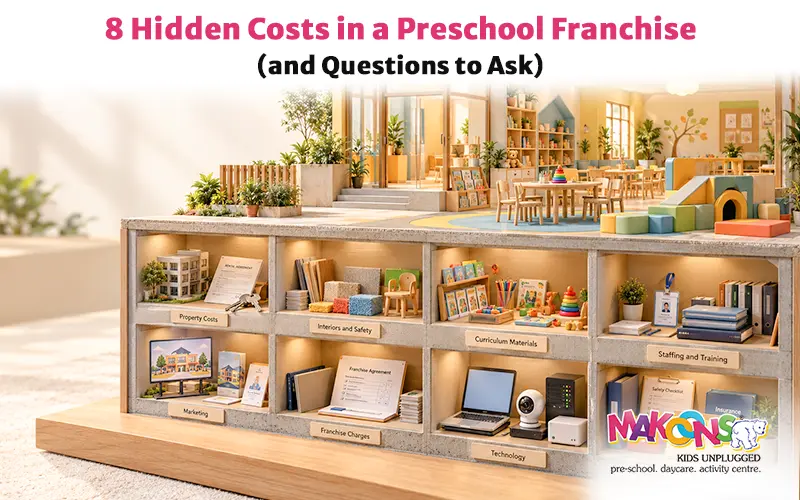
Entrepreneurs who are interested in developing a business in early childhood education can find an exciting opportunity in starting up a preschool franchise. Recognised brand, structured curriculum and set-up guidance may make it easier. Money on offer in a franchise brochure, however, may not be the total amount you will require to start and run a centre.
In addition to the franchise fee, property deposits, further setup costs, fees for the curriculum and staff training, and other costs may arise in the first few years.
It is important to know these hidden franchising costs in the preschool industry before signing an agreement so that you can set a realistic budget, protect your working capital and avoid unpleasant surprises.
In this guide, we discuss eight costs to consider, what questions to ask the franchisor, and how to determine the total financial investment.
Why You Should Look Beyond The Advertised Franchise Fee?
These are some of the elements that can come in a franchise package: brand, curriculum materials, furniture, training and set up support. However, the inclusions are different for each brand.
For instance, a complete setup might not contain the rental security deposit, local renovation work, salary costs prior to opening or adequate working capital to cover the initial few months.
One good way to begin is to split up your finances into three groups:
Start-up costs: These are costs that occur prior to the preschool's opening.
Recurring costs: These are the costs that must be paid on a monthly, annual or agreement basis.
Contingency and working capital: cash held to pay for unforeseen expenses and lower than usual enrollment.
Let's examine the 8 expenses that need to be kept in mind.
Also Read: Low Investment Play School Franchise: What's Realistic And What To Question
1. Property Deposit, Brokerage And Rent Before Opening
One of the critical expenses of setting up a preschool is property. Rent is not the only limitation of cost.
Before the centre begins operating, you may be required, depending on the property and rental agreement, to deposit a security deposit, a brokerage fee, advance rent, maintenance charges and/or utility connection charges.
Rent can be charged before the preschool begins tuition collection, during the process of renovating, furnishing, recruiting and pre-launch marketing.
Questions to ask:
How much of a security deposit and advance rent will the landlord ask for?
Does the broker have to be paid and by whom?
Will rent commence on commencement or post fit out?
Do maintenance fees, parking or common area fees count?
Are space, access and safety requirements to the property as per the brand?
If the property is turned down after making a deposit, what should you do?
How To Prepare: Obtain a written rental quote and verify that the lease includes child care. Please verify local requirements, if any, before purchase. Don't assume that a cheap rent month is an appealing location.
2. Interiors, Civil Work And Child-Safety Improvements
When you are selecting a property to house a preschool, you need to have a child friendly environment, however the property you choose may not be prepared for you to move right in.
Other work may involve flooring, painting, electrical work, child-proofing, wash room renovations, partitions, classroom storage, outdoor play area, signage.
These costs can rise if the building needs repairs or if the franchisor specifies requirements for design.
Questions to ask:
Are design, installation and labour charges covered in the franchise package?
Is there furniture, play equipment and classroom storage?
Who is responsible for electrical, plumbing and washroom modifications?
Do transport, installation and contractor charges apply?
Do you need to upgrade the interior of the brand in the future?
Is it possible to get a written Bill of Quantities prior to any work being carried out?
How To Prepare: Request a site-specific quote instead of relying on pictures or description of a standard quote package. Have itemized cost estimates for materials and labour, and have a contingency for repairs that may not be anticipated.
3. Curriculum Kits, Books And Mandatory Learning Materials
Curriculum materials are very important in a preschool's programme of learning. There may be some ongoing expenses, though.
This can be a range of annual student sets, workbooks, teaching resources, activity materials, replacement materials and curriculum changes. A franchisor may also stipulate the need for buying from endorsed suppliers.
The key factor is not that materials are present, but how much each will cost as numbers of enrollee increases.
Questions to ask:
Do the initial curriculum kits come in the franchise fee?
How much does each child cost for the annual learning materials?
Are all books, uniforms/activity kits required to be bought from the brand?
Do you have to order a minimum quantity?
Payment for shipping, handling and replacement parts?
Is it possible for prices of materials to fluctuate while the contract is in effect?
Preparation: Ask for a price list in writing and make material estimates for various levels of enrolment. Work out the cost per child and see if this is funded by the preschool or if there is a parent fee for this which is paid separately.
4. Staff Recruitment, Salaries And Ongoing Training
Preschool quality and operations depend on teachers and support staff. Their expenses can go beyond their monthly paychecks.
Consider recruitment, background checks (where applicable), induction, substitute cover, uniforms and replacement recruitment hiring, if employees leave.
A franchisor can offer some training, but will charge for further training sessions, travel, training/accommodation for new recruits.
Questions to ask:
What is the staffing size for the centre?
Does the employer provide training for all staff or for specific staff?
Is there a cost for refresher courses and training to replace staff?
How are trainers' travel and accommodation costs covered?
What do you have to offer new hires?
Are there any staffing and/or qualification requirements?
How to prepare: Create a monthly budget for staffing, based on the anticipated number of children, number of hours, and staff duties for each position. Allow for a realistic staff turnover and training allowance – do not assume that staff will stay all year long.
5. Marketing, Admissions And Brand Promotion
Even if marketing templates and launch support are offered by an established brand, local admissions call for effort.
These costs may be digital advertising, local promotions, printed materials, community events, open house activities, signage and photography. There may also be franchise fees to be paid to a central marketing fund in some franchise contracts.
Don't assume that providing marketing assistance equates to a promise of admission.
Questions to ask:
Does the package include pre-launch marketing?
Do there need to be regular monthly or annual marketing payments?
Who pays for local advertising campaigns?
Is there an option to select a local marketing agency of my choice?
Does the franchisor give leads and what does it really entail?
Do there have to be any required events or promotions?
How to do it: Develop a marketing budget for launches and a monthly budget for continued marketing. Inquire with the franchisor the stuff it will provide, and the stuff you will have to fund on your own.
6. Royalty, Renewal And Other Franchise Hidden Charges
Recurring fees play a big role in the cost of a franchise business. The percentage of revenue, fixed or annual royalty, marketing contributions or technology charges may be required as a result of the agreement with the franchisor.
Even a brand that claims to have no upfront costs can have ongoing charges or purchases. It's the actual agreement, not the marketing headline, that defines what you owe.
Questions to ask:
Is royalty calculated on gross revenue, net revenue or another amount?
Does the calculation of discounts, refunds and taxes vary?
Do you have to pay an annual renewal fee or a brand extension fee?
Do you have any marketing, inspection or administration fees?
Are there any charge increases that may happen during the agreement?
If I sell, transfer or close the centre what payments do I have to make?
How to do it: Ask for a full list of charges and fees – one time and recurring. Before signing, read the terms of payment, renewal and termination. If any wording is unclear, take independent legal advice.
7. Technology, Software And Maintenance
More and more preschools are implementing online applications, registration, communication with parents, and fee collection and school updates. All of these can aid administration, but there might be extra expenses involved in subscription and equipment.
This may cover school-management software, website support, parent communication systems, computers, internet access, CCTV and equipment maintenance or repair, data storage.
Questions to ask:
Does the software come as a full agreement or only for the initial period?
Do you have monthly or annual membership fees?
Does the price apply to the number of students/staff?
Who does the installation, upgrades and technical support?
Are CCTV, internet and data storage included in the package?
What if the franchise ends, what will happen to the students' records?
How to prepare: Ask for a technology cost sheet that includes installation, subscription, upgrades and support. Also set out how student information will be securely processed and transferred or retained if the relationship with the student ends.
8. Compliance, Insurance, Repairs And Working Capital
There are some costs that are obvious in a franchise setup package, while others are easy to overlook.
Based on where you are, your business and property type, you may need to allocate funds for registrations, local approvals, fire and building safety, professional and insurance costs, etc. Requirements are variable, check with the relevant authorities and qualified local advisers.
Also consider regular maintenance, cleaning, hygiene products, pest control, equipment replacement, and unexpected maintenance.
Keep an adequate working capital ratio above all else. Even if lower number of admissions are received or fees are not paid on time, rent and salaries are paid.
Questions to ask:
What registrations, permissions and safety requirements are applicable to this property?
Is compliance guidance offered by the franchisor, and is there a restriction on this?
What type of insurance should be obtained for the property, employees and children?
Who is responsible for inspection, renewal and repair?
What is the amount of cash to keep in the initial operating period?
If they are not opened or the number of admissions is not as expected?
How to prepare: Set aside a separate working-capital buffer that includes conservatively estimated monthly expenses with an admissions forecast. Avoid promises of instant enrollees and guaranteed break-evens.
Also Read: How to Start a Preschool Franchise in India | Read Full Guide
How To Calculate The Real Cost Of A Preschool Franchise?
It is important to make a complete budget with actual quotes, if possible, before comparing brands.
Include:
Any initial licensing fees and franchise fee.
Brokerage and the pre-opening rent, and property deposit.
Interiors, furniture and play equipment.
Materials for the curriculum and transportation.
The recruitment, salaries and training of employees.
Marketing and admissions.
Software, utilities and maintenance.
Relevant compliance and insurance costs.
Recurring royalties, renewal fees and other contractual charges.
Working capital and contingency funds.
An Illustrative Example
Suppose that a franchisor charges ₹ 12 lakh as setup package. Once you've reviewed the details you see other costs:
Property deposit & pre opening rent: ₹2 Lakhs.
Additional repairs and safety measures: ₹1.5 lakh.
Recruitment & launch marketing: ₹75,000.
Other supplies and equipment: ₹ 50,000.
Working capital reserve: ₹3 Lakh.
These are only hypothetical additions, and will add up to ₹7.75 lakh or a total of ₹19.75 lakh (before additional expenses not stated above).
Not a market estimate or prediction of the cost of your preschool (this is an example of how your budget may change). Use specific, written quotes throughout, in place of each number.
Plan for the first 12 months at least with a month-to-month forecast of cash flow; test a scenario where admissions are reduced.
Final Checklist Before Signing a Preschool Franchise Agreement
Before payment – you must have:
A breakdown of the total amount invested in writing.
All one off costs and repeating costs are listed.
New estimates of the cost of home construction/ home improvement.
Compulsory price list and Curriculum price list.
A staffing/training plan.
Information about marketing and technical assistance.
Good working capital and operating budget.
Become familiar with royalty, renewal and territory and exit fees.
Making up any catch-up payments on unexpected expenses.
Consulted with a competent professional to discuss agreement if necessary.
The greatest due-diligence questions are the ones that enable you to convert all of the guarantees into dollars, responsibilities and documentation. Franchise tips also suggest researching aspects such as the agreement, support, territory and experience of existing and former franchisees prior to investing.
Frequently Asked Questions
1. What are the most common hidden preschool franchise costs?
Ans: Some of the common costs are property deposits, extra work in the interior, curriculum kits, staff training, local marketing, software, renewal fees, and repairs and working capital. The costs may vary by brand, property and agreement, so get a thorough written quote.
2. Does the advertised preschool franchise investment include everything?
Ans: Not necessarily. Some packages may contain salary deposits, local modifications or working capital and some packages may not have any of these. Some may contain some branding, curriculum and some set up items. Request a breakdown of costs that includes everything involved, as well as exclusions and extras.
3. What is the amount of working capital that I should have for my preschool?
Ans: The quantity will vary for each centre. Base monthly rent, salaries, utilities, supplies, marketing and recurring fees and then assume they will be less, since you're a model.Take your monthly rent, salaries, utilities, supplies, etc., and seek to assume that admission will be less than expected, because you're a model. Have a separate reserve according to that prediction and financial situation.
4. Can a zero-royalty preschool franchise still have hidden charges?
Ans: Yes. Zero royalty is connected to the royalty that is specified in the contract. Marketing costs, learning resources, software, learning, renewals and compulsory purchase may incur additional costs. If no contract, review any periodic payments prior to investing.
5. What questions should I ask a preschool franchisor before signing?
Ans: Ask about upfront costs, ongoing charges, if they cover changes to the property, material costs, any training and marketing assistance they offer, and any renewal or departure fee. Discuss existing franchisees on how the arrangement works.
6. What can I do to minimize any unplanned costs of running my preschool?
Ans: Get quotes in writing, view the property before entering a lease, factor in supplier costs and have a contingency reserve. Review the franchise agreement and then take a conservative estimate of the number of students enrolled – and remember there is no guarantee of reaching break even or return on investment.
