
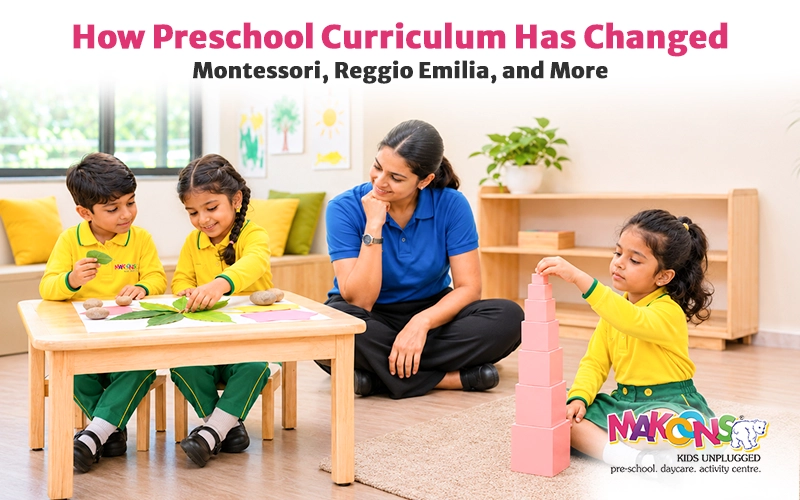
This blogpost will explore the modifications made to preschool curricula while we study various educational methods which include Montessori and Reggio Emilia, together with contemporary educational methods. The research will show you the advancements that early childhood education programs are making to support their students.
Early Preschool Curriculum: Then vs Now
In the past, preschool education was simple. Teachers focused on:
- Learning
ABCs and numbers
- Memorizing
words
- Sitting quietly and following instructions
Children had limited freedom. There was less focus on creativity or thinking skills.
Today, things are very different. Modern preschool teaching methods focus on
- Learning
through play
- Asking
questions and exploring
- Building
social and emotional skills
- Encouraging creativity
The preschool educational system has undergone transformative development through this transitional process. Active participation in learning activities helps students to achieve better educational results according to current school understanding.
What Are Modern Preschool Teaching Methods?
Contemporary preschool teaching methods show no connection to established preschool teaching methods because they base their practices on research about how children acquire knowledge. Children at a young age develop their learning skills through practical experiences rather than through auditory instruction.
Some key features include:
- Activity-based
learning
- Group
work and interaction
- Storytelling
and role play
- Hands-on experiences
These methods are part of early childhood curriculum trends that focus on the whole child, not just academics.
Montessori Approach
The Montessori method is one of the most popular preschool learning approaches.
Key Features:
- Children
learn at their own pace
- Classrooms
have special learning materials
- Teachers
act as guides, not strict instructors
- Focus on independence and self-discipline
The Montessori classrooms are such that the children decide for themselves the activities in which they will choose to engage, and at that very moment, their working on activities that only suffice to build feelings of confidence and good judgment.
Benefits:
- Improves
focus
- Builds
independence
- Encourages
problem-solving
- Reggio Emilia Approach
The Reggio Emilia approach is another modern method. It started in Italy and is now used worldwide.
Key Features:
- Learning
is based on children’s interests
- Strong
focus on creativity
- Use
of art, drawing, and expression
- Teachers observe and support learning
Children are encouraged to express their ideas in many ways. This is why it is sometimes called “100 languages of children.”
Benefits:
- Boosts
creativity
- Encourages
communication
- Supports emotional development
Montessori vs Reggio Emilia Approach
When we consider montessori vs reggio emilia approach, we are looking at two modern and child-oriented ways devised for the betterment of the child.
Montessori:
- Structured
environment
- Fixed
learning materials
- Focus on individual work
Reggio Emilia:
- Flexible
environment
- No
fixed curriculum
- Focus on group learning and projects
Both are part of progressive education models for kids. The choice depends on what suits the child better.
Play-Based Curriculum in Preschool
One of the biggest preschool curriculum changes is the focus on play.
A play based curriculum in preschool means children learn through games and fun activities.
Examples:
- Building
blocks to learn shapes
- Role
play to understand real-life situations
- Story games to improve language
Play helps children:
- Think
better
- Work
with others
- Learn without stress
This method is now widely used in modern preschools.
Other Preschool Learning Approaches
Apart from Montessori and Reggio Emilia, there are other preschool learning approaches comparison points to consider
- Waldorf
Approach
- Focus
on imagination
- Limited
use of screens
- Strong
role of storytelling and art
- HighScope
Approach
- Active
learning
- Plan-do-review
system
- Children
make choices and reflect
- Traditional
Approach
- Teacher-led
learning
- Focus
on books and worksheets
- Less flexible
These approaches show how diverse early education has become.
Why Preschool Curriculum Has Changed?
There are many reasons for these changes.
1. Better Understanding of Child Development
Experts now know that early years are very important. Brain development happens quickly in this stage.
2. Focus on Skills, Not Just Knowledge
Schools now focus on:
- Communication
- Creativity
- Problem-solving
These skills are important for the future.
3. Changing Needs of Society
Today’s world needs people who can think and adapt. This is why modern preschool teaching methods are more flexible.
Early Childhood Curriculum Trends Today
Some key early childhood curriculum trends include:
- Learning
through play
- Use
of technology (in a balanced way)
- Focus
on emotional well-being
- Inclusive education
Preschools are also involving parents more in the learning process.
Preschool Learning Approaches Comparison
Here is a simple comparison to understand different methods:
|
Approach |
Focus Area |
Learning Style |
|
Montessori |
Independence |
Self-paced |
|
Reggio Emilia |
Creativity |
Project-based |
|
Waldorf |
Imagination |
Story-based |
|
High Scope |
Active learning |
Plan and reflect |
|
Traditional |
Academics |
Teacher-led |
This preschool learning approaches comparison helps parents choose the right method.
Benefits of Modern Preschool Curriculum
Modern curriculum offers many benefits
- Better
social skills
- Strong
communication
- Improved
confidence
- Love for learning
Children enjoy learning more when it is fun and interactive.
Challenges in Modern Curriculum
Even though there are many benefits, there are some challenges
- Not
all schools follow the methods correctly
- Some
parents still prefer traditional learning
- Training teachers for new methods takes time
It is important to choose a preschool that follows these methods properly.
Conclusion
Since its inception, preschool education has undergone substantial changes. The original system concentrated solely on delivering basic educational content to students. The current system provides comprehensive development programs which benefit all aspects of a child's growth.
Montessori and Reggio Emilia educational methods demonstrate that students can experience enjoyable and purposeful learning activities. These methods represent contemporary preschool teaching approaches which assist children through multiple developmental areas.
FAQs
1. What are preschool curriculum changes?
The educational transformation that preschool curriculum changes bring about results in educational procedures that shift from traditional teaching methods to modern methods which focus on play-based learning and creative expression and comprehensive child development.
2. What is the difference between Montessori and Reggio Emilia?
Montessori is structured and individual, while Reggio Emilia is "flexible, group-oriented," and geared toward creative expression.
3. What is a play-based curriculum in preschool?
This is a learning strategy that enables children to learn by playing, doing, or making some craft without reading books only.
4. Which preschool method is best?
There is no single best method. The selected method requires assessment of the child's particular requirements and the child's actual interests and the child's specific learning method.
5. Why are modern preschool teaching methods important?
They offer children guidance to develop important life skills such as verbal and non-verbal communication, creativity, and resigning occasions.
6. Are traditional preschool methods still used?
Although some schools still use traditional methods, most of them are starting to combine traditional methods with the modern.
