
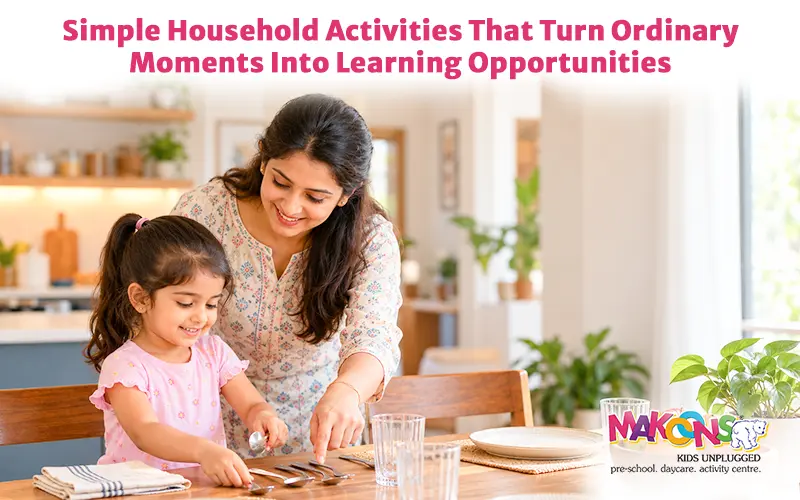
Children learn more than just from sitting with a workbook and working on it in preschool. These are some of the most important learning opportunities for them to help with setting the table, sorting laundry, watering plants, making a simple snack or putting away their toys.
Young children's learning takes place at home. They have opportunities through a variety of everyday activities to observe, ask questions, count, compare, communicate, move, experiment and solve simple problems.
This is in line with the ongoing early childhood education system in India. The National Curriculum Framework for Foundational Stage (NCF-FS) places immense focus on the role of play and activity in the learning process and views conversations, stories, games, art, music, exploration and hands-on activities as crucial learning moments for the child.
The Ministry of Women and Child development's Aadharshila curriculum for children 3-6 also supports and advocates the philosophy of play-based and activity based learning and offers close to 150 activities in various developmental areas.
So, the parent does not necessarily have to be carrying around lots of costly learning toys and lesson plans daily. Other times, the best home learning experiences are those that occur daily in the home.
Why Everyday Activities Are Valuable For Children?
Young children learn best by being able to move and participate, see, hear and touch.
One household skill may be able to meet more than one skill requirement. For instance, if you ask the child to place 5 spoons on the dinner table, you are asking him to:
Counting
One-to-one correspondence
Following instructions
Hand-eye coordination
Responsibility
Vocabulary
Concentration
NCF-FS is a perspective that focuses on young children as active learners who learn through play and exploration, manipulation, experimentation and interaction with others. Such experiences can be used to nurture creativity, problem-solving skills, communication, attention and perseverance.
This is why it's better to learn things through all day activities than to always have to remember things.
15 Household Learning Activities For Kids
1. Sorting Laundry
Laundry could be just a classification game.
Have your child sort clothes by:
Colour
Size
Type
Family member
Socks versus shirts
Light versus dark clothes
When older pre-schoolers, ask questions about the groups, such as: "Which group has more clothes?” or "Can you find two socks that look the same?”
They will learn about sorting, comparing, vocabulary, visual discrimination and early mathematical thinking.
2. Counting While Setting The Table
Help children to make mealtimes one of the easiest learning experiences for them.
Ask your child to:
Count plates
Bring four spoons
Match the glasses to the plates
Count family members
Identify the smallest/largest plate
Simple addition and subtraction can be gradually introduced based on real-life situations.
For example: "We have three people at the table and three plates. Do we need another plate?"
The activity offers the children a good reason to use the numbers, instead of just regurgitating them.
3. Helping In The Kitchen
Children are able to participate in some simple food preparation tasks with adults, who are supervising them.
They may be able, depending on their age:
Wash fruits and vegetables
Tear lettuce
Mix ingredients
Name and count the fruits.
Identify colours
Identify large and small objects
Talk about smells, textures and tastes
Vocabulary can be introduced like smooth, rough, soft, hard, sweet, sour, cold and warm.
The nursery offers opportunities to discuss healthy eating and hygiene through the development of children's physical underpinning and in the kitchen.
4. Grocery Shopping As A Learning Activity
Going shopping can be a fun experience.
Confer a small job to your child before leaving.
For example:
Search for the 3 red fruit(s).
Count five bananas.
Identify round vegetables.
Search for an object that's boxed.
Compare the sizes of two packets.
Look for numbers that are printed on the price labels.
Children can help at home to sort food into categories like fruits, veggies, grains and household items.
Seeing, classifying, counting and developing language as they go shopping.
5. Water Play At Home
Water can be a very rich learning experience!
Provide children with cups, bowls and small containers under close supervision to explore how to pour and transfer water.
Ask:
Which container is the bigger?
Which one is empty?
When pouring slowly, what happens?
What will happen if you pour quickly?
Which container has the most in it?
Water activities in particular are identified by NCF-FS as being helpful in coordinating, attending and developing early understandings of measurement.
Restrict water play for the younger children to shallow water and supervision.
6. Cooking Measurements
Older preschoolers are able to observe while an adult measures ingredients to mix food.
For example:
Count two bananas.
Add one spoon of flour.
Fill a cup halfway.
Compare a full and empty container.
Find out more and less.
This doesn't have to be a formal maths class for students. Allow the child to observe, anticipate and engage safely.
7. Watering Plants And Gardening
Creating a mini science lab on a balcony or terrace, a garden or even a few house plants!
As plants are being watered:
What plants need to grow
The roots, stems and leaves
Different leaf shapes
Colours and textures
Changes that occur from day to day
Excessive water can be detrimental
Let your child water one of the plants and monitor the results.
This engenders curiosity and helps to connect learning to nature.
8. Cleaning And Organising Toys
Cleaning doesn’t have to be a task that is done only to get it done.
Have children categorize their toys:
Cars
Dolls
Blocks
Puzzles
Soft toys
Art materials
Then ask them to make a list of items from smallest to largest or a particular list.
This helps to develop responsibility, sequencing, organisation and classification.
Most of all, children are taught that normal activities are ones that they, as children, can do and not ones that adults do all the time.
9. Building With Household Materials
Store safe cardboard boxes, paper rolls, containers and other clean recyclable materials.
These can be used by children to make:
Houses
Garages
Towers
Shops
Roads
Animals
Pretend kitchens
Ask open-ended questions such as, "How can we make the tower taller?" or "What can we use as a door?"
NCERT also emphasizes the importance of making and experimenting with toys using inexpensive or free materials (as appropriate), with the guidance of adults.
10. Cooking Or Pretend-Shop Role Play
Create a small "store" at home with empty, safe food packages or objects.
Little ones can take the roles of the shopkeeper or the customer.
They can practise:
Greeting others
Asking questions
Naming objects
Counting
Comparing quantities
Taking turns
Using polite language
Role play is useful especially as it incorporates imagination and communication and social interaction.
11. Storytelling During Everyday Routines
It is not always necessary to have a picture book to foster language development.
Create a short story when you're folding clothes, travelling, cooking or preparing for bedtime.
You could ask:
"What do you think happened next?"
Ask your child to make a story about a toy, family member or imaginary character.
Within play-based learning the NCF-FS specifically emphasizes storytelling, conversation, read-alouds, rhymes and question and answer interactions.
12. Matching Socks
When laundry is dry, provide your child with a basket of socks, and request that he or she match pairs.
Make it more challenging by asking:
Which pair is bigger?
How many pairs are there?
How many socks are left?
Can you arrange them by colour?
This is a simple task that integrates matching, counting, visual observation and fine motor practice.
13. Making Patterns
Patterns are found all around the house.
Use safe objects such as:
Spoons
Blocks
Bottle caps
Toys
Paper shapes
Make a straightforward design:
Red – blue – red – blue
Next, ask your child to guess what comes next.
Preschoolers over 4 years of age can make their own patterns.
This is an introduction to mathematical thinking (MT) without the child perceiving that he is learning formal mathematics.
14. Exploring Sounds Around The Home
Have your child pay close attention to various sounds.
For example:
Fan
Doorbell
Water running
Birds
Vehicles
Pressure cooker
Clock
People talking
Ask "What made that sound?”
Loud and soft sounds or fast and slow rhythms can also be compared.
In India, the concept of play-based learning is embedded in the curriculum of the Foundation Stage of school education and music, rhythm, conversation and movement are recognised as elements of play-based learning.
15. Simple Household Science Experiments
Cause and effect is a natural curiosity of children.
Consider the following activities that can be done simply and with supervision:
What sinks and what floats?
Put safe household items in a container of water and have the child make a prediction.
What melts?
Compare an ice cube placed in various locations.
What mixes?
Watch what happens when you add salt or sugar to water.
The aim is not to impart detailed technical scientific jargon. Instead, encourage children to observe, predict, test and describe.
The following are habits of scientific thinking.
Related Topic: Common Learning Activities In Indian Preschools
What Children Can Learn Through Household Activities?
Household involvement in the planning of the household can help:
Language: naming, describing, storytelling and conversation
Early maths: counting, sorting, matching, measuring and patterns
Physical development: pouring, carrying, reaching and manipulating objects
Cognitive skills: observing, comparing, predicting and problem-solving
Social-emotional development: Cooperation, patience, responsibility and turn taking.
Creativity: building, drawing, pretending and inventing
Life skills: cleaning, organising, hygiene and helping with routines
Confidence: ability to do small work without assistance
The NCF-FS also highlights that learning takes place through active engagement and experiences, a suggestion that is further reinforced in the Ministry's Aadharshila framework which also emphasises play-based activities and learning.
Related Topic:15 Skills Children Should Really Learn Before Starting School
Final Thoughts
Home learning for preschool kids often doesn't present itself in traditional studying formats.
It can be as simple as counting the spoons at dinner, checking if the socks have matched after laundry, watering the plant, helping to wash vegetables or wondering why ice melts.
These are common moments that count because kids are learning from what's around them.
It is not the parent's role to be the teacher at home. They can just be facilitators, good questioners, listeners and observers to give children opportunities to participate in a safe way with their ideas.
As daily activities turn into explorations, children learn an important concept: Learning is not confined within the walls of the classroom or books. It's part of everyday life.
Frequently Asked Questions
1. What are some simple learning activities at home for preschoolers?
Simple options include counting objects in the house, sorting laundry, matching socks, watering plants, storytelling, or building with boxes, helping in the kitchen, or creating patterns and playing with water. They don't need any specialised equipment.
2. How can household chores become educational activities for children?
Parents can engage children in suitable activities and ask some basic questions. For instance, children can count plates and spoons as they set the table. They can categorize laundry by colour, size or type while sorting.
3. Are household objects useful for preschool learning?
Yes. Safe household items can be used for sensory play, sorting, matching, counting, and for pretend play and problem solving. The Ministry of Women and Child Development of the Government of India takes special cognizance of the value of use of materials from the household in the play activities of young children.
4. What is the recommended amount of time that children should spend on home learning activities?
Not all activities need to be planned in the same way as a classroom activity. Brief, frequent chances in daily activities can be good. It's more important to have good interaction and involve the child in activities rather than make the home a classroom.
5. How do parents make learning through everyday activities fun?
Respect their interests, let the child make choices, use real objects, ask open-ended questions and don't make activities tests. Allow children to try out and fail at times.
6. Can everyday household activities replace preschool education?
Household activities are a valuable complement to early education but should not be a substitute for the wider experiences of a good early education or preschool setting. A quality early years setting includes play, interaction, planned experiences, social learning and physical activity and opportunities to explore.
