
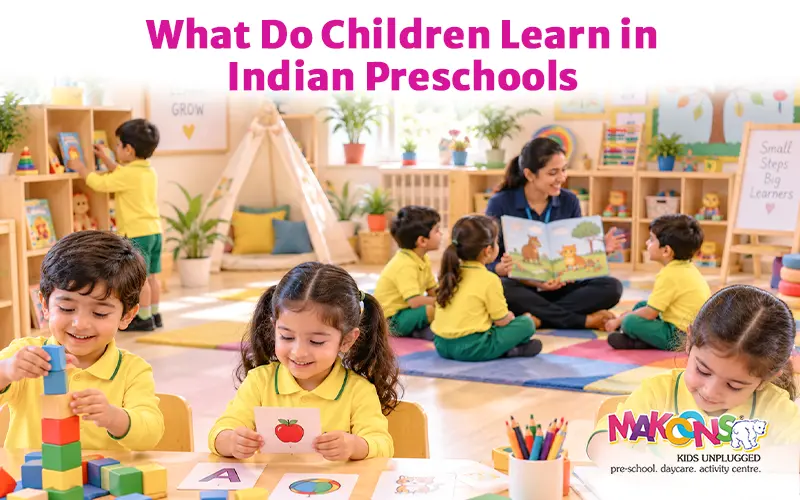
Many parents ask themselves: ‘What will my child learn at preschool?’
It's so much bigger than being able to learn the alphabet, numbers or nursery rhymes.
Good preschool learning in India emphasizes the development of language, early mathematical thinking, physical coordination, creativity, social skills, emotional awareness and independence. Many of these are taught to children through stories, conversations, games, music, movement, art and through everyday activities—rather than long periods of formal instruction.
This is also aligned with the Early Childhood Care and Education (ECCE) that has been put as the cornerstone of the National Education Policy (NEP) 2020 in India. Early learning is play-based, activity based and inquiry based, and is described as being in the areas of language, numbers, colours, shapes, puzzles, art, music, movement, teamwork and social development.
Therefore, what children learn in the pre-school is not a list of subjects. It is a blend of knowledge, skills, habits and experiences which aid them in their preparation for the next phase of learning.
What Is Preschool Education?
The term preschool is used to describe early learning programmes that lie before formal primary education. The current education system in India includes 3 years of preschool education (Anganwadi) and Classes 1 and 2 as the base level.
Preschool education aims to provide young children opportunities to:
Explore their surroundings
Communicate with others
Develop early language skills
Know simple numerical and pattern relationships
Improve physical coordination
Express themselves creatively
Become aware of sharing and cooperating
Become more independent
Develop healthy habits
Develop team self-assurance in a team environment
What's important is that children don't learn at the same rate. The approach of the National Curriculum Framework for Foundational Stage (NCF-FS) towards learning outcomes is not age-centred but developmental.
1. Language And Communication Skills
Communication is one of the most critical aspects of preschool children's development.
Lots of listening and talking takes place during much of the preschool day. Stories, songs, conversations, picture books, rhymes and role play can all be used to help children express themselves, which teachers can do.
Children can slowly and incrementally learn to:
Listen attentively to a story or conversation
Follow simple instructions
Name familiar objects and people
Learn new words
Speak in simple sentences
Describe pictures
Ask and respond to questions
Speak words and phrases from a familiar story
Express their needs and feelings
Join in with group discussions
Depending on the environment of the school and the native language of the child, some Indian preschools may also be bilingual.
Multilingualism and Indian languages are particularly emphasised in NEP 2020 and opportunities are suggested for children to be taught in familiar languages.
A basic class room demonstration
A teacher with a picture of a marketplace in front of them might ask:
"What can you see?"
"Who works here?"
“Which color is this fruit?”
"What would you buy?"
Such a simple interaction can serve to develop vocabulary, observation, confidence and comprehension all at once.
2. Early Literacy
Preschool isn't expected to be a time when all children can read long sentences on their own.
Rather, children are taught the stepping-stones that will carry them later on into reading and writing.
These may include:
Recognising letters
Identifying sounds
Listening to rhymes
Recognising their own name
Looking at books
Interpretation of the meaning of print
Picture to word association
Recognising familiar symbols
Practising pre-writing strokes
Developing interest in stories
Children can practise vertical lines, horizontal lines, curves, circles and patterns before moving on to controlled writing.
This is especially crucial as it is not enough to recognize the alphabet if one is going to write. Hand strength, coordination, visual attention and the ability to control small movements are also needed in children.
The NCF-FS suggests that learning should be through stories, conversation, toys, music and art/craft, and using suitable methods to early literacy and numeracy.
3. Early Numeracy And Mathematical Thinking
Early mathematical development is also an important aspect of preschool curriculum in India.
This does not imply complicated calculations for young children.
Rather, math content is presented in real-life situations.
Children may learn:
Counting
Number recognition
More and less
Big and small
Tall and short
Shapes
Colours
Sorting
Matching
Patterns
Sequencing
Comparing objects
Position and direction
For instance, the teacher may present 5 blocks, and instruct the children to count.
Or children might sort buttons according to colour or size.
The activities in this section are designed to give children an idea of mathematical relationships in preparation for more formal arithmetic.
4. Physical And Motor Development
The importance of children's physical development in their early education cannot be overlooked as they learn through movement.
Running, jumping, balancing, climbing, throwing and catching are all examples of preschool activities.
The experiences promote children's development of:
Gross Motor Skills
They include the use of larger body parts like:
Walking
Running
Jumping
Hopping
Balancing
Throwing
Catching
Climbing
Fine Motor Skills
These include more refined and limited movements including:
Holding crayons
Turning pages
Using scissors safely
Threading beads
Building with blocks
Drawing
Pasting
Handling classroom materials
The NCF-FS particularly emphasizes on physical development, healthy eating and hygiene practices, safety awareness, sensory development and co-ordination of various muscle groups.
5. Social Skills And Learning To Work With Others
Preschool is a place where children may first have some regular contact with a group outside the family.
This is very significant in the realm of social development.
Children develop the ability to:
Share materials
Take turns
Wait patiently
Listen to others
Work in groups
Make friends
Listen and obey simple instructions in class
Ask for help
Help classmates
Respect personal space
Participate in group activities
For instance, if four children are constructing a tower of blocks they are learning much more than building a tower.
They are learning to communicate, cooperate, be patient and problem solve.
6. Emotional Development
An effective preschool setting also provides children with opportunities to learn and express feelings.
Teachers can assist children to identify emotions like:
Happiness
Sadness
Anger
Fear
Excitement
Frustration
Surprise
Children can slowly begin to learn to express phrases like:
"I am sad."
“I don't like this one.”
"I need help."
"I am angry."
This type of emotional language can enable children of all ages to express their needs rather than just crying or reacting physically.
Teachers can also demonstrate, for example, taking a breath, seeking assistance, waiting for their turn or moving to a quiet place.
7. Creativity Through Art And Craft
Art is not just a means to pass the time with kids.
Children can experiment, make choices and express ideas through drawing, painting, clay work, collage and paper activities and craft.
The kinds of activities that are common in preschool involve:
Finger painting
Colouring
Drawing
Tearing and pasting paper
Clay modelling
Leaf printing
Collage making
Simple craft projects
At times, the end product is not as important as it may seem.
The choice of colours, positioning of materials, or drawings a child makes can be as significant as the artwork itself.
The experiences suitable to the foundation stage in the NCF-FS are visual art, craft, drama, puppetry, music and movement.
8. Music, Rhymes And Movement
Songs and rhymes are prevalent in Indian preschool classrooms as they involve language, memory, movement.
Children might sing:
Alphabet songs
Number rhymes
Action songs
Festival songs
Nursery rhymes
Animal, fruit, colour and everyday routine songs.
Children can clap, jump, turn, march or move along the rhythm as teachers wish.
These activities can be used to aid:
Listening
Memory
Vocabulary
Rhythm
Coordination
Group participation
Confidence
Music also provides a relatively low pressure means of engagement for children, especially for those children who are shy when directly questioned.
9. Environmental Awareness
Young children are curious about the world around them.
That curiosity can be harnessed to teach preschoolers some basic concepts about the natural world and the environment in preschool activities.
Children can be taught about:
Plants
Animals
Birds
Weather
Seasons
Water
Food
Family
Neighbourhood
Cleanliness
A teacher might lead the children outside for a look at leaves, flowers or insects, for instance.
Children can be encouraged to observe rather than memorise the names of objects:
“What do you see?”
“Is this a smooth or rough leaf?”
“Which is greater?”
"Where does the bird live?"
This makes mundane observation a learning opportunity for early science.
10. Health, Hygiene And Self-Care
Preschool also teaches children habits that will assist them in developing their independence in daily activities.
Children may learn about: depending on their age and school schedule:
Washing hands
Covering mouth when coughing or sneezing
Keeping belongings organised
Eating healthy foods
Drinking water
To keep the class room clean.
Properly using the toilet
Recognising some simple safety measures.
These lessons are usually learned by watching a demonstration, singing, using story books or daily activities, rather than listening to a lecture.
Repeated practice is especially crucial for young children.
11. Independence And Everyday Life Skills
Among the most beneficial benefits of preschool may be improved independence.
Children can slowly become able to:
Put away their toys
Carry their own bag
Open a lunch box
Pack away materials
Wear or remove simple items of clothing
Ask for assistance
Follow classroom routines
Make simple choices
These could seem like normal things to do, but they encourage children's confidence and responsibility.
A teacher may have a child give out crayons or put books back on the shelves.
The task is easy, but it communicates to the child:
"I can contribute too."
12. Problem-Solving And Logical Thinking
For preschool children, opportunities should be provided for them to solve age-appropriate problems and not be handed answers.
Teachers can use:
Puzzles
Building blocks
Matching games
Sorting activities
Memory games
Sequencing cards
Simple experiments
Construction activities
For example:
A teacher may hand out a child some objects and ask the child to sort them into groups based on colour.
Another activity can be a fill-in-the-blanks:
Red – Blue – Red – Blue – ?
The aim is not to teach advanced mathematics. It's learning how to see connections and consider possibilities.
Puzzles, logic and problem-solving skills are within the overarching foundational learning experience in the NCF-FS.
13. Cultural Awareness And Indian Festivals
India celebrates festivals and traditions in the preschool that are also used as a learning tool.
Children can attend age appropriate activities around:
Diwali
Holi
Eid
Christmas
Onam
Pongal
Janmashtami
Independence Day
Republic Day
Regional cultural traditions
Stories, songs, crafts, dress-up, decorations and food discussions are all activities that could be included.
The aim should not be to repeat information.
Children can learn about other traditions and the importance of respecting cultural differences, however, rather than the former.
The importance of the rich local traditions in early childhood education in India which includes stories, poetry, games and songs have also been recognised in NEP 2020.
14. Learning Through Play
Play is probably the most significant difference between preschool and traditional classroom settings.
A child may be learning when they play with blocks:
Counting
Shapes
Balance
Spatial relationships
Cooperation
Problem-solving
An activity for the pretend kitchen could include:
Vocabulary
Social interaction
Imagination
Sequencing
Everyday-life concepts
A basic game outside could emerge:
Balance
Coordination
Listening
Following instructions
Teamwork
That's why all learning needs to be fun for preschoolers and not necessarily school work.
In India, play is also at the heart of pedagogy for the foundational stages, in the NCF-FS, along with conversations, stories, toys, music, art and craft.
Read More:15 Skills Children Should Really Learn Before Starting School
What A Typical Preschool Day May Look Like ?
Each preschool has their own curriculum and may offer a variety of the following:
A sense of welcome and free play time.
Circle time
Storytelling
Language activities
Number games
Art or craft
Outdoor play
Music and movement
Eat snacks or meals at regular times.
Discussions and class discussions
Quiet or rest time
Note taking/closing process.
The ratio will vary according to the child's age and school philosophy and programme.
A good programme should offer a balance of adult-led activities and children's exploration.
Read More: 10 Inspiring Indian Freedom Fighters Every Child Should Know
What Parents Should Look For In A Preschool Curriculum?
How many alphabets and numbers a child can say and the use of worksheets should not be taken into account by parents while comparing preschools.
Ask:
Does learning primarily happen via play?
Are children provided opportunities to be active and exploring?
Are children encouraged to ask questions by their teachers?
Is there enough outdoor and physical activity?
Are stories and conversations a routine in your life?
Are there opportunities for children to work co-operatively?
Is emotional development supported within the school?
Is hygiene and safety learnt practically?
Are the activities developmentally appropriate?
Does the curriculum value creativity rather than only correct answers?
Do teachers have training in early childhood education?
Developmentally appropriate learning, as outlined in the NCF-FS, is not a checklist of items on which children must check off at exactly the right age.
Preschool Is More Than Academic Preparation
A common fallacy is that the “best” preschool would be the one that would teach the most worksheets or writing or homework.
That is not necessarily the case.
The goal of early childhood education is bigger.
Children require opportunities to develop:
Language + Numeracy + Physical skills + Social skills + Emotional skills + Creativity + Curiosity + Independence
It isn't spaces separate from each other, but rather spaces that are connected.
A confident, routine following, co-operative, problem solving, and learning child is laying the foundation for success in school.
According to NEP 2020, ECCE is the foundation of learning and emphasizes on flexibility of experience and learning, play approach, activity approach, inquiry approach and not being a miniature of higher classes.
Final Thoughts
Thus, what do children learn in Indian preschools?
They are learning more than just ABCs and 123s!
They listen and talk, count, watch, move, make, share, solve, and feel, and they are becoming more independent.
The best learning in the preschool in India should be a natural way of learning through play, conversation, story, movement, exploration and relationships in a safe and interesting environment.
Therefore, parents should not only consider the ability of a preschool to get the children to repeat a list of facts at the end of the year, but also if the children are developing curiosity, confidence, ability and comfort in learning.
This is in fact what quality preschool education is all about.
Frequently Asked Questions
1. What do children learn in preschool in India?
Typical language and literacy, numeracy, physical and motor skills, social-emotional skills, creativity, problem solving, environmental awareness and hygiene habits and independence skills are typically acquired early in childhood. The material in this course may vary from one school to another.
2. What is the preschool curriculum in India based on?
The current framework of the foundational stage in education in India was influenced by NEP 2020 and National Curriculum Framework for Foundational Stage. The framework supports language, literacy, numeracy, physical development, socio-emotional development and creative expression based upon play, activity and inquiry.
3. Is preschool only about learning ABCs and numbers?
Early learning doesn't just have to be in the form of ABCs and numbers. Other areas of learning which are highlighted in preschool include communication, physical coordination, social interaction, emotional development, creativity, problem solving, independence and healthy habits.
4. How does play contribute to children's learning?
Children are able to practise their skills in meaningful contexts: through play. Language, coordination, mathematical thinking, creativity, cooperation and problem-solving skills can be enhanced through building blocks, pretend play, puzzles, outdoor games, and music and art.
5. Should preschool children be given homework?
Little written work is required in the preschool classes. Young children can learn through hands-on activities, conversation, stories and experiences. Learning can be reinforced at home by very simple activities – not too many worksheets.
6. How can parents support preschool learning at home?
Parents can apply strategies to make everyday life a classroom with no need to create a “classroom at home.”Parents can make any everyday activity into a learning experience and do not need to make home into another classroom. Read to them or count as they go to the shops, allow them to perform small tasks at home, talk about colour and shape, encourage them to draw and ask open ended questions such as ‘why does that happen?'.
