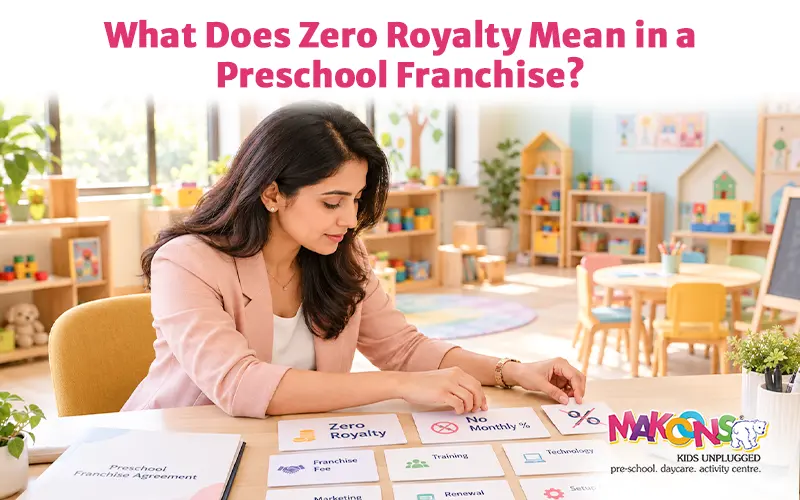
If you are looking into preschool franchise opportunities, you could find the term “zero royalty” thrown at you. It is viewed as a wonderful option but what is it really? It is crucial to know what the zero royalties definition entails, as well as what it is not before entering into an agreement or determining your anticipated returns. A zero royalty preschool franchise means that the monthly revenue and sales of the franchisee is not divided into a percentage called a royalty and paid to the franchisor. But, no royalties sometimes does not mean no fees. It is possible that it still has an up-front franchise fee, marketing charges, technology fees, training fees, renewal fees, or other fees.
What is Zero Royalty in a Preschool Franchise?
In a traditional franchise, the franchisee may be required to pay a recurring fee (usually a percentage of its revenue) to the franchisor. This payment will be made over the life of the franchise.
In a zero royalty model, the franchisor doesn't collect that particular ongoing royalty. Rather, the brand can receive revenue from the upfront franchise fee, product or material sales, training, technology services or other fees agreed to.
This varies by brand, and "zero royalty" doesn't necessarily mean no ongoing payments.
Zero Royalty Meaning for Franchise Owners
From the point of view of a prospective franchise owner, the zero royalty can be a simple concept: Profits generated by the preschool may be kept by the business after operating expenses and other applicable charges.
Suppose a pre-school has an income of ₹5 lakhs per month. If a franchise agreement stipulated the payment of 5% royalty, then ₹25,000 would be the royalty amount for that month. That particular royalty of ₹25,000 would not be levied on a zero royalty basis.
This example does not reflect the fees of any specific brand, however. The structure of the franchise varies and additional charges may apply.
There are also benefits to having a Zero Royalty Preschool Franchise
There are a number of possible benefits of a zero royalty preschool franchise, particularly for new business owners.
Less monthly expenses: Monthly costs may be more predictable and manageable without a revenue based royalty.
There is the possibility of keeping a larger share of the operating revenues in the preschool after paying expenses such as salary, rent, utilities, supplies, taxes and
other operating costs.
Better financial planning: Owners can make budgets simpler as one expense is taken out of the equation and is in percentage format.
Potentially higher long-term margins: If there is a significant increase in enrolment and revenue, then not having to pay a percentage-based royalty can be more beneficial over time.
These benefits are subject to the full fee structure and the actual performance of the preschool.
Does No Royalty Mean No Franchise Fees?
No. There are other costs that may be incurred with a no royalty preschool franchise. Before investing, one of the most crucial things to be aware of is this.
Possible expenses include:
An upfront payment for the franchise or brand.
The cost of establishing and developing a preschool's setup and infrastructure.
Training charges
The added value of marketing and advertising efforts
No amount of technology or software fees will be refunded.
Learning materials fee, learning curriculum fee
As a result of these, they have to pay renewal or annual fees.
The expenses for equipment and branding
There are no security deposits, (where applicable)
So, don't just look at the word “royalty” look at the full financial picture.
Familiarize yourself with the cost of a Preschool Franchise
There is a wide variation in franchise fees for preschools. There may be firms that require a higher initial fee and no royalty fees afterwards. There are also other options that may have an initial fee that's lower, but charge royalties or service fees each month.
Compare opportunities over a number of years by calculating total expected cost. Take into account the cost of any one-time and recurring costs.
Request a detailed, written report from the franchisor on:
Initial investment
Franchise fee
Rates / fees.
Royalty percentage
Marketing fees
Training fees
Renewal fees
Required purchases
Technology charges
All extra and/or contingent expenses.
This will provide a better understanding of the true cost of a preschool franchise.
Also read: How Can Housewives Start A Preschool Franchise?
What Should You Check in a Preschool Franchise Agreement?
The main document that outlines the relationship between the franchisor and the franchisee is a preschool franchise agreement. Don't just use promotional statements or oral explanations.
Please read thoroughly prior to signing:
The term of the agreement is as follows.
Renewal conditions
Recurring charges such as royalty
Geographic or area limitations
Users of brands and trademarks.
Curriculum and training requirements
Marketing requirements
Purchasing restrictions
Termination clauses
Refund policies
Transfer/re-sale conditions
Dispute-resolution procedures
On agreements that contain “zero royalty”, ask if this term is explicitly stated and if there is another charge that substitutes for royalty.
Terms to Discuss for Preschool Franchise
All franchisees are encouraged to ask in-depth questions before investing.
Useful questions include:
Does the royalty consist of a flat rate for each barrel or is it calculated as a percentage of net oil sales?
Do there exist marketing or technology fees?
Do there exist any compulsory purchases by the franchisor?
Do you have a yearly or renewal charge?
Are there any fee adjustments throughout the agreement?
What if the preschool were to close?
Is there a minimum number of students or minimum performance needed?
What is covered under the franchise agreement?
Preventing misunderstandings later is likely to be aided by getting answers in writing.
Also read: 10 Common Mistakes New Preschool Franchise Owners Should Avoid
How Zero Royalty Can Affect Preschool Franchise Cost?
The start-up cost of a preschool franchise is not the only factor that should be used to judge the cost of the franchise. Even a franchise that has a low entry cost can be costly if there are considerable recurring charges. Likewise, a franchise that demands greater startup costs could have a more enticing long-term deal if the monthly fees are not too expensive.
Develop a basic 5-year forecast that includes:
Initial franchise investment
Expenses associated with buying or renting a home.
Interior setup
Staff salaries
Utilities and maintenance
Learning resources
Marketing expenses
Technology costs
Any fees that recur after the initial installation, such as renewal or other fees.
Next compare the total cost that you project with the expected revenue and enrollment.
Does a Zero Royalty Model Always Work?
Not necessarily. Zero royalty is a feature and not an assurance of business success.
A well-branded, well-supported curriculum, teacher development, marketing support, and operational advice may be more valuable to a preschool even if it costs a royalty. On the flip side, a zero royalty option might be appealing if the brand provides solid support and doesn't impose hidden or permanent fees in place of royalties.
It will depend upon the entire package, your budget, location, long-term business objectives, and how many students you plan to have enrolled.
Final Thoughts
One advantage of a zero royalty preschool franchise is eliminating one of the standard ongoing franchise costs. But, it is important to comprehend the whole deal, though. It does not follow that a zero royalty means no fees or that it is a less invested program.
Before selecting a preschool franchise, review the preschool franchise terms, run the total cost for a preschool franchise and grasp all the payments included in the preschool franchise agreement. Make a comparison between the investment, the costs that have to be paid periodically, the support, training, the brand value and the renewal conditions.
Most importantly, do not pay until you have received full written details. Clarity in your fee structure is a great way to help you feel that you're making the best decision, and are not getting any surprises as you expand your preschool business.