
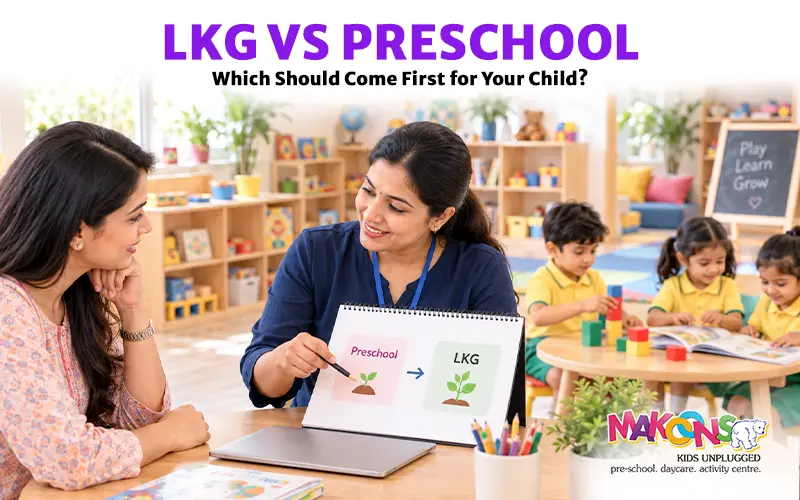
Parents can find it difficult to know which early education stage to select. Schools use the terms of preschool, nursery, LKG, UKG and kindergarten differently, making LKG vs preschool one of the most frequently asked questions.
What is the best order of attendance, LKG before preschool or preschool before LKG? Is LKG really a part of preschool? What age should be considered as LKG admission age? So, what are parents looking for in an early education programme?
It depends on the child because the short answer is that preschool and LKG are typically not competing options. Many Indian schools have LKG as one of the phases in the preschool or pre-primary path. Each school and each state will have different requirements for naming and admissions, however.
The Foundational Stage (ages 3–8) is as per the National Curriculum Framework for the Foundational Stage (NCF-FS) of India. Preschool education to ages 3-6 is called early childhood education and Grades 1-2 is ages 6-8. It also indicates that children should start in Grade 1 at age 6, if possible.
Let's get to know the difference between the preschool and LKG, how they fit into each other and how parents can make a sensible decision.
What Is Preschool?
Preschool is a general term for the early education that is organised before primary school.
It is typically used for children ages 3 to 6 (or 4 to 8); these ranges vary across institutions.
In a good preschool programme, interest is placed on the child's overall development and not just on academic preparation.
Children may participate in:
Storytelling and conversations
Rhymes, songs and music
Art and craft
Drawing and colouring
Blocks and puzzles
Outdoor play
Pretend play
Early language activities
Games of numbers and numbers counting.
Recognize shapes and colours
Social and group activities
Movement & Physical activities
Understands ways of self-help and independence activities
Supervised play-based learning is a key principle of the NCF-FS, encouraging children to learn through play and develop their curiosity, creativity, communication, cooperation, social interaction and more.
Preschool shouldn't be just sitting at a desk and doing worksheets.
Read More: Is Your Child Really Ready for Preschool? 7 Signs Parents Often Overlook
What Does LKG Mean?
LKG is the Lower Kindergarten.
It is widely used in India for a pre-primary class, which is preceding the UKG (Upper Kindergarten) and Grade 1 class.
In many schools, the typical sequence might be:
Playgroup → Nursery → LKG → UKG → Grade 1
But this is not the case across the board. Some schools use:
LKG→ Grade 1 → UKG → Preschool.
Some others may apply alternative names or merge some steps.
So it is important for parents to always find out the exact school sequence and not assume it is the same sequence in all schools.
Typical Learning Goals For LKG?
LKG might offer a more formalised learning experience like:
Letter recognition
Knowledge of sounds or early sound awareness
Vocabulary development
Pre-writing skills
Number recognition
Counting
Basic patterns
Shapes and colours
Simple mathematical concepts
Stories and comprehension
Drawing and creative activities.
Fine-motor exercises
Social and classroom routines are set up.
These should still be covered within developmentally appropriate activities, however.
Early language, literacy and numeracy are important pillars of foundational learning according to the NCF-FS, and play and experiential learning are emphasized throughout.
LKG Vs Preschool: Are They Actually Different?
This is where there's a lot of confusion.
Preschool is a general term and the LKG is usually a class or a level in the pre-primary system.
Imagine it like this:
Pre-school = Early education wider stage.
LKG = Lower Kindergarten (many schools have a particular level called LKG)
A preschool might have, for instance:
Playgroup
Nursery
LKG
UKG
In this instance the LKG is definitely an element of the preschool programme.
Sometimes, another institution may just call its programme as "preschool" for children in the age group of 3-6 years without using LKG and UKG.
It is because the decision of preschool vs LKG is not always a binary one; sometimes it's more of a “both/and”.
Preschool Vs LKG: The Main Difference
The primary contrast is typically: level and structure.
Preschool
Generally provides:
Wide early childhood opportunities
Play-based learning
Socialisation
Language development
Motor development
Early numeracy
Creative expression
Self-help skills
LKG
Generally provides:
Increased formal classroom procedures
Emphasis given to early literacy.
Greater systematic number activities.
Pre-writing development
Vocabulary building
Classroom independence
Preparation for UKG and eventually Grade 1
However, do keep in mind that there should be a lot of play, movement, stories and hands-on activities within a good LKG classroom.
Should Preschool Come Before LKG?
Yes generally speaking, except if the next formal school step up is Nursery or Preschool.
For example:
Class = Nursery/LKG/UKG/Class 1
The sequence of the stages would typically be followed by a child.
However, it is not mandatory that every child has to make the prescribed number of preschool years before LKG.
Depending on some children may directly join to LKG:
Their age
Previous early education
The school's admission policy
The readiness of the child to develop
State or local requirements
As such parents should never take it for granted that a lack of preschool attendance means that a child is at a disadvantage – or that every child must follow the same preschool trajectory.
What Is The Typical LKG Admission Age?
Different schools have different admission criteria for the LKG.
The age range for LKG is usually between 4 and 5 years of age, but may vary from school to school.
An example of this is that one school may consider a child to have completed 4 years by a certain age, while another may have a different age.
That's why parents need to look out for:
Minimum age
Cut-off date
Date of birth requirement
Previous class requirement
Transfer requirements
State-specific rules
The NCF-FS is a national developmental framework that is broader than any single national LKG admission cutoff. It suggests that preschool education should start from the age of 3 and Grade 1 entry at the age of 6.
So, don't rely solely on an age mentioned on a random website or social media post.
Be sure to review the individual school's admission policy.
Why Age Alone Shouldn't Decide LKG Admission
Chronological age is significant – but not the only factor.
It’s important to consider also whether the child can step by step handle some of the basic expectations in the classroom.
Does the child have the opportunity to:
Listen to a short instruction?
Communicate basic needs?
Participate in group activities?
Have a good grip on crayons or pencils?
Recognise some familiar objects or symbols?
Follow simple routines?
Perform simple self-care activities?
Do you feel you can be separated from parents with proper assistance?
Engage in interactions with other children?
These skills take on unique developmental patterns.
It is not necessary for a child to be able to read fluently or write a lot of letters before joining LKG.
What Should A Preschool Curriculum Include?
Parents need to consider more than worksheets and homework when considering the curriculum used in preschool.
The NCF-FS identifies the core learning outcomes in the following key areas of development: physical and motor development, socio-emotional development, cognitive development, communication, early language and literacy, early numeracy and cultural and artisanal development.
The balanced curriculum may therefore incorporate:
Language Development
Stories
Rhymes
Conversations
Vocabulary
Listening activities
Sound awareness
Early reading experiences
Early Mathematics
Counting
Sorting
Matching
Patterns
Shapes
Comparing quantities
Simple measurement concepts
Physical Development
Running
Jumping
Balancing
Throwing
Drawing
Cutting
Pasting
Manipulating small objects
Social-Emotional Development
Sharing
Cooperation
Taking turns
Expressing feelings
Building friendships
Following classroom routines
Creative Development
Music
Dance
Drawing
Craft
Dramatic play
Storytelling
This general curriculum allows children to develop capabilities which will facilitate their future learning.
LKG Curriculum: What Can Parents Expect?
Often an LKG curriculum is based on previous experiences in the preschool setting.
A child can slowly progress from recognizing concepts to utilizing them more independently.
For example:
Language
Children may start:
Recognising letters
Identifying beginning sounds
Expanding vocabulary
Retelling simple stories
Practising pre-writing patterns
Mathematics
Children may progress from recognising numbers to:
Counting objects
Comparing quantities
Identifying patterns
Sorting objects
Recognising simple number relationships
Independence
Teachers can allow children to:
Organise their belongings
Follow routines
Tidy up following activities
Follow the rules of responsible use of classroom resources.
Express their needs
This is why it is usually more organized than an introduction to preschool programme, varying by institution, but generally focused on learning objectives.
What If My Child Has Never Attended Preschool?
Parents sometimes worry:
"My child has never attended preschool. Can they directly join LKG?"
There is no one right answer.
Children may be directly admitted to LKG in some schools based on their age and school's admission policy. Some may require prior experience in Preschool or Nursery.
The question is how will the child adjust to the new setting with necessary supports?
Parents can practise at home:
Storytime
Simple conversations
Drawing and colouring
Puzzles
Counting everyday objects
Singing rhymes
Following simple instructions
Putting toys away
Utilizing toilet independently, developmentally appropriate
Leaving parents for short periods of time
Avoid preparing an exam mini-programme.
The aim is not to memorize, but to be confident and independent.
Red Flags Parents Should Not Ignore
Take care if the preschool/lkg programme:
Dedicates virtually all of time spent on worksheets
Uses fear or punishment to control children
Has little play/movement
Discourages children from asking questions
Has unclear methods of safety measures
Lacks ability to articulate their curriculum is poor
Overstimulates very young children with too much academic work
Assures that every child will read or write much beyond their years.
The key to early education is to establish a solid foundation, not too much pressure.
How Parents Can Prepare A Child For LKG
There are a number of simple habits that can help make the transition smoother.
Read Every Day
Read picture books and talk about the pictures for 10-15 minutes.
Practise Conversations
Ask open-ended questions such as:
What is the story about?
What animal do you like the most?
What were you doing today?
Use Everyday Mathematics
Count:
Fruits
Toys
Steps
Plates
Cars
Encourage Independence
Allow your child to slowly:
Put toys away
Bring their own pocket sized bag
Select from two different looks
Wash hands
Put items into their place
Practise Fine-Motor Skills
Use:
Clay
Crayons
Puzzles
Building blocks
Drawing
Safe threading activities
These ordinary activities can be more beneficial than requiring children to fill in worksheets.
A Simple Preschool-To-LKG Progression
A typical pathway would be:
Age 3–4: Preschool/Nursery
↓
Age 4–5: LKG
↓
Age 5–6: UKG
↓
Around age 6: Grade 1
These ages are merely examples, however, and do not apply to everyone as an age admission requirement. There can be other age cut-offs and naming systems in schools and states.
The wider national context stipulates that ages 3–6 are in preschool/Balvatika type early childhood education and that Grade 1 should commence at age 6.
Parents are therefore advised to refer to the school's current admission policy in the last resort.
Final Thoughts
The answer to the question of LKG vs preschool can appear quite complex since the schools in India do not always employ the same terms.
It's the easiest to explain when you think about it:
Preschool is the first stage of education (before school) and LKG is usually a pre-primary level of that stage.
Children's development goes:
Preschool / Nursery to LKG to UKG to Grade 1.
This isn't the only kind of buildings schools use.
It is not important whether your child's class is called "preschool" or "LKG. It is the quality of the programme in terms of being safe, nurturing, play-based and developmentally appropriate that counts.
For India, the NCF-FS identifies the period of ages 3-8 as a critical stage, highlighting the significance of children's play, exploration, communication, social development, early literacy and numeracy.
So, if you are selecting a school for your kid, you need to check the label when deciding preschool admission and LKG. Take account of your child's age, developmental readiness, previous experience, the school's admission policy, approach and environment.
A high-quality early learning program should enable children to be curious learners, confident communicators and increasingly independent—children who can do more worksheets.
Frequently Asked Questions
1. What is the difference between LKG and preschool?
Preschool is an umbrella term for early childhood education and LKG (Lower Kindergarten) is usually a particular level of pre-primary education. Many schools offer a Kindergarten programme, with LKG being a part of it.
2. What is the average age of admission into LKG?
LKG is generally provided in the age group of 4 – 5 years but there isn't a fixed age limit that is universally used by all schools in India. Please refer to the actual age, date-of-birth, and admission policy for LKG with the school itself.
3. Should my child complete preschool before LKG?
If the school's programme is structured in this way, children typically move through an earlier preschool or nursery phase prior to LKG. Some schools may have the provision of direct entry into LKG for eligible children. Review the requirements of the school to which you intend to apply.
4. LKG is the abbreviation for what?
LKG is the Lower Kindergarten. A pre-primary class, one that usually precedes UKG (Upper Kindergarten), in schools that have a hierarchical approach to their nursery programs.
5. What should be taught in LKG?
Children can learn early language and literacy, number concepts, pre-writing skills, vocabulary, communication, social-emotional skills, physical coordination, creativity and independence. Learning should be age appropriate, and involve play, story, activity and hands-on learning.
6. Is preschool education important before Grade 1?
High-quality early education can foster children's early development in key skills. India's NCF-FS identifies the ages 3-8 as the Foundational Stage and suggests play-based, experientia
