
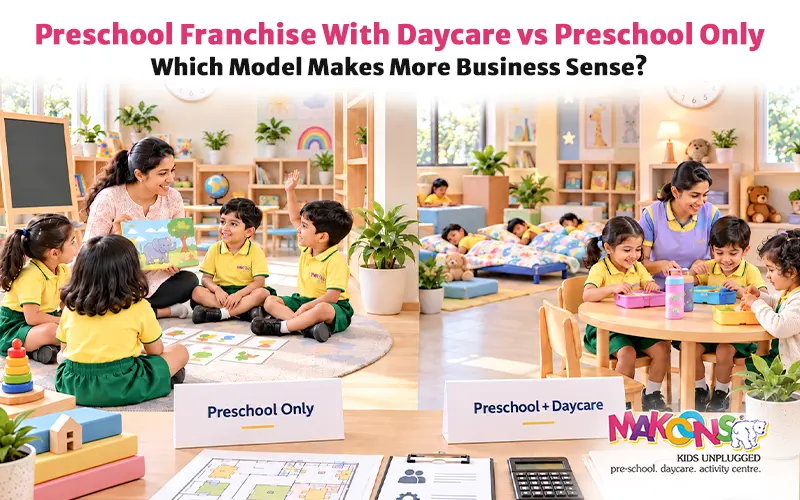
For those who are interested in starting an early childhood education centre, this is a very appealing business opportunity which allows the combination of education and a sustainable local business. Before selecting a location and/or a franchise agreement, you must make one important decision:
How about opening a preschool only or a preschool daycare?
It is dependent upon the location, target parents, available space, investment capacity, operating hours, staffing plan, and local demand.
A model that provides services for preschool children may be easier to run and need less infrastructure and staffing. On the other hand, a daycare preschool can generate an extra revenue stream and provide services to families for a longer period of time.
Early Childhood Care and Education (ECCE) is considered as covering care and education for children from birth to age 8 in the National Curriculum Framework for the Foundational Stage of the National Curriculum in India. It also records that after three years, many children are in institutional care for a large period of time in Anganwadis and preschools.
The difference between education and extended childcare is important to consider when assessing a preschool day care business model.
What Is A Preschool Only Model?
A Preschool Only Centre provides child care for young children mainly for the purposes of early childhood education within a specific school time.
It can provide services such as:
Playgroup
Nursery
LKG
UKG
Early learning programmes
Activity-based learning
Enrichment activities
Parent engagement programmes
The centre usually runs for short periods of time, mornings or early afternoon.
The main advantage?
Operational simplicity.
You may be able to concentrate on:
Curriculum
Teachers
Classroom quality
Admissions
Parent relationships
Learning outcomes
This can make the business simpler for the first time entrepreneur.
What Is A Preschool Franchise With Daycare?
A preschool daycare franchise combines early childhood education and child care services outside of preschool hours.
A centre might operate, for instance:
- Preschool: 9:00 AM–1:00 PM
- Daycare: 1:00 PM–6:30/7:00 PM
Timings will vary according to local demand and the franchise model.
The daycare may offer:
Supervised care
Rest time
Meals/snacks were offered
Indoor activities
Creative activities
Outdoor play
As of course, homework support for older children (if applicable).
Extended-hours care
It might be particularly attractive to families who want one consistent setting for early learning and care, and/or for daytime care.
Read More: Real Difference Between Playschool Vs Preschool Vs Daycare
Preschool Only Vs Daycare: The Key Difference
The easiest way to explain the difference:
- Preschool-only model
- Education-focused
- Preschool + daycare model
- Education + extended childcare
The second model isn't always more profitable.
It just adds another revenue stream and responsibilities and costs to the operator.
That's the crucial point prospective franchisees should understand.
1. Revenue Potential
The most significant factor that makes entrepreneurs think about a preschool franchise with daycare is the opportunity to make money from other sources, apart from the preschool tuition.
A Preschool Only Centre may generate income through:
Admission fees
Tuition fees
Annual charges
Activity programmes
Transportation, where offered
A preschool with day-care, may also generate revenues from:
Monthly daycare fees
Extended-hour care
If applicable, meals/food services
Holiday programmes
Activity programmes
Additional childcare services
The day-care structure, therefore, is a possibility of adding revenue per family enrolled.
But, as more revenue is generated, it does not always lead to more profit.
2. Daycare Can Increase Customer Lifetime Value
Suppose there are two imaginary families.
Family A – Preschool Only
The child attends preschool for 3 hours.
Annual preschool revenue:
₹60,000
Family B – Preschool + Daycare
The child goes to preschool and remains for daycare.
Preschool revenue:
₹60,000
Daycare revenue:
₹60,000
Total:
₹1,20,000
These are only example fees and are not guaranteed or representative of any fees.
But the example demonstrates an important concept:
If there is an actual need for more service, the same customer relationship can yield more revenues.
This is often referred to as increasing customer lifetime value (CLV).
3. Daycare Requires More Staffing
This is where things get a bit more complicated:
A preschool only centre may need to have:
Teachers
Teaching assistants
Centre head
Administrative support
Housekeeping
Extra staff cover might be necessary for a day care operation if children are staying longer at the day care centre.
As per age group and mechanism of operation, you might need:
Additional caregivers
Extended-shift staff
Additional housekeeping
Meals provided (kitchen/food support):
More supervision
So don't just take the total of the daycare fees and add preschool revenues to that to calculate the profitability of a daycare franchise business.
Calculate:
Increase in daycare profit = Additional Daycare Revenue – Additional Daycare Costs
It is this number that counts.
4. Longer Operating Hours
Preschool-only centres may cease to operate at the end of the main school day.
A daycare centre continues to open during the day.
This can provide new income gains, but it can also mean:
Longer staff shifts
More electricity consumption
More cleaning
More supervision
More administrative work
More operational responsibility
The owner should also be happy to run a business that runs longer hours.
5. Location Matters Even More With Daycare
A preschool is likely to thrive in numerous residential catchments.
However, the demand for daycare can be more nuanced with the characteristics of the community.
Before opening, study:
The number of young families that live nearby.
Working-parent population
Close to offices and other business areas
Apartment communities
Residential density
Traffic patterns
Making it easy for people to drop-off and pick up.
Competition
Local childcare options
Household income
Typical working hours
A daycare that does very well in one area may not do as well in another.
So when picking daycares, do not select one because another daycare franchise provider is offering it.
6. Space Requirements
Space is another important consideration.
A preschool needs classrooms, activity space, reception, toilets, storage space and may need outdoor play space.
Adding daycare may require additional areas for:
Rest
Quiet activities
Meals
Extended play
Storage
Childcare routines
For instance, Makoons currently says its more comprehensive preschool business model calls for approximately 1,500+ square feet of built up space, and 500 square feet of play area (which may differ by model and site).
When considering a preschool with a daycare franchise, if the individual site is being assessed, request confirmation from the franchisor that the size details of the combined franchise correlate with the preschool specification, as this is not always the case.
7. Investment Can Be Higher
The combined preschool and day care model may need more initial and working capital investment due to:
Additional furniture
Resting equipment
Additional safety infrastructure
Increase number of toys/activity materials.
More staff
Additional operating hours
Food facilities, if available
Higher utility consumption
Additional working capital
The actual investment is, however, dependent on:
City
Property
Size
Existing infrastructure
Franchise brand
Daycare capacity
Services offered
For instance, Makoons has a total range of investments in the preschool segment of ₹10 - 25 lakh and has a specific day care format as well. They're not a standard industry cost, but rather figures published by the franchise holders.
Get a site estimate.
8. Preschool Franchise With Daycare Can Improve Space Utilization
An interesting business benefit.
Assume that students are mostly seated in your classroom between the hours of:
9 AM–1 PM
Depending on the time of day, there may be some restrictions on the use of the same area in the afternoon.
The centre may be able to be used by a daycare programme during these extra hours.
This could allow you to make more money from the same real estate.
However, this is only possible if:
Local demand exists
The area is appropriate
Staffing is economical
Safety needs are being met
The extra income is more than the extra costs.
9. Parent Convenience Can Become A Competitive Advantage
Convenience is a factor that parents place a value on.
Imagine two centres:
Centre A
Preschool only
After school, parents should make their own arrangements for childcare.
Centre B
Preschool + daycare
The child has the opportunity to stay in one known place for the remainder of the working day.
This may be seen as a huge benefit for some families.
A combined model may thus have the potential of improving:
Parent convenience
Retention
Customer lifetime value
Referrals
Differentiation from surrounding competitors.
However, again it's dependent on the place market.
10. Daycare Can Improve Retention
A child can opt-out of preschool if his/her family's childcare needs change.
If a family uses both preschool and daycare, it may be more important for them to stay with the centre as moving would have more of an impact.
This does not ensure retention!
The centre still has to provide:
Safe care
Good teachers
Clean facilities
Communication
Reliable timings
Quality learning
Positive parent experience
Trust is of greater value in early childhood businesses than just providing more services.
11. Preschool-Only Is Easier To Manage
The preschool-only model does have an obvious advantage in this area.
Fewer hours in service and fewer services can mean easier management.
You can concentrate on:
Admissions
Curriculum implementation
Staff training
Parent communication
Marketing
Classroom quality
It's often better to start small than to run a complex operating model if you are a first-time entrepreneur lacking in management experience.
12. Daycare Creates Additional Operational Responsibility
Children may be present with daycare for extended periods of time, therefore operational discipline is crucial.
Have clear systems for:
Child pick up and authorisation
Attendance
Emergency contacts
Health information
Food and allergies (if meals are furnished)
Rest periods
Supervision
Visitor management
Child safety
Incident reporting
Staff handovers
Parent communication
Carefully read the franchise agreement and local rules before starting the daycare aspect.
13. Compare Contribution Margin, Not Just Revenue
Suppose daycare generates:
₹15 lakh additional revenue
But requires:
An extra ₹6 lakh employee expenses
A total of ₹ 2 Lakh extra food/material expenses.
Extra maintenance and utilities worth ₹1 lakh.
Incremental contribution:
₹15 lakh – ₹9 lakh = ₹6 lakh
Just to say that is not that meaningful:
“Revenue from Daycare is ₹15 lakh.”
Always consider the incremental economics when comparing Preschool only versus Daycare.
Read More: Is Your Child Really Ready for Preschool? 7 Signs Parents Often Overlook
When Does Preschool With Daycare Make More Sense?
When a preschool franchise with daycare might be a better business sense:
There are numerous working parents in the area.
The density of the residential sector is high.
Families require longer childcare provision.
Parents want to attend 1 centre for education and care.
The site can be used for both.
You have adequate working capital.
The franchise offers appropriate daycare systems and training.
Local competitors don't adequately serve this need.
In these cases, day care may be a valuable competitive edge.
A Simple Decision Framework
Try to answer the following seven questions:
1. Is there genuine daycare demand?
Don't assume.
Speak with at least 30-50 parents in the area, if possible.
Ask:
Looking for day care?
For how many hours?
What age group?
What range of fees do you find acceptable?
What do you currently use?
2. What do competitors have to offer?
Visit nearby centres.
Record:
Preschool fees
Daycare fees
Timings
Capacity
Facilities
Staff
Parent reviews
Admission process
3. Do you have a property that will accommodate daycare?
Check:
Floor area
Resting space
Toilets
Outdoor area
Safety
Pickup/drop-off
Ventilation
Storage
4. What additional staff will daycare require?
Obtain a real-time staffing plan.
Avoid taking the approach of just adding another worker to the mix.
Explain to the franchisor how workers are required to change when:
20 daycare children
versus
40 daycare children
versus
60 daycare children.
5. What is the incremental investment?
Calculate:
Cost of setting up daycare + extra working capital
On what day will the day care have a break-even?
For example:
If other fixed daycare costs are ₹6 lakhs per annum and the contribution made per day care child is ₹30,000:
₹6,00,000 ÷ ₹30,000 = 20 children
To cover those incremental costs that were modeled, you would need to have about 20 daycare enrollments.
7. Can you manage the longer hours?
Daycare isn't passive income.
There must be someone to watch over:
Staff
Children
Parents
Attendance
Safety
Cleaning
Operations
For those who prefer not to have a long operating day, preschool-only might be the option.
A Major Mistake: Choosing Daycare Because "It Earns More"
This is one of the largest pitfalls.
Daycare can generate more revenue.
But:
More revenue ≠ more profit.
And:
More profit ≠ better return on investment.
Suppose that in daycare, Rs. 8 lakhs are needed for additional investment in setting up the daycare and Rs. 2 lakh annual incremental operating profit is generated by daycare.
The simple payback period would be:
₹8 lakh ÷ ₹2 lakh = 4 years
That might be desirable or not, depending on what you're looking to accomplish.
So, compare the marginal return on the marginal investment.
Final Verdict: Which Model Makes More Business Sense?
No general victor.
Choose Preschool Only if:
You are seeking simplicity, limited investment, and the need for early education is a primary need in your local market.
Choose Preschool + Daycare if:
The demand for working families is high in your locality and there is potential to profitably run extended child care.
The best model doesn't necessarily have the highest claims to revenue.
It is the one in which:
Demand + Pricing + Capacity + Staffing + Costs + Retention = Sustainable Profit
A preschool with a daycare franchise may provide a good economic package since the income generated per family may be higher and the facility is used more efficiently during the day. It does, however, impose extra staffing, safety, compliance and management obligations.
The framework of early childhood care and education is based on the principle that early childhood care and education is an integrated package of care and education, highlighting the need for child care to be more than just a revenue source.
When considering a particular franchise, check out ROI and investment details only from the company they are promoting. Currently, Makoons offers and promotes preschool and kindergarten franchise and daycare formats, as well as its investment and support information. This is a starting point, and then ask for the real financial assumptions, actual daycare-specific costs, staffing needs and terms of the franchise agreement for you.
In the end, the most successful preschool daycare business model is one that addresses a real community need and is also profitable.
Frequently Asked Questions
1. Is a preschool with daycare more profitable than a preschool-only business?
It may be but it isn't guaranteed. Daycare provides another revenue stream, and can boost revenue per family, but it also brings with it additional staff, infrastructure, utilities, working capital needs, and operations. Profitability relies on the local demand for daycare, as well as the incremental cost of delivering the service.
2. What's the distinction between a preschool and a preschool with a daycare franchise?
Preschool is usually a place that offers early childhood education within specific childcare hours. A preschool franchise daycare is a preschool establishment that offers an extended daycare service, whereby children may stay at the preschool after the preschool sessions have finished.
3. Is daycare a good addition to a preschool franchise?
If there is a real need for daycare from working parents in the area of interest, it can be a powerful complement. Research the competition first and discuss with local parents the time it requires, the fees paid and any childcare arrangements.
4. Does a preschool with daycare require more investment?
In general, the more you add to your daycare, the more you will invest, as you will likely require more furniture, staff, safety equipment, crafts and working capital. This will vary by franchise, location, size of property, daycare capacity and services offered.
5. How do I determine if daycare will be profitable?
Determine the incremental day care economics:
Daycare revenue – Additional daycare operating costs = Incremental daycare profit
Then determine the incremental profit to the additional investment. This is more beneficial than comparing overall preschool and daycare income.
6. Should a first-time entrepreneur choose preschool only or preschool with daycare?
A first time entrepreneur might want to go with preschool-only because it's simpler and they don't have as much experience dealing with the kids. A hybrid approach is appropriate where there is a robust local appetite, investment potential, adequate premises and access to quality staff. The final choice should be based on a financial model specific to the location, not a generic ROI for the franchise.
Read More: What The Top Preschools In India Have In Common That Others Don't
