
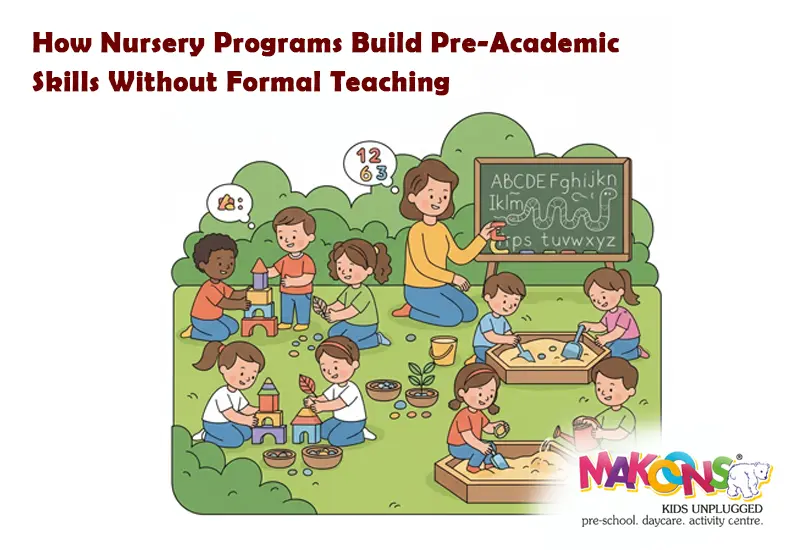
Many parents worry that nursery programs do not teach enough. There are no textbooks. There are no exams. There is no formal teaching. Yet, children who attend good nursery programs often adjust better to school. They pick up reading skills faster. They understand sounds, words, and patterns early.
This happens because nursery programs focus on pre-academic skills. The skills mentioned above are essential for the learning process. They equip the children for the activities of reading, writing, and mathematics to a certain degree. Nevertheless, all this is realized through play, usual practice, and the interaction of children with their surroundings.
This blog explains how nursery programs build these skills naturally. It also explains how early exposure to phonic sounds for kids and phonics learning happens without pressure.
What Are Pre-Academic Skills?
Pre-academic skills are basic abilities children need before formal schooling. These are not academic lessons. They are readiness skills.
Some key pre-academic skills include:
- Listening and attention
- Understanding sounds
- Vocabulary development
- Early reading skills
- Hand-eye coordination
- Memory and sequencing
- Social interaction
Nursery programs focus on these areas daily. They do not use formal teaching methods. Instead, learning happens through experience.
Learning Through Daily Routines
Nursery classrooms follow simple routines. These routines repeat every day. Repetition helps children learn without effort.
For example:
- Greeting time builds language and confidence
- Clean-up time teaches sequencing
- Snack time improves vocabulary
- Circle time improves listening skills
Children begin to understand instructions. They learn to wait, respond, and participate. These are important skills for future classroom learning.
How Nursery Introduces Phonics Naturally?
Phonics is the connection between sounds and letters. In nursery programs, phonics is not taught as a subject. It is introduced through sound awareness.
Children hear sounds before they see letters. This is the correct order.
Nursery phonics activities include:
- Rhymes
- Songs
- Story reading
- Sound games
This helps children recognize phonic sounds for kids without pressure.
Role of Rhymes and Songs in Phonics Learning
Rhymes and songs play a major role in phonics learning. They help children notice sound patterns.
For example:
- Repeating words that sound alike
- Clapping to syllables
- Singing alphabet songs
Children start identifying beginning sounds. They learn that words are made of sounds. This is the base for phonics for beginners.
No worksheets are needed. Learning happens through repetition and fun.
Storytelling and Early Reading Skills
Storytelling is a daily activity in nursery programs. Teachers read picture books aloud. Children look at pictures and listen to words.
This builds early reading skills in many ways:
- Understanding story sequence
- Recognizing familiar words
- Predicting what comes next
- Improving attention span
Children also learn that print has meaning. They understand that books are read from left to right. These concepts are essential for future reading.
Vocabulary Building Through Play
Play is not free time without purpose. It is structured learning.
During play, children:
- Name objects
- Ask questions
- Follow instructions
- Describe actions
For example, during pretend play, children use new words. They copy adult language. This improves sentence formation.
A strong vocabulary supports better phonics understanding later. When children know more words, phonics becomes easier.
Sound Awareness Without Pressure
Nursery programs focus on listening skills. Before learning letters, children must hear differences in sounds.
Sound awareness activities include:
- Identifying animal sounds
- Matching similar sounds
- Recognizing loud and soft sounds
This prepares children for using a phonics sounds chart later in preschool or kindergarten.
They learn to hear sounds clearly before associating them with letters.
Introduction to Preschool Phonics
Preschool phonics starts slowly in nursery. Letters are not forced. Instead, exposure happens naturally.
Examples include:
- Alphabet posters on walls
- Letter-shaped toys
- Name recognition activities
Children start recognizing letters in their names. They connect letters with sounds slowly. This is the first step of preschool phonics.
Nursery Phonics Through Play-Based Activities
Nursery phonics activities are always playful. There is no testing or memorization.
Some common activities are:
- Sorting objects by starting sound
- Singing alphabet songs
- Playing sound-matching games
- Using flashcards casually
Children participate because it feels like play. This makes learning stress-free and effective.
Fine Motor Skills Support Academic Readiness
Writing cannot happen without strong hand muscles. Nursery programs focus on fine motor skills.
Activities include:
- Drawing
- Coloring
- Pasting
- Building blocks
- Clay modeling
These activities prepare children for holding a pencil later. They also improve focus and coordination.
This supports writing readiness without formal writing lessons.
Social Interaction Builds Learning Confidence
Learning is not only about letters and sounds. Confidence matters.
In nursery programs, children learn to:
- Speak in groups
- Share ideas
- Ask for help
- Follow group rules
These skills make children comfortable in learning environments. Confident children participate more in reading and phonics activities later.
Also Read: Montessori-Based Activities for Kids in School and Home
No Pressure Means Better Learning
Formal teaching too early can create fear. Nursery programs avoid this.
There are:
- No exams
- No grades
- No strict targets
Children learn at their own pace. This builds curiosity instead of stress.
When children enjoy learning, they absorb concepts faster. This includes phonics and reading skills.
Smooth Transition to Formal Schooling
Children who attend nursery programs often adapt better to school.
They already know:
- Classroom routines
- Listening skills
- Sound awareness
- Basic phonics concepts
This makes formal phonics lessons easier. They can understand a phonics sounds chart more quickly. They progress faster in reading.
Why Parents Should Trust Play-Based Learning?
Many parents expect visible results. But nursery learning is subtle.
The results show later:
- Better reading confidence
- Faster phonics learning
- Stronger language skills
Trusting the process is important. Nursery programs are designed to build foundations, not finish the syllabus.
Conclusion
Nursery programs do not use formal teaching. Yet, they build strong pre-academic skills. This happens through play, routine, and interaction.
Children develop listening skills, sound awareness, and vocabulary. They are introduced to phonic sounds for kids naturally. They develop early reading skills without pressure.
Nursery and preschool phonics are ways of introducing children to formal education, which one enjoys doing; it is quite stress-free.
A strong foundation matters more than early textbooks. Nursery programs understand this well.
