
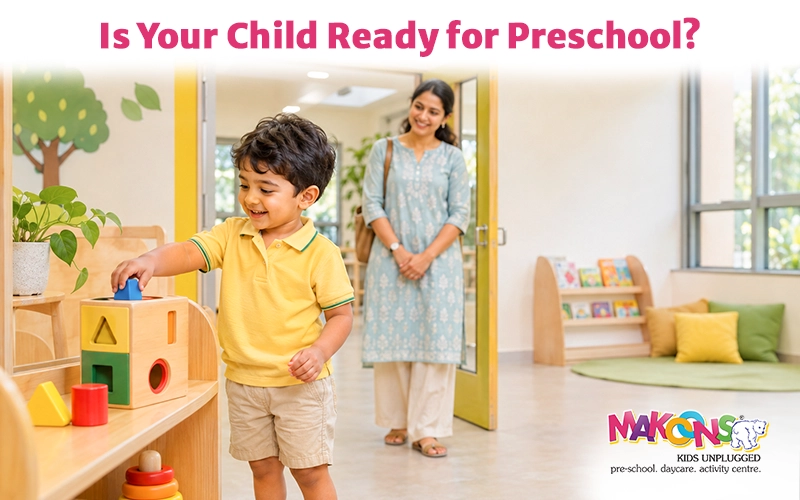
Preschool is an important transition time for children and their parents. It opens new friends, new fun, new colourful classrooms and new learning opportunities. But there's also an important question to ask here: is your little one prepared for this big step?
All children grow in their own unique ways and at their own speed. There are children who will readily head to new environments and others who require time and space to adapt to new surroundings and new people. The great thing is that preschool readiness does not mean having to be perfect or knowing the alphabet before going to school! It is about building fundamental capacities which enable children to make the best of their early learning.
If you are thinking about the possibility of your child being ready for preschool, these ten signs can give you insight into your child's needs and prepare for the transition to preschool.
What is Preschool Readiness?
Preschool readiness is the social, emotional, physical, language, and early learning skills that enable children to be successful in a preschool setting. It does not mean that a child has to learn all the skills prior to school entry.
Parents may find it puzzling when to begin preschool, particularly if they have youngsters who are equal in age and abilities. Children start at two years or three years (depending on the programme and local admission policy and on the individual child's development).
Here are 10 Signs To Watch For That Will Indicate Readiness For Preschool.
1. Your child is curious about new things
Does your child like to play with toys, flip through picture books, ask questions and look around? It's great to see curiosity as a sign of developing preschool readiness.
Children are supported in making discoveries using stories, music, art, puzzles and practical activities at Preschool. Such experiences might be enjoyed by a curious child, and gradually foster a love of learning.
Long periods of quiet time, or complex directions are not required for your child. It's a good beginning to have an interest in exploring, observing, and trying new things.
2. They can spend some time away from you
Preschool is a new situation in which parents might not necessarily be present during the entire program. Getting used to short absences can help.
Observe your child's behaviour when you are away and with a trusted carer or relative. Do they calm down as time goes on after you leave—even when initially upset?
If your child cries during separation, this doesn't necessarily mean that your child is not ready. Many children settle into a routine gradually and over time, with reassuring teachers and routines.
3. They take an interest in playing with other children
Children learn how to interact with others when they play with other children. Your child may be looking at other children, mimicking their behaviour, sharing toys sometimes or taking part in basic group activities.
Children may be playing a lot of parallel play at this stage; playing at the same time as other children, but not interacting with them directly. This is a normal part of development.
Your child doesn't have to make a lot of friends or share everything just right. A caring attitude towards other children may be one of the good indicators that a child is prepared for school.
4. They can communicate basic needs
One of the important factors of readiness for preschool is communication. Children are supported to communicate basic needs including: thirst, the need to use the toilet, discomfort and to seek help.
Does not always need to form sentences in order to convey information. Some child repeats words, phrases or body movement or both.
Prior to admission, inquire about teachers' approaches to supporting children who are still acquiring language. A positive school environment should encourage communication, but not necessarily that all children are fluent speakers of English.
5. They are able to follow simple directions
Tidy up, sitting to listen to a story, wash hands or wait in line with classmates are examples of preschool activities.
Observe whether your child can follow and carry out verbal instructions, supplemented by movement and/or modelling, that are in line with their age.
They will not follow all the instructions as you would want them to but that's okay. It is not about doing routine tasks, but getting used to them.
Practice at home by diffusing instructions into play. For example, once your child has used the blocks, ask him or her to put the blocks in a basket.
6. They are developing independence
Children don't need to learn to be self-reliant before preschool. It's great to show interest in daily activities, but not showing interest in it is a negative sign.
Your child might try to use a spoon to feed, drink from a cup, walk shoeless, wash their hands with help or not put toys away.
Children experience these small successes and build their confidence and are part of classroom routines.
Give your child opportunities to do things but don't push him/her. Support as needed, and give them encouragement for their work, not for their performance!
7. They are able to manage their simple feelings with support
While preschool is filled with exciting experiences, it can also be frustrating, waiting, unfamiliar, and having disagreements.
For a child who is emotionally ready, the initial step may be towards gradually calming themselves through reassuring behaviors, frustration and or difficulties, or the comfort of a trusted adult.
Temper tantrums, tears and feelings are natural and normal in early childhood. Your child needs not to regulate emotions on his/her own prior to school.
Seek a school that is calm, attuned to children's feelings and supports them to express feelings in healthy ways.
8. They have some basic self-care skills
Preschool can be more comfortable thanks to self-care skills. These can range from helping your child to eat and drink, washing their hands, identifying when they need to go to the toilet and knowing when to call for aid, depending on your child's age and development.
The toilet training needs of schools and programmes differ. Some do welcome children that are still learning, others have policies. Please check for admission before arriving.
A well-functioning preschool should have clear guidelines and expectations and offer the right amount of independence for age but without embarrassing children for accidents or challenges.
9. They can participate in short activities
Preschool activities include singing, listening to stories, drawing, building blocks and movement games.
Check if your child is participating or engaging in any activity if the activities are interesting. It could be rhyming, puzzling, short stories or maybe joining a favourite song.
The Little kids need attention and they are not expected to just sit and learn everyday.
The ability to participate in a shorter time period and to move from one activity to another with some assistance can help prepare for a smoother transition to preschool.
10. They are interested in new routines
A child's experience of the transition to preschool can be smoother if they enjoy the familiar routine. They may respond positively during certain periods of the day, such as meal time, play time, bedtime or to basic activities throughout the day.
Get started with a “preschool” schedule at home by planning time for reading, play, outdoor play, and snack time.
Talk positively about school, look at picture books about preschool and visit the school if you can. These mini-steps can help to make this experience not feel so foreign.
Preschool Readiness Checklist
Some easy checklist:
Demonstrates interest in toys, books and activities.
Tolerates brief absences.
Approaches the other children in the area of play with interest.
Shows basic needs using words or gestures.
Understand some simple instructions.
Try everyday tasks with appropriate help.
Accepts comforting when strong emotions.
Is learning to care for oneself.
Joins in with short, fun activities.
Can take initial steps towards
coping with simple daily routines.
This checklist is a guide, not a test. Your child may be consistently displaying some skills and others are emerging.
Final Thoughts
Preschool readiness is not about comparing your child with others - it's about knowing him or her! These are some readiness signs that may help in your child’s growth.
When making decisions about beginning preschool, take your child's age, comfort level, developmental needs and school admission requirements into consideration. If you are concerned about your child's development, speak to teachers and your paediatrician.
Keep in mind that it doesn't matter if your child is not totally self-supporting, or perfectly social, or academically gifted, before they join school. Preschool can be a happy start to their learning with a supportive environment, caring teachers, encouragement at home.
