
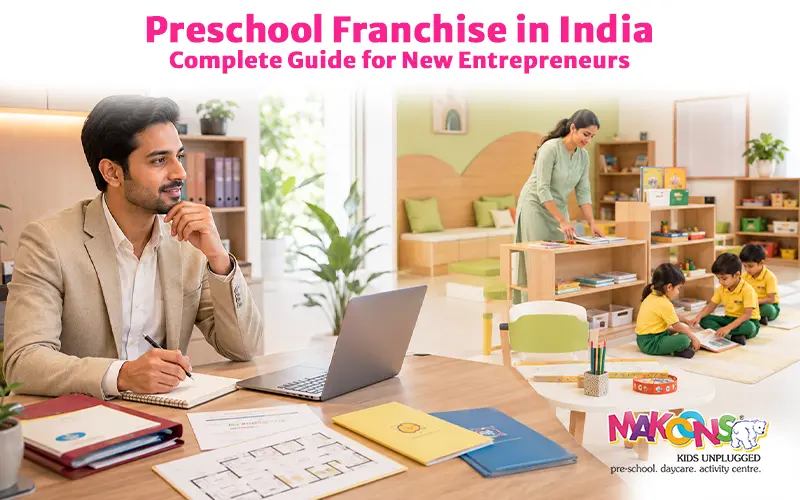
The demand for quality early childhood education is increasing more in India. There is an increasing demand from parents for safe, structured and stimulating learning environments in which their children can develop social, emotional, language and basic academic skills prior to formal schooling. With all this growing demand, the Preschool Franchise in India has become an attractive business proposition for the new entrepreneurs.
A preschool franchise is a business arrangement in which a preschool owner can use a well-known brand's name, curriculum, pedagogy, training program, and business support to run his or her preschool. Franchise owners can leverage on a proven business model and brand.
This model can help some of the problems that may arise in establishing a preschool if you are interested in the preschool education industry but not certain how to start your own preschool franchise. But, location, management, staff quality, parent trust and ongoing service is still a major factor in success.
Why Start A Preschool Franchise? – What Are The Benefits And Opportunities?
There are a number of benefits to the Preschool Franchise Business.
Established Brand Recognition
Creating a new preschool brand will take time. If the franchise is a known brand then it may be easier to start marketing as there is a presence amongst parents in the community.
Ready Business Model
A franchise usually includes a system of rules related to admissions, classroom operations, curriculum, teacher preparation, and day-to-day activities. This could be particularly valuable for business owners who have not worked in schools before.
Training And Operational Support
A number of the franchise businesses offer training for teachers, centre heads and franchise owners. Continuous guidance can also include parent communication, marketing and admissions, classroom management.
Growing Market Opportunity
Early education is beginning to play an important role in children's learning. In the background of parents' growing awareness, there is opportunity for businesses in the preschool sector in residential areas, growing neighbourhoods and emerging cities.
Scope For Expansion
Upon the establishment of the first centre, an entrepreneur can either expand to other centres or other services like daycare, activity programmes or after-school learning depending on the franchise model.
Preschool Franchise Cost In India
Preschool Franchise Cost is one of the first questions that new entrepreneurs will ask themselves. The total amount may fluctuate based on brand, area, property, interior, facilities and business model.
A typical Preschool Franchise Investment can consist of:
| Expense | What it covers |
|---|---|
| Franchise Fee | Right to operate under the brand |
| Infrastructure | Interiors, classrooms, furniture and learning areas |
| Learning Material | Toys, books, activity kits and teaching resources |
| Staff | Teachers, helpers, centre manager and support staff |
| Marketing | Local advertising, launch campaigns and promotional activities |
| Technology | Admission, communication and administrative systems |
| Working capital | Salaries, utilities and other initial operating expenses |
In addition to the franchise fee, the entrepreneurs should hold enough cash to cover a couple of months of start-up overheads. Before the centre is at the expected admissions even the rent, salaries, electricity, maintenance, marketing, supplies etc. can be ongoing.
As such, rather than only considering the franchise fee, determine the Preschool Franchise Investment to open and run the centre in a comfortable fashion.
The Concepts Of ROI And Profitability Involve Revenue, Expenses, And Break-Even
The main contributing factors to profitability in a preschool are the number of students, fee structure, operating costs and capacity utilisation.
The main income source is typically from student fees. Depending on the services offered, some centres earn extra income from daycare, transport, extra-curricular, or other services.
Major Expenses
Common expenses include:
- Staff salaries
- Property rent
- Electricity and utilities
- Marketing and advertising
- Teaching and learning materials
- Maintenance and housekeeping
- Technology and administrative costs
- Franchise fees/renewals
Understanding Break-Even
Where the income of the preschool equals all fixed and operating costs is the break-even point. The time frame is dependent on the centre.
For instance, a school that has a high demand for children and controls its expenses and that has a high rental rate may break even quicker than a centre located in a community with a high child-to-career ratio.
To make an investment decision, make a basic financial forecast based on:
Estimated Revenue =
(Expected student admissions) × (Average fee).
Subtract operating expenses on a monthly basis to see the potential operating surplus.
Avoid assuming projected ROI that any franchise provides as a sure bet. The actual profitability will be determined by local market conditions and centre performance.
Location And Space Requirements
One of the most crucial elements in Preschool Business in India is its location. Parents tend to like schools that are easily accessible and/or in safe neighbourhoods.
When choosing a site, take into account:
- Population of young families in the area
- Diversity of good and decent pre-schools in the area
- Residential development
- Accessibility for parents
- Road and roadside parking conditions.
- Sufficient space around the area where trees are being planted.
- Security of the environment.
- Lack of visibility of the centre
- Local competition
- Rental/Property Expenses
Space requirements are based on the type of franchise and their centre format. A good preschool will have sufficient space for the classrooms, activity areas, reception and office space, child friendly toilet facilities, storage areas and any other required facilities.
Larger space doesn't mean better. The aim is to locate a safe, functional area that is in accordance with anticipated student population and is financially viable.
Legal & Compliance Requirements
It is important for the entrepreneurs to be aware of what laws and local requirements apply to them before opening a preschool. State, city and local requirements may vary.
Requirements can vary depending on location and centre model and may include:
- Business registration
- Local municipal permissions
- Appropriate property and land-use permissions
- Fire safety requirements
- Building and safety regulations.
- Health and hygiene facilities
- Ensure staff are registered and compliant
- Child safety policies
- Required insurance
- Applicable tax registrations
Owners of preschools also need to keep good records, have emergency plans in place, make sure the premises have the right types of electrical and play equipment for a safe setting, and satisfy necessary background checks for employees.
The regulations may differ, so it is recommended to check with local authorities and/or get legal/compliance advice before opening the centre.
Selecting The Best Franchise Brand Is Challenging
One of the most crucial aspects in the launch of a Preschool Franchise in India is selecting the right brand. Avoid choosing a franchise because of its popularity. Look at the full business offering prior to investing.
Check Brand Reputation
Do some research before you invest into the brand to determine its presence, parent reviews, franchise network, and history. Talk with current franchisees about their true experiences.
Evaluate The Curriculum
Seek a program that emphasizes the child's age, play, creativity, communication, social skills and child growth.
Understand Training
Question if the franchisor offers initial and ongoing training for teachers, centre heads and franchise owners.
Check Operational Support
Learn about the support you will receive during admissions, class management, marketing, technology, curriculum implementation and daily operations.
Compare Fees
Know the total expense of the franchise, including franchise fees, renewal fees, royalties, marketing fees, technology fees, and other expenses.
Before Signing, It Is Important To Read The Agreement Carefully
Review the length of time and renewal terms, territory rights, exit conditions, responsibilities, and financial obligations of the agreement before signing. Legal counsel can aid you to grasp provisions that can impact your business.
The Step-By-Step Process To Getting A Preschool Franchise Up And Running
If you're wondering how to start a preschool franchise, a step-by-step process can make it easier.
Step 1: Research The Market
Research the need for childcare in the area you are interested in. Look at the amount of young families, preschools, fees and rivals.
Step 2: Establish Your Budget
Estimate your Preschool Franchise Investment – franchise fee, interiors, rent deposit, staff salaries, marketing, learning materials and working capital.
Step 3: Shortlisting The Franchise Brands
Research the reputations, curriculum, support, investment needs and agreement terms of various brands.
Step 4: Click On Location
Select safe, easy to access, location near residential communities and families with young children.
Step 5: Complete Documentation
When signing the contract, make sure you have a full understanding of the franchise agreement and have all legal and local procedures completed.
Step 6: Set Up The Centre
Set up classrooms, reception areas, activity spaces, child friendly washrooms, furniture, learning materials and safety facilities.
Step 7: Recruit And Train Staff
Hire teachers and paraprofessionals who are patient, responsible, and tolerate children.
Step 8: Start Marketing
Start local promotions prior to opening the centre. Leverage social media, local SEO, events, referrals and parent engagement activities.
Step 9: Begin Admissions
Organise centre visits, parent information sessions, answer parents' questions and ensure a seamless admission process.
Step 10: Monitor Performance
Monitor enrollment, costs, parent opinion, employee performance and monthly income to determine areas for improvement.
Curriculum & Staff Requirements
Any successful Preschool Business in India hinges on a solid curriculum. Young children acquire and learn most through experience, not too much from textbooks.
A quality preschool programme may contain:
- Storytelling, language activities.
- Music, movement and rhymes;
- Art and creative activities
- Basic knowledge of numbers and words
- Hands-on learning and sensory activities
- Outdoor play
- The growth and progress of social and emotional attributes
- Life skills and independence building activities
Finding The Right Teachers
Patience, caring, observation and understanding of young children's needs are to be expected in teachers. Communication and fostering a positive classroom are valuable skills, but academic qualifications are important, too.
Staff to be provided with regular training on:
- Classroom management
- Child development
- Activity-based teaching
- First aid and emergency procedures
- Hygiene practices
- Protection and safety of children
- Parent communication
The safety of the child must continue to be a concern. Activities should include background checks, safe pick up protocols, supervision, emergency contact, secure premises and staff responsibilities.
Marketing & Admission Strategies
No matter how good preschools are, they must have good marketing to get parents to attend. A mixture of digital and local marketing will help to create awareness.
Local SEO
Create and maintain a strong online presence for your centre. The business information, content, reviews, photos and location-based searches can assist parents in finding the preschool.
Social Media
Share the activities, events, learning experiences, celebrations, and useful parenting information in the classroom through platforms like Instagram and Facebook. The emphasis should be placed on establishing trust, not just on sales of admissions.
Parent Events
Conduct open houses, storytelling sessions, art activities, workshops or trial classes. These are opportunities for parents to get a feel for what the environment is like before they make a choice.
Referral Programmes
Happy parents are a great source of new admissions. An easy referral system can prompt current families to invite friends and family to try the preschool.
Parent Engagement
Frequent communication can reinforce positive parent relationships. Provide suitable information regarding activities, development, events and programmes which occur in class.
The Main Differences Between A Franchise And An Independent Preschool
There are some benefits to both models, but they are better for certain entrepreneurs.
| Factor | Preschool Franchise | Independent Preschool |
| Branding | Established brand identity | Build your own brand |
| Curriculum | Usually provided by franchisor | Create your own |
| Support | Training and operational support | Mostly self-managed |
| Initial cost | Includes franchise-related fees | No franchise fee |
| Flexibility | Limited by brand guidelines | Greater flexibility |
| Marketing | May receive brand support Fully responsible | Fully responsible |
| Business model | Established framework | Build from scratch |
| Decision making | Shared brand guidelines | More independent |
A first-time entrepreneur that is seeking a blueprint and guidance might want to consider a franchise. For those who wish to maintain all the curriculum, brand, pricing and operations in an independent preschool, that might be a better fit.
Find Some Common Mistakes
To launch a Preschool Franchise Business, planning is essential. Avoid these common mistakes:
Selecting The Wrong Location
A good preschool will struggle if there is not enough demand for it in the surrounding area. Research demographics and competition prior to signing a property.
Underestimating The Budget
Don't just sum up the cost of the franchise and the setup. Maintain adequate working capital to cover rent, salaries, utilities, marketing, and other expenses.
Hiring Inexperienced Staff
The impact of the experience and satisfaction of parents is directly affected by teachers. Paying on the basis of salary alone has the potential to create quality and retention issues.
Ignoring Marketing
Awaiting for admissions to occur naturally may take longer to launch. Do some community awareness building prior to opening.
Lack Of Understanding Of The Agreement
Don't forget renewal fees, territory requirements, royalties, termination clauses, etc.
Copying Competitors
Know what other centres provide and value what's important and unique about them, and don't just mimic what they do or promote.
A Case Study Of A Franchisee
A Nature Of The Business: Illustrative Example: A New Preschool Franchise
Let's imagine Riya is a hypothetical CEO who plans to start a preschool in an emerging residential community.
She chose a franchise because she did not have much experience in managing an education business and she wanted to access an established curriculum and training program, along with guidance on business operations.
Her first expenditure consisted of the franchise fee, setting up the premises, interior, furniture, learning materials, hiring staff, marketing for launch and working capital.
Initial Challenges
In the initial months, Riya had some difficulties, including:
- Developing capacity in the community
- Competing with established preschools
- Controlling initial operating costs
- Making enquiries into admissions
- Training new staff
In addition to advertising, she arranged for parents to interact in sessions, held open house and trial activities, and hosted community awareness sessions.
Growth And Lessons
Awareness of the centre by parents and increasing referrals led to a gradual improvement in admissions.
The take away from the example is that even if there is a framework involving a brand name all the way down, the franchisee needs to take an active role in running a business. Performance can be significantly influenced by location, parent relationships, staff quality, financial discipline and local marketing.
Note: This is an example case study and not a confirmed case study of a real financial record of a franchisee. There is a wide variation of actual investment and returns depending on brand and location.
Final Conclusion
To conclude, consider the following questions to determine if a Preschool Franchise is the appropriate option for you:
For those business entrepreneurs who wish to set up a business in the education industry which is already established and developed with a framework rather than having to develop all the systems, a Preschool Franchise in India may be an appropriate choice.
It might be especially appropriate for new business entrepreneurs who are looking for brand recognition, a curriculum, training, and operating support.
But it's never all about brand names. When making your decision, be sure to do your homework:
- Investments and working-capital requirements
- Brand reputation
- Curriculum quality
- Training and continuous development
- Location potential
- Competition
- Franchise agreement
- Recurring fees
- Marketing support
- Realistic Revenue and Profitability projections
Not every Preschool Business Opportunity is the largest business name. It is the one that suits your budget, location, objectives and capacity to create a safe and meaningful learning environment for children.
FAQs About Preschool Franchise In India
What Is The Cost Of A Preschool Franchise In India?
Preschool Franchise Cost varies as per the brand, city, property, size of the centre, interiors, and facilities. When deciding on setup, take into account the full setup cost, and not just the cost of the franchise fee.
What Are The Costs For Opening A New Child Care Center?
Preschool Franchise Investment may cover the franchise fee, property, interiors, furniture, learning resources, staff hiring, marketing, technology and start-up costs. The exact quantity relies on the picked franchise model.
What Is The Required Space?
The space requirements will depend on the brand and centre format. A preschool should be larger than needed for classrooms, for activities, for a reception, for storage, for children to use children's washrooms and for safe movement.
Can A Preschool Franchise Be Profitable?
When a preschool has good enrollment and control of expenses, it can be profitable. But there is no guarantee of profitability, as it is subject to location, fees, occupancy, rent, salaries, competition and management.
What Kind Of Licenses Do You Need?
This is subject to state and local authority requirements. As per location, Business Registrations, local permissions, fire, safety compliance, building related approvals, hygiene arrangements and other applicable registrations may be required of entrepreneurs.
How Long Does It Take To Start A Preschool Franchise?
The timeframe is dependent on the franchise brand, property, documentation, local approvals, construction or interiors, hiring of staff and marketing. A comprehensive launch plan is to be drawn up in conjunction with the franchisor and other local authorities.
Related Topic: Top 10 Preschool Franchise Brands in India: Costs, Fees, Profits & Brand Comparison
