
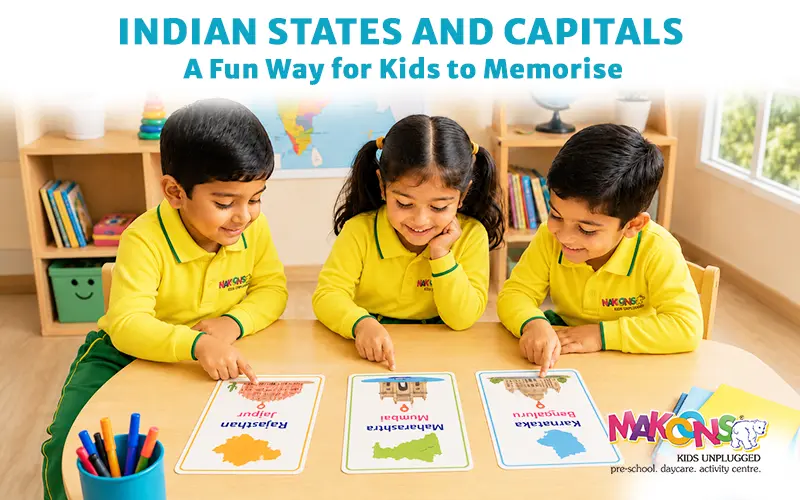
Learn the names of all Indian states and their capitals in a simple and easy-to-read table. Perfect for kids, parents, and teachers to build general knowledge in a fun and engaging way.
Having the kids learn about the Indian states and capitals is a fun way of teaching them about their country. India is a diverse country comprising 28 states and eight Union Territories, each with its own language, culture, traditions, food and iconic landmarks. Learning the names of the states and their capitals would benefit the children in improving their geographical knowledge, performing better in the school and also would help them get a stronghold in the Indian GK.
Children can learn via games, stories, maps, songs and quizzes rather than memorizing long lists. These activities can ensure that learning is fun and information can be retained longer. This will help you to remember the states and capitals with the fun facts.
Why Is It Important That Kids Learn About The Indian States and Capitals?
Knowing states and capitals is just a basic thing, every child should know as it helps children to :
Identify various regions of India on map.
Build general knowledge and confidence.
Get to know India's rich culture and diversity.
Develop better memory and observation skills.
Develop interest in traveling, history, and traditions.
India at a Glance
This learning should be preceded by children learning some basic facts about the Indian states list:
There are 28 states and 8 union territories.
Every state has its capital.
New Delhi is the capital of India.
The Central Government is responsible for government matters and States have their own government.
India is a huge and diverse country.
These simple rules allow it to be easier to learn the full list.
States and Capitals of India
There's a updated list of States and capital.
| State | Capital |
|---|---|
| Andhra Pradesh | Amaravati |
| Arunachal Pradesh | Itanagar |
| Assam | Dispur |
| Bihar | Patna |
| Chhattisgarh | Raipur |
| Goa | Panaji |
| Gujarat | Gandhinagar |
| Haryana | Chandigarh |
| Himachal Pradesh | Shimla |
| Jharkhand | Ranchi |
| Karnataka | Bengaluru |
| Kerala | Thiruvananthapuram |
| Madhya Pradesh | Bhopal |
| Maharashtra | Mumbai |
| Manipur | Imphal |
| Meghalaya | Shillong |
| Mizoram | Aizawl |
| Nagaland | Kohima |
| Odisha | Bhubaneswar |
| Punjab | Chandigarh |
| Rajasthan | Jaipur |
| Sikkim | Gangtok |
| Tamil Nadu | Chennai |
| Telangana | Hyderabad |
| Tripura | Agartala |
| Uttar Pradesh | Lucknow |
| Uttarakhand | Dehradun *(Winter), Gairsain (Summer) |
| West Bengal | Kolkata |
Children get to know capitals of India with the help of this table read regularly.
Also Read: Human Body Parts For Kids Their Uses
How to Remember Indian States and Their Capitals?
At first it can appear challenging to remember long lists, however these are easy methods to make learning fun.
1. Learn Regionby Region
Section the states into regions: North, South, East, West, Central and Northeast India instead of studying all together.
2. Use Colourful Maps
A child recalls where things are on a map more readily if it is a colourful map. Click on each state and name it by saying it out loud with the capital along with it.
3. Create Flashcards
Learn it like a game, write state and capitals on the side. Shuffle the card and start asking.
4. Compose Rhymes and Songs
It's easy to learn with the music or funny rhymes. It helps children to remember faster.
5. Practice Small Quizzes
Form simple questions such as:
What is the capital of Goa ?
Which state has Shillong as its capital?
Fun Activities for Kids
With creative activities, parents and teachers can make Indian geography for kids fun.
1. Match the Pairs
Fill in the names of the state in one column and the capitals in the other. Allow children to make lines to match the right pairs.
2. Map Challenge
Give a map to children and ask them to identify states and capitals.
3. Memory Game
Read 5 states. At the end of 1 minute, have children remember their capitals without looking.
4. State of the Week
Pick a state each week. Find out about its capital, food, language, famous places, festivals and wildlife.
5. Family Quiz Night
Make learning a fun game with all participating answering questions on states and capitals of India.
Here Are Some Interesting Facts About States in India
It is easier to remember facts along with names.
Goa is the smallest state by area.
Mumbai is known as the ‘city of dreams.’
Rajasthan is the largest state by area.
Jaipur is known as the ‘pink city.
Chandigarh is the capital of two states.
- Kerala is famous for its beautiful backwaters.
- Assam is known for its tea gardens.
- Gujarat is famous for the Gir lions.
- Ladakh is known for its snowy mountains and beautiful lakes.
These are interesting facts that will enable children to make associations between places and images.
Also Read: Ocean Names: Teaching Kids About Earth's Biggest Water Bodies
Tips for Parents and Teachers
Children learn easily when the lessons are fun and enjoyable. There are some tips that you should follow:
Do 10 mins of practice each day.
Help children to ask questions about the various states.
Take advantage of maps, puzzles and learning games.
Reward effort, even if they can only remember a handful capitals.
Practice lessons frequently to reinforce memory.
Confidence is fostered and a lifelong interest in Geography developed with positive encouragement.
Conclusion
Children can easily learn Indian states and capitals with the help of children's maps, games, and practice. Knowing states and capitals is just a basic lesson every child should know. It helps them to value their country's diversity, language, and culture. It's not a one way learning, we have to practice it regularly with fun activities and quizzes. It also improves general awareness and knowledge.
FAQs:
1.How many states are there in India ?
Ans: 28 states
2. How many union territories?
Ans: 8 union territories
3. What's the capital of Bihar?
Ans: Patna
4. Which state is the largest in India?
Ans: Rajasthan.
5. How can a child learn easily?
Ans: Child can learn easily by puzzles, quizzes, games , and flashcards to make it more interactive and exciting.