
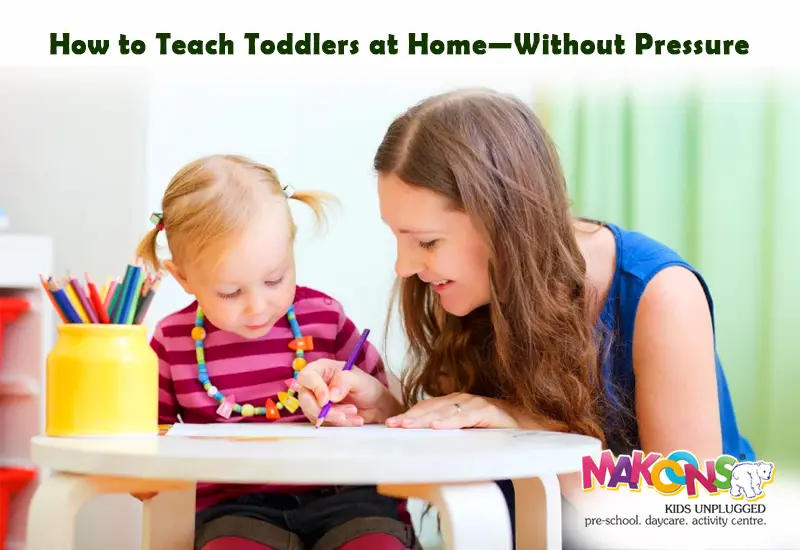
There is no need to approach it like a classroom when teaching small people, and it should not be stressful. The most effective way of learning is by...
There is no need to approach it like a classroom when teaching small people, and it should not be stressful. The most effective way of learning is by being curious, relaxed, and free to explore, which is the case with Toddlers. This occurs when parents are too pushy or exert too much pressure that learning begins to seem like a burden rather than an exciting finding.
The good news? It is possible to develop an interesting early education at home that is playful, gentle, and fun. It can be so easy to teach toddlers at home when you have the right attitude in your head, when you are not stressed about getting the worksheet done, but you are watching your child develop into a confident individual.
Here, we shall examine the easy to follow strategies, concepts and routines that can be put into place to create stress free learning to toddlers, all based on connection, curiosity and love.
The Importance of Home Learning Toddlers
Childhood life is a wonderful phase. Toddlers have been predisposed to watch, copy, enquire and experiment. That is why home based learning among toddlers is ideal- because learning occurs in real life within the daily environment.
At home, children get:
- A calm, familiar environment
- More one-on-one attention
- Liberation to study their own style.
- Practices of repetitions.
- Security and time of love.
Home learning does not require pushing academics and instead enables toddlers to create the base that is most important:
- Language development
- Problem-solving
- Creativity
- Emotional expression
- Social skills
- Independence
This style is rather closely associated with the approaches of learning gentle parenting, in which not performance but respect, empathy, and understanding whether your child is ready or not is important.
What Does It Mean to Have a Stress-Free Toddler Learning?
Toddler stress free learning entails:
- No strict timelines
- No pressure to perform
- No analogy with other children.
- No forcing or punishing
Instead, it focuses on:
- Encouragement
- Little itchy toes to walk around.
- Note: Paying attention to the cues of your child.
- Turning learning into fun and reality.
Keep in mind: a toddler is not going to memorize the ABCs; he is going to learn more by pouring water, sorting out the spoons, and building blocks.
The Strength of Play-Based Learning in the House
Play based learning at home is one of the best methods of home based teaching toddlers.
Play is how toddlers:
- Understand cause and effect
- Develop motor skills
- Build imagination
- Learn emotional regulation
- Practice communication
Children gain meaning of the world through play. They are learning early math, science, and language when they stack cups, feed their dolls, splash water or draw with crayons- they are doing it instinctively.
Rather than posing, What shall I teach to-day?
Ask, "What can we explore today?"
Basic Home Learning Activities with toddlers
You do not have to spend a lot of money on toys and funny constructions. Common and daily objects may serve as effective learning resources.
The following are simple, practical home learning activities of toddlers:
1. Sensory Play
Assists in brain growth, concentration and motor dexterity.
Ideas:
- Rice or sand trays
- Play with cups and spoons with water.
- Squeezing and rolling of Playdough.
- Foam or bubble play
Discussion of textures: soft, sticky, wet, rough, etc.
2. Practical Life Activities
Young children are fond of imitating adults. Let them help!
- Wiping tables
- Watering plants
- Sorting laundry
- Use of the spoon to transfer beans.
These tasks are helpful in independently and problem-solving - an important aspect of early home-based education.
3. Conversations and Story Time
Reading gets one to develop imagination, empathy and language.
Try:
- Picture books
- Touch-and-feel books
- Storytelling by use of toys.
- Such questions as, What do you see?
Toddlers use conversation as a form of home learning through talking, singing, rhyming and narration of various daily routines.
4. Art and Creativity
No necessity of perfect crafts--of perfect expression.
- Crayons and scribbles
- Finger painting
- Tearing paper
- Sticker play
Emotional expression and confidence are increased by creativity.
5. Movement and Outdoor Play
Movement maintains development of the brain.
- Running
- Jumping
- Climbing
- Dancing
- Nature walks
The largest classroom is the outdoor one. Discussion on leaves, insects, clouds, colors- basic meaningful learning.
Adhering to the Learning Methods of Gentle Parenting
Learning approaches of gentle parenting promote closeness and respect rather than coercion and control. This does not imply that there is no structure--it involves the establishment of boundaries with good nature.
Key principles:
- Stay patient
- Validate feelings
- Avoid forcing activities
- Praise effort, not results
- Follow the child's interests
When your toddler does not want to participate in something, no problem. Try later. Toddlers are short-lived- Attention need not last long of 5-10 minutes can suffice.
Instead of saying:
"Sit here and finish."
Try:
All right, play a little and then you can leave.
Such a style maintains the constructive and peaceful home-based teaching of toddlers.
Building a Gentle Routine
An expected pattern provides toddlers with security but not strictness.
Sample flow:
- Breakfast + conversation
- Short play activity
- Outdoor time
- Quiet reading
- Free independent play
- Family time in the evening
Notice - no tight time slots. Flexible timetables are useful towards stress-free learning of toddlers.
Common Mistakes to Avoid
Parents can be too pushy even with the best motives. Try avoiding:
- Too many worksheets
- The problem of overloading activities.
- Making comparison with other children.
- Expecting perfect behavior
- Reward-punishment learning
Children do not have to act to ensure that they are learning.
It is evidenced by their play, questions, curiosity, and creativity.
How to Know Your Child is Learning
At this age, learning appears to be different. Indications of development in your toddler:
- Increasing curiosity
- More words and gestures
- Better coordination
- Imitating real-life actions
- Trying to solve problems
- Showing imagination
- Being guided on basic instructions.
These developmental milestones develop naturally when we embrace play based learning in the home.
You Do Not Have to Be a Teacher, Just Be There
Parents would always be worried: Am I doing enough?
If you are:
- Talking
- Listening
- Playing
- Responding with love
Children are satisfied when they are secure, cherished and allowed to roam.
Final Thoughts
It does not involve rushing academics when teaching toddlers at home. It is a matter of cultivating interest, closeness, trust, and happiness. When we decide to expose toddlers to stress free learning, they not only become smarter, but happier.
In home learning among the toddlers, practical experiences take the form of lessons. Connection precedes control with caring parenting teaching strategies. And with home based learning of toddlers being based on home based learning in the form of play based learning, each day is a natural learning day.
Slow down. Play more. Enjoy the journey.
Beautifully learning--your toddler is.
If Just tell me!
