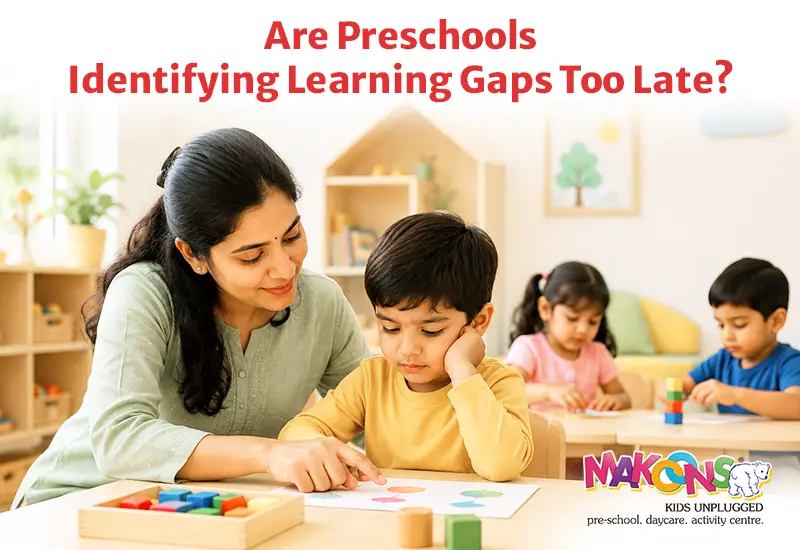
Preschool is the starting point for children’s learning. It is the time when children are learning language, social skills, and early cognitive and emotional intelligence. But a big question is cropping up in the modern school settings; are learning gaps in preschools being detected late?
Children with poor communication, attentive, or motor skills are often not detected until they progress to higher grades. The gap will grow more difficult to seal by that time. Current researchers in early childhood believe that early detection of problems is a critical factor in effective development and success in the classroom later on.
This article critically examines the current status of early detection of learning difficulties in preschools and the appropriateness of the current systems.
Understanding Learning Gaps in Preschool
Learning gaps in preschool are defined as a child’s failure to meet the skills expected for his or her age level. These may include:
- Late onset in speech and/or language development
- Inability to identify shapes, colors or letters.
- Poor attention span
- Difficulty relating with peers
- Takes longer to develop motor skills
This is not always indicative of a disability. Many times their difference is due to learning speed, environment, or exposure.
But if left untreated, minor learning delays can develop into bigger learning problems down the road.
Early Identification is Important Because of the Following:
Early childhood is the most critical period in brain development (ages 2-6). Children make many observations, are actively interacting with them, and making many repetitions during this period.
When identify learning difficulties kids systems are postponed, children might:
- Experience difficulty in primary school studies
- Develop low confidence
- Face communication barriers
- Experience behavioral challenges
If support is provided early, educators can help address issues before they become chronic.
That’s where early intervention in education is very significant.
Present Assessment Practices in Preschool in India
Formal or standardized testing is not used in most preschools; it is done through informal and observation-based assessment. Usually the preschool assessment tools consist of:
- Teacher observation
- Activity participation tracking
- Basic oral questioning
- Samples of drawing and writing.
- Behavioral notes
These techniques provide information about general development, but fail to provide accuracy in identifying small learning delays.
This means that many children who have mild and/or hidden difficulties are not identified early enough.
Is there a training level for teachers to recognise gaps?
Teacher training is one of the most significant issues to be solved to resolve early education problems. Preschool teachers are frequently knowledgeable about classroom management and activities but not necessarily in developmental psychology.
This leads to:
- Misreading the conduct as lack of interest or laziness
- Slow to identify words or to pay attention
- Variability in how children are assessed in classrooms
If there is no structured training, determining what the learning gaps are in preschool is subjective instead of systematic.
Large Classroom and Limited Attention
Classroom size is another big problem. There are high ratios of students to teachers in many urban preschools. This makes it challenging to monitor each child’s performance.
In such environments:
- Quiet children may go unnoticed
- Early identification of slow learners is not made
- Individual progress tracking is poor.
This has an impact on the ability to accurately diagnose learning difficulties at an early age in children.
Including too Much Emphasis on Activities Rather than Evaluation
This is good news for engagement; creative activities are highlighted in modern preschools. But in some cases, a structured evaluation is de-prioritized.
Play-based learning is integral but without the structured tracking, it can take longer to identify learning gaps in preschool. Teachers can make the assumption that all children are making the same progress when engaged in activities, despite what real progress they are making.
The key importance of early intervention
Early Intervention in Education means support for children that is given early, when developmental delay is identified. This can include:
- Speech therapy
- Behavioral support
- Extra classroom attention
- Sensory activities
- Parental guidance
Early interventions may help children catch up better with peers.
However, interventions that occur too late raise the likelihood of having long-term academic issues.
Parent’s role in identifying learning gaps
It is important that parents are aware of early signs. Children may be observed in structured settings, parents in unstructured settings.
Parents can identify symptoms such as:
- Difficulty speaking clearly
- The student fails to respond to instructions.Student does not respond to instructions.
- The inability to interact with other individuals.
- Having problems with basic tasks
Good school-home relations enhance the capacity to identify child development problems.
Limitations of Current Preschool System
Although the system has been enhanced, there are still some gaps:
- Lack of standardized evaluation tools
- Inconsistent teacher training
- High student-teacher ratios
- Limited use of data-based tracking
- The lack of communication between parents and schools is poor.
These problems combine to hinder the identification of learning gaps in the preschool.
Need for Better Preschool Assessment Systems
The schools need to enhance the preschool assessment process by integrating observation and structured tools to improve and promote early detection.
Such better systems may comprise:
- Monthly developmental checklists
- Progress tracking apps using digital tools.
- Standardized milestone benchmarks
- Regular parent-teacher evaluations
- The screening procedures are based on child psychology.
These enhancements can help to improve the accuracy and timeliness of assessments.
Importance of Remedial Education in Preschool
Identification of learning gaps leads to the need for remedial education preschool strategies. These are specific support programs which are aimed at helping children to catch up.
Examples include:
- Extra language sessions
- Promote fine motor skill activities.Encourage fine motor skill activities.
- One-on-one learning support
- Special attention groups
- Remedial education helps children not get ‘stuck’.
The Risk of Late Identification
If gaps are detected too late they could experience:
- Academic dissatisfaction at primary school level
- Reduced confidence
- Behavioral issues
- Slow learning progression
The later it is detected, the more difficult correction is going to be and the more intensive intervention may be necessary later.
Walking on the Path to a Better System
Early childhood education programs need to move away from a reactive approach to monitoring and more towards a proactive approach. In strengthening early education challenges, the following factors should be observed:
- Improvement of teacher training programmes
- Standardized developmental benchmarks
- Stronger parent-school communication
- Use of technology for tracking progress
- Early screening systems
These measures can make a major contribution to improved learning outcomes.
Conclusion
The worry that the gaps in children’s learning in preschool are being caught too late is not without merit. Preschools become more activity-driven and child-oriented, while there is a lack of structured assessment systems and early detection systems.
For this, a need for enhancing the assessment process in preschool, teacher training and focus on early intervention in education. Early identification of problems can prevent long-term problems in child development, and support is provided to all children at the right moment.
Ultimately, strengthening remedial education preschool systems and improving the ability to identify learning difficulties kids early can transform early childhood education into a more effective and inclusive system
FAQs:
1. What are learning gaps in preschool?
Ans: Learning gaps in preschool are delays in a child’s development compared to age-expected skills, such as speech, motor skills, attention, or early literacy abilities.
2. Why is early identification of learning difficulties important?
Ans: Early identification helps in timely support through early intervention in education, preventing small issues from becoming long-term academic or behavioral challenges.
3. What are common preschool assessment methods?
Ans: Most preschools use observation, activity participation, oral interaction, drawing tasks, and basic developmental tracking to assess children’s progress.
4. Can learning gaps in preschool be corrected?
Ans: Yes, with proper remedial education preschool support, personalized attention, and early intervention, most children can significantly improve their learning pace.
5. Who is responsible for identifying child development issues?
Ans: Both teachers and parents share responsibility. Teachers observe children in school, while parents notice behavior at home, making collaboration essential.






 Twitter