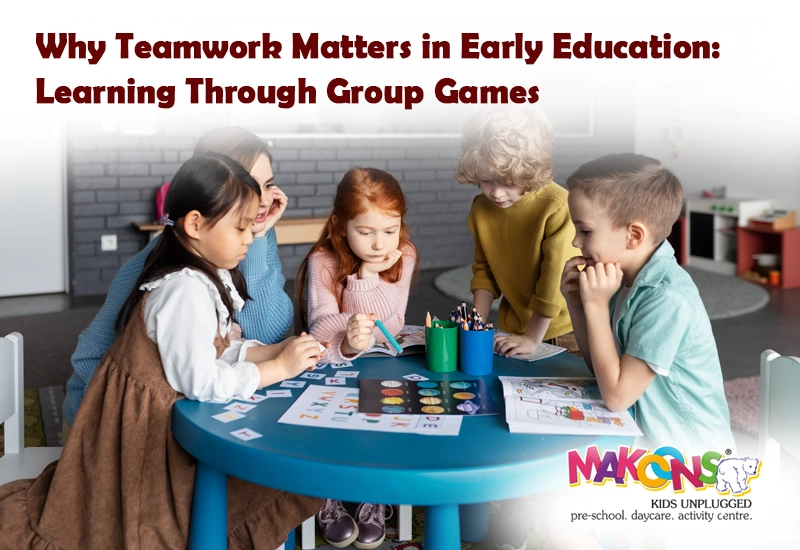
When one is in early childhood, he or she gets to learn some of the best things in life, such as how to share, how to listen, and how to collaborate. Teamwork among kids and using group games with children are considered one of the best methods of teaching these lessons.
Preschool activities of a team are not all about fun. They develop confidence, enhance communication and social skills during early education. Children learn to play together and through this they grow together.
Now we shall consider the significance of teamwork and the way in which preschool group activities enable children to acquire the necessary skills in life.
What Is Teamwork For Kids?
Teamwork is used to refer to a group of people who work together to attain a shared purpose. In the case of young children this might be:
- Cooperative learning: constructing a block tower.
- Playing a relay race
- Solving a puzzle as a group
- Singing songs in a circle
In cooperative learning, children will learn that the contribution of each individual is important.
The Importance Of Teamwork In Early Education
The initial level of learning is in early childhood. Children are also in the process of learning emotional, social, and communication skills during this period.
This is why it is so essential to work as a team:
1. Develops Social Skills In Early Education
In children taking part in children group games, children learn:
- How to take turns
- How to listen to others
- How to express their ideas
- The guidance on respecting various opinions.
These experiences enhance social abilities in early education, which is useful in making children have friends and good relationships.
2. Promotes Interpersonal Communication
During team work, children will be required to communicate, elaborate and debate.
For example:
- Deciding how to build a tower
- Getting the order of things to race.
- Exchanging resources in art activities.
This will enhance fluency, self-esteem and articulation.
3. Teaches Problem-Solving
Children have challenges when they are to work in collaboration. Maybe the block tower falls. Perhaps, the pieces of the puzzle do not fit.
With the help of cooperative learning, children:
- Brainstorm solutions
- Learn patience
- Learn that errors are involved in learning.
Children support each other and problem-solving is simplified.
4. Acquires Emotional Intelligence
Teamwork teaches children:
- Caring (putting yourself in other people’s shoes)
- Patience
- Kindness
- Self-control
When the child is sad in the middle of the game, other teammates learn how to console and support the child. Such emotional teachings are no less crucial than education.
5. Builds Confidence
Enrolling into preschool group activities provides children:
- A sense of belonging
- A chance to contribute
- Peer and teacher recognition.
Once a group has made it, every child will be proud. This builds self esteem and motivation.
Related Topic: The Role of Group Activities in Personality Growth
Best Group Games To Play On Teams To Promote Teamwork
The following are simple and useful group games that can be played by children and promote teamwork:
1. Puzzle Race
- Group children in small groups.
- Give each group a puzzle
- They must solve it together
This develops interaction and collaboration.
2. Relay Races
- Children alternate in doing tasks.
- The contribution of every child leads to a victory of the team.
This is a lesson on accountability and collective success.
3. Group Art Projects
- One large drawing sheet
- Each child adds something
- All people make one giant masterpiece.
This promotes innovativeness and cohesion.
4. Circle Time Games
- Passing a ball while singing
- Group storytelling
- Team clapping games
These enhance communication and teamwork.
5. Block Building Challenge
- Children collaborate in order to create the highest structure.
- They must plan and cooperate
Cooking good problem solving and teamwork with the kids.
Related Topic: Problem-Solving Exercises / Activities for Preschoolers
Cooperative Learning Preschool
Cooperative learning implies children learn not competing but working together.
Cooperative learning can be used by teachers in early education to:
- Assign small group tasks
- Encourage peer teaching
- Encourage collective responsibilities.
- Lessen maladaptive competition.
In cases where children do cooperate, they also get to learn that success is more effective when shared.
Significance Of Teamwork Outside The Classroom
Teamwork is much more than preschool. Children that learn the importance of teamwork very early in life tend to:
- Become good leaders
- Work well in school projects
- Establish positive relationships.
- Excel in sports and other extracurricular activities.
- Acquire job skills in the future.
A life skill such as teamwork remains forever with children.
Ways In Which Teachers And Parents Can Promote Teamwork
These are some of the easiest things that adults can do to encourage teamwork amongst the kids:
Encourage Sharing
Congratulate the kids when they share toys or assist peers.
Avoid Over-Competition
Concentrate on the involvement other than victory.
Create Group Tasks
Delegate cleaning to a team task.
Model Teamwork
Show children adults cooperating with one another.
Appreciate Company Milestones
Congratulate the whole group and not only the child.
The Advantages Of Preschool Group Activities
In conclusion, the advantages of group activities in preschool are as follows:
- Enhances communication capabilities.
- Strengthens friendships
- Builds empathy
- Encourages responsibility
- Boosts confidence
- Enhances creativity
- Develops patience
- Teaches leadership
Learning should be fun and interesting through organised group games with children.
Early Education And Team Work
The capacity to develop social skills at the early stage of education is among the largest preschool programs objectives.
Children who learn teamwork:
- Adapt more effectively in kindergarten.
- Easy to socialize with.
- Peacefully manage conflict.
- Respect diversity
This is because the personality and future success of these individuals are formed by these skills.
Final Thoughts
The thing is that teamwork is not about being together but about learning together. Children develop the basis of communication, empathy and cooperation through participating in group games and meaningful activities in preschool groups.
Teamwork cannot be overlooked in early education. Children are taught to work as a team which makes them develop into confident, kind, and capable individuals.
Questions And Answers Of Teamwork In Early Education
1. Why is group work relevant to children?
Team work also aids children to learn social, emotional, and communication skills as well as learn to work as a team towards a common objective.
2. When are children taught to be a team player?
At such a young age as preschool (3-5 years old) children can learn the idea of teamwork by participating in simple team-building exercises and games.
3.What are the benefits of group games in early childhood education?
Group games will help them to take turns, listen, cooperate, and solve conflicts, all social skills that are imperative.
4. What is cooperative learning in kindergarten?
Cooperative learning refers to a mode of instruction that involves children operating in small groups and collaborating to do assignments and solve problems.
5. Is collaborative learning able to enhance academic performance?
Yes. Working children are usually good at working in groups as they tend to perform better in group projects and classroom discussions.
6. What can parents do to encourage teamwork at home?
Parents can also promote team work by setting up family games, group tasks and activities where teamwork is involved.







 Twitter