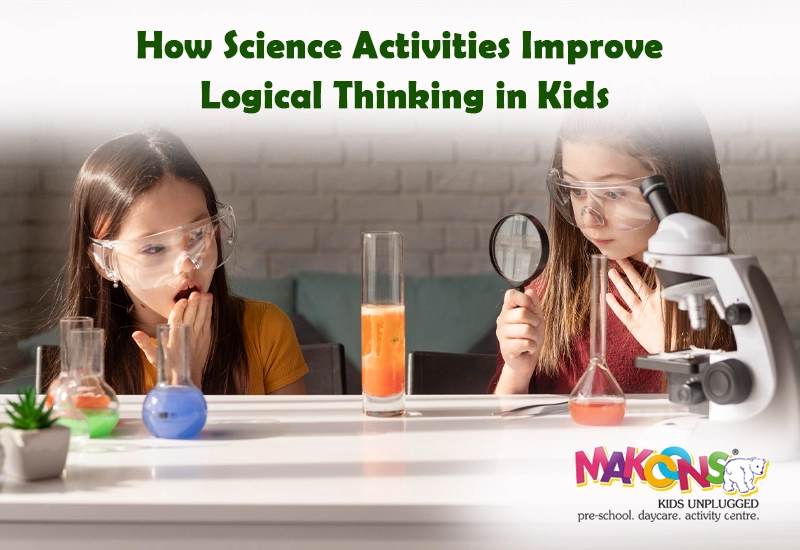
Children are inquisitive in nature. They inquire, investigate the world around them, and play around with ordinary items. It is this natural interest that makes science one of the strongest instruments of shaping out young minds. Participation in science activities for kids will not only arouse excitement but also reinforce their reasoning and analytical skills.
Simple experiments of water and observation of plants growing help to make children think logically, predict, and draw conclusions. As practiced appropriately, science based learning in children would comprise a building block of the powerful intellectual capabilities that will be lifelong.
Let us discuss why science produces children with good logical thinking and why it is so worthwhile to acquire it as early as possible.
Learning to think logically in Early Years
Thinking logically is the capability to reason, analyze the given situation, recognize patterns and solve problems in a step-by-step manner. The ability to think logically by children is developed during early childhood.
Young children can fail to put up complex terminologies, but they always exercise logic. For example:
If I drop a ball, it falls.
If I mix colors, they change.
If I water a plant, it grows.
These connections are realized in science experiments. By observing over and over, children reinforce cause and effect knowledge, which is fundamental to critical thinking among children.
The Importance of Practical Experiments
Among the greatest benefits of science activities among children is the fact that they are practical. Children do not passively listen, but they are actively involved.
For example:
Combining acid with baking soda is a lesson on chemical reactions.
The density is illustrated using floating and sinking experiments.
Seed germination exhibits life cycles.
These rudimentary tasks make children anticipate what will happen prior to the results being seen. This is the prediction process of problem solving skills by means of science.
The reasoning skills of the child are developed when children test their ideas and compare results. This enhances the power of observation and analysis.
Promoting Investigation and Doubting
Curiosity drives learning. Science makes children pose questions of why and how. Instead of answering directly, teachers have the opportunity to help children seek solutions.
In science based learning among kids, teachers usually pose a question:
What do you think will happen?
Why did that change occur?
How can we test this idea?
Through such open ended questioning, kids think critically. It educates children that the answers to questions are in research and logic rather than in memorizing.
This attitude is necessary in the creation of life long learners who think critically on issues.
Developing Problem-Solving Skills
Science basically constitutes problem-solving. Each experiment is initiated by a question and terminated with a conclusion.
By using science activities on kids, the children:
- Identify a problem.
- Form a hypothesis.
- Conduct an experiment.
- Observe results.
- Draw conclusions.
This gradual process develops great problem solving skills as a result of science. Persistence can be learned by children because experiments sometimes fail. They vary their approaches and make new attempts.
This strength promotes confidence and flexibility which are the important elements of logical reasoning abilities of children.
Enhancing Cause-and-Effect Insight
Logical reasoning relies on the cause and effect relationships. These relationships are made clear by science.
For example:
Ice melts when heated.
There are metals that are drawn into the magnets.
Plants bend toward light.
With the early science education benefits, the children get to realize that there are certain outcomes of actions. This knowledge will enhance decision making and reasoning in real life scenarios.
Children that understand patterns and relationships develop more critical thinking in children that goes beyond science lessons.
Improving the Skills of Observation and Analysis
One of the key skills in science is the aspect of observation. Children are taught to observe things like change of color, motion, texture and sound.
Close attention helps in enhancing focus and span. It also aids in the collection of the data even on a basic level.
As an example, patience and observation are taught by counting the number of days a plant grows. Such habits help in science based learning among children that enhances analytical thinking.
Logical thinking skills in children involve analytical skills because they involve comparing results and drawing conclusions on the differences.
Confidence created in the course of Discovery
Children feel proud when they manage to pass experiments. This achievement helps in increasing self-esteem.
Confidence building is one of the benefits of early science education that have been neglected. Children understand that they can find answers on their own.
Confidence will make people participate and will decrease the fear of failure. This means that children will be more open to taking on new challenges and their problem solving ability will be enhanced, as a result, by science.
Promoting Mathematical and Language Skills
There are several subjects integrated in science. The measurement of water levels helps in math. Observation description enhances vocabulary.
By means of science activities among the children, the children are able to use numbers, comparison and description words in a natural way. This cross-disciplinary learning leads to the development of general academics.
Mathematics is closely associated with logical thinking. Through organized experiments, children afford sequencing, categorizing and pattern recognition – all key components of critical thinking in children.
Encouraging Teamwork and Cooperation
The activities of many types of science are done in groups. Joint experiments promote communication and exchange of ideas.
Children, when collaborating, do:
- Share hypotheses
- Compare observations
- Discuss outcomes
This communication promotes thinking and meditation. Team learning enhances the ability of children to think logically since they are exposed to different thoughts.
Social skills and cooperation are also enhanced with team based learning of science among kids.
Benefits of Long-Term Early Science Education
Science is introduced at a young age and grounded towards the future success of the student in academics. There is a tendency of children that have early science experiences to grow up better in analysis skills.
The long-term benefits of early education are some:
- Better performance at school.
- Increased world interest.
- Stronger reasoning skills
- Enhanced creativity
The mindset of inquiry and evidence-based thinking develops when the child is exposed to structured inquiries at an early age.
Scientific Projects with young students
Simple experiments can be carried out in home or in school by the parents and teachers:
- Water cycle in a jar
- Color mixing with food dye
- Shadow plays games with flashlights.
- Magnet exploration
- Plant growth projects of simple order.
These are entertaining science experiences that a child can have with the use of limited materials and a lot of learning outcomes.
These experiences produce a stronger problem solving skill when done regularly and cultivate curiosity throughout one lifetime.
Conclusion
Science is not merely a subject, it is also a way of thinking. Science activities among kids develop reasoning, observation and analytical skills. Children also develop very good logical thinking abilities in children that are used in the day to day decisions through structured inquiry.
Science based learning is powerful on the hands-on, exploratory approach to kids. It develops critical thinking in children, builds resilience and improves academic bases.
Through the experiences of early science, parents and educators can access rich early science education advantages that lead to comprehensive development and intellectual growth over time.
Finally, science contributes to problem solving so that children would be able to become confident thinkers ready to survive in the complicated world.
FAQs:
Q1. What is the significance of science activities among young children?
Ans: Kid activities in science promote exploring, reasoning, and curiosity which enhances logical reasoning ability among children.
Q2. What is the benefit of science based learning in kids in regards to enhancing critical thinking?
Ans: Science based learning among children encourages inquiry, observation, and analysis of all of which encourages critical thinking among children.
Q3. How are there some advantages to early education of science?
Ans: The advantages of early science education are better problem-solving skills, better reasoning skills, and the increase in curiosity.
Q4. What are the ways science activities develop problem solving skills by science?
Ans: Kids are guided through systematic procedures such as predicting, testing and concluding, which, naturally, through science, instills problem solving skills in them.
Q5. Are simple experiments enough to enhance the ability to think logically among children?
Ans: Yes. Simple, practical experiments are especially effective to build cause-and-effect knowledge, and analytical thinking, which are some of the essential elements of logical thinking skills among children.







 Twitter