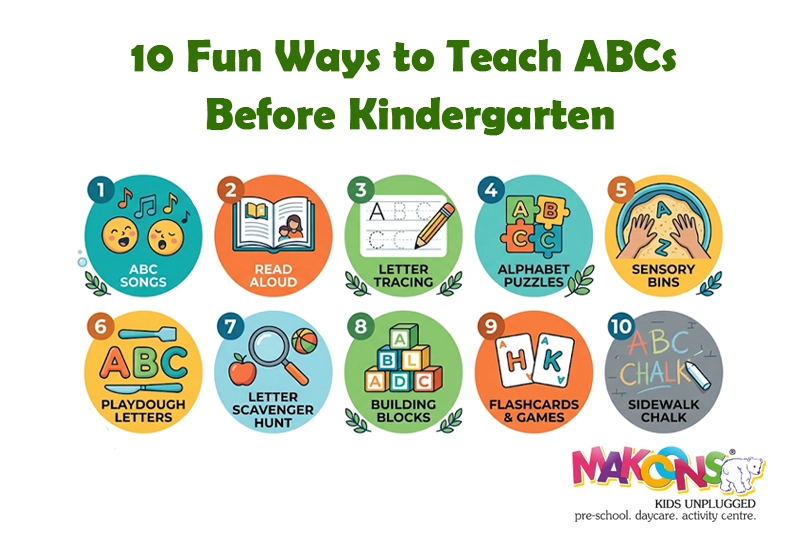
It does not need to be a formal lesson to help young children study the alphabet before kindergarten. Indeed, teaching ABCs to children is best achieved through play, creativity and daily interactions. Teenagers exposed to letters at a tender age develop good early literacy skills, enhanced communication, and confidence among young learners.
And, as a parent, care giver or teacher, you may need interesting ideas and here are
10 Fun Ways to Teach ABCs to Toddlers
1. Alphabet Song with Actions
One of the simplest methods of introducing letters is music. It is even more compelling when the traditional ABC song is accompanied by moves or dancing.
Clap for each letter
Jump on vowels (A, E, I, O, U)
Different sounds are represented by hand gestures.
This exercise enhances memory and keeps children engaged in learning alphabet exercises.
2. Letter Hunt Game
Make your own treasure hunt at home! Place cards with the letters of the alphabet all over the house and have your child locate them.
Name a letter and allow them to hunt.
Correspond uppercase to lowercase.
Add objects (like “B for ball”)
It is a very interesting preschool alphabet game that creates recognition and excitement.
3. Sensory Play with Letters
Children get lessons in the best way when they can feel and touch. Learning letters is easier with sensory activities.
Try:
- Letter in the sand or flour.
- Shaping out alphabets using clay.
- Tracing letters in water
These letter recognition tasks reinforce motor skills and learning.
4. Storytime with the Alphabet Focus
This introduction to the letters can be done in a very natural way by reading. Select books with an emphasis on alphabets and sounds.
While reading:
- Indicate letters on per page.
- Questions such as Can you find the letter A can be asked.
- Repeat sounds together
This develops a pre-phonics knowledge and improves early literacy.
5. Fun Phonics Games
Phonics enables children to relate letters to sounds, an important aspect of reading.
Phonics fun games are simple and include:
Sound matching (A = apple sound)
Animal sound guessing
Rhyming word games
Through all these activities learning becomes interactive rather than repetitive.
6. Alphabet Art and Craft
Imaginative tasks allow children to memorize letters easier. Allow them to create and adorn alphabets.
Ideas include:
A for Apple collage
B for Butterfly painting
C for Car using cut-outs
Alphabet learning activities that are craft based maintain the attention of the kids and help to solidify the ideas.
7. Use Everyday Objects
Studying does not require any special resources. Teaching opportunities are found everywhere around us.
Indicate letters in sign boards.
Use fridge magnets
Name food packaging letters.
This makes children know that alphabets exist in real life, but not only in books.
8. Alphabet Puzzle Play
Puzzles are a great way to enhance recognition and concentration.
Wooden alphabet puzzles
Matching letter cards
Sorting lowercase and uppercase.
The preschool alphabet games build problem-solving skills in addition to learning.
9. Interactive Writing Practice
Bring writing into the scene in a fun-no pressure manner.
Write trace letters first.
Use dotted worksheets
See what you can write with crayons or chalk.
Make it fun–do not concentrate on excellence. This is about familiarity and confidence in toddler learning of ABC.
10. Pretend and Role Play Learning
Kids love pretending! Make learning a game, take the roles of teacher and student or shopkeeper.
Sell something beginning with some letters.
Alphabet teaching play in the classroom.
Use toys to depict letters.
This technique enhances imagination and improves letter recognition exercises.
Parent and Caregiver Tips
In order to make these methods even more efficient:
- Keep sessions short (10-15 minutes)
- Be patient and encouraging
- Do not do anything too often.
- Magnify little ones.
Keep in mind that all children have different learning rates. The idea is to enjoy the learning process rather than to stress over it.
Final Thoughts
Learning the alphabet does not involve hard lessons and pressure. When the combination is perfect with the elements of play, creativity and consistency, children can learn letters and sounds very easily prior to kindergarten.
These are fun concepts that not only assist in teaching kids their ABCs, but also provide a solid background in reading, writing, and communication. This is because, with the help of games, narratives, and practical exercises, you are fostering interest and preparing your kid to succeed in learning throughout his life.
Begin small, make it a fun activity, and see your child’s love letters!
Frequently Asked Questions:
Q1. When should ABC learning begin in toddlers?
Ans: Toddlers can learn ABCs at an early age of 2-3 years by means of fun and play.
Q2. What do I do to teach ABCs at home?
Ans: Keep learning interesting by using games, songs, and alphabet learning activities such as letter hunts and storytelling.
Q3. What is the duration of learning sessions?
Ans: Make it brief–ten to fifteen minutes a day will be more concentrated and consistent.
Q4.What are some of the fun alphabet games at preschool?
Ans: Use puzzles, letter matches, and some silly phonics games to make the learning interactive.
Q5. Do early literacy skills require the use of worksheets?
Ans: No, paper-based letter recognition tasks and play-based learning are more useful in the initial stages.







 Twitter