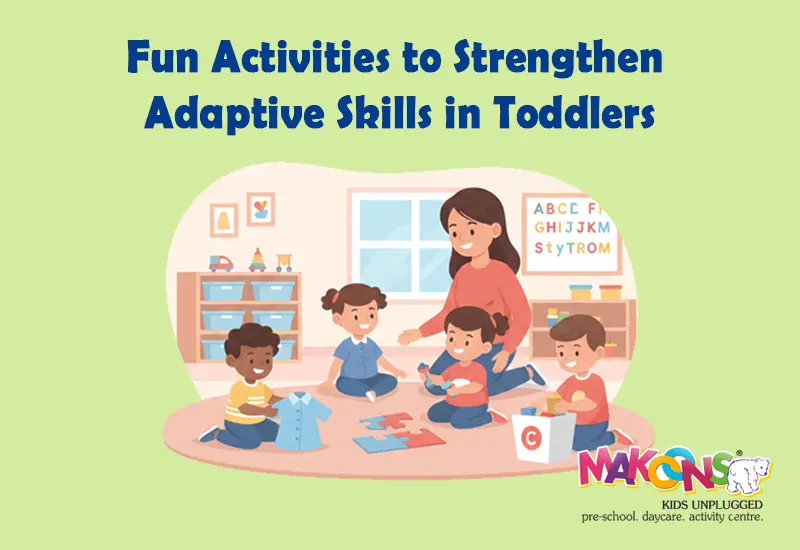
Every day, toddlers surprise us with the rate of acquisition of new things. They are one moment in need of help with everything and the next moment they want to accomplish everything by themselves. This increasing independence has a strong connection to the subject of adaptive skills in toddlers- the daily skills that assist children to cope with simple things, communicate with others and relate to new circumstances.
Construction of these skills does not take hard line lessons or pressure. Actually, the most effective method of assisting early childhood adaptive learning is by means of fun and daily activities that are not only natural and appealing to the child.
What Do Adaptive Skills In Toddlers Mean?
Adaptive skills refer to abilities of daily living that enable the toddlers to operate independently in their day to day activities. The skills enhance the general growth and readiness of the children to preschool and social settings.
Adaptive skills encompass the skill to:
- Eat with minimal help
- Dress and undress under direction.
- Communicate basic needs
- Follow simple routines
- Adjust to the changes and new environment.
Good preschool adaptive abilities contribute to giving the toddlers the feeling of confidence, ability and safety.
The Significance Of Adaptive Skills During Early Childhood
Adaptive skills can be developed in early life to ease the process of transitioning – home to preschool and further into structured learning.
Advantages of high adaptive skills are:
- Improved emotional management.
- Better confidence and self-sufficiency.
- Light adaptation to preschool activities.
- More intense social contact with friends.
- Less frustration among the children and the parents.
The trick is to promote these abilities in a steady and gradual manner.
Daily Life Events That Develop Life Skills
The daily habits are great chances to learn. Basic activities they perform in their everyday life allow toddlers to train independence without any stress.
Helpful activities include:
- Allowing toddlers to wash their hands under supervision.
- Promoting toy clean up.
- They were allowed to wear two outfits.
- Engaging them in some basic clean-ups.
These everyday life activities of toddlers generate a feeling of responsibility and control.
Dining Practices To Promote Independence
Mealtimes are also good to enhance adaptive and motor skills. Even crass efforts are worthwhile learning time.
You can motivate adaptive skills by:
- Providing the finger foods in order to encourage self-feeding.
- Child safe spoons and child safe cups.
- Toddlers can be allowed to wipe spills with a cloth.
- Simple habits to learn in order to eat at a table such as sitting and waiting.
Confidence and coordination are established when the person is patient during meals.
Dressing And Personal Care Activities
Personal care routines are used to make the toddlers realize self-help skills and develop body awareness.
Try these simple activities:
- Allowing toddlers to draw up socks or pants.
- Showing them how to take Velcro shoes off and put them on.
- Training them to use a basket of clothes.
- Teaching how to brush hair or teeth.
These actions reinforce self-sufficiency and habitual consciousness.
Adaptive Learning Play Based Activities
The most effective method of supporting toddler development activities is through play. Children are taught how to solve problems, be patient, and flexible which they learn through play.
Engaging play ideas include:
- Imitation of toys, kitchens or tool sets.
- Sorting toys in terms of color, size, or type.
- Stacking games and simple puzzles.
- Role-playing games such as a shopping game or a doctor game.
Life skills and social understanding naturally come out in such play.
Activities Which Prompt Communication And Choice-Making
The expressing of needs and simple decision making are also adaptive skills.
You can support this by:
- Making toddlers decide between two snacks.
- Getting them to use a word or a gesture to request assistance.
- Labeling feelings at play and practice.
- Reciting songs by action and by rhyme.
Such activities facilitate language growth and emotional intelligence.
Activities In The Society That Develop Flexibility And Cooperation
The social interactions enable the toddlers to acquire patience, sharing, and flexibility.
Some of the useful social activities are:
- Play in groups with siblings or peers.
- Taking turns in games such as rolling a ball.
- Group sings and movement games.
- Training in greetings and goodbyes.
Through such experiences, emotional control and social confidence are enhanced.
Outdoor Activities To Encourage Adaptive Skills
Outdoor play helps in physical growth and educates the toddlers to adjust in various settings.
Outdoor activities can consist of:
- Moving on diverse surfaces such as grass or sand.
- Using small steps or play structures.
- Catching or kicking a ball.
- Field trips with parents.
These experiences create strength and organization.
The Way Preschools Can Help In Adapting Skills
Quality preschools pay much attention to the preschool adaptive skills by providing directed routines and control independence.
In preschool settings, adaptive learning is facilitated by:
- Sticking to routine day to day schedules.
- Promoting the self help at snack and clean up time.
- Encouraging mutual interaction and collaboration.
- Giving out age-related duties.
This organized care prepares the toddlers for lifelong learning.
The Ideas To Advice Parents On Promoting Adaptive Skills At Home
The most crucial role in the development of adaptive skills is expressed through the parents.
Keep these tips in mind:
- Give toddlers more time to attempt things on their own.
- Compliment hard work and not excellence.
- Never hurry and be too quick to correct.
- Stick to regular practices.
Big progress is achieved with little steps every day.
Common Mistakes To Avoid
When assisting the toddlers in developing, it is easy to watch them slip backwards.
Try to avoid:
- Performing tasks too fast in their cases.
- Comparing your child with others.
- Expecting perfection
- Displaying anger on learning activities.
Soft mentoring is much more effective than coercion.
Conclusion
Adaptive skills are not developed using special tools or rigid lessons in order to support the development of adaptive skills in toddlers. The best learning occurs in the regular time- mealtime, playtime, dressing, routines. As toddlers are challenged to experiment, investigate, and make minor decisions, they develop independence on their own.
Coupled interactions at the level of the fun, supportive toddler life skills activity allow parents and educators to train children in confidence, flexibility, and preschool and beyond readiness. Adaptive learning is enjoyable in early childhood through patience and consistency.






 Twitter